


GITEX 2026 Preview: Huawei Brings Agentic AI Infrastructure Race to Dubai
Huawei will arrive at GITEX GLOBAL 2026 with a considerably bigger ambition than showcasing another generation of enterprise hardware.
As Platinum Sponsor of this year’s event, the Chinese technology giant has chosen “Advancing the Agentic World” as the theme of its participation, placing the infrastructure required to run increasingly autonomous AI agents at the center of its 1,225-square-meter exhibition space in Dubai.
Huawei has already confirmed that its GITEX presence will focus on unified AI infrastructure and open ecosystems, bringing computing, networking, cloud and storage together as enterprises move from experimenting with generative AI toward deploying AI agents inside real business operations.
That makes Huawei one of the companies worth watching most closely at GITEX 2026.
The bigger story is no longer simply who can build a faster AI accelerator. The competition is moving toward who can make thousands — and eventually hundreds of thousands or even millions — of processors, memory systems, storage devices and networks behave like one enormous AI computer.
What Huawei Has Confirmed for GITEX 2026
Huawei will occupy a 1,225-square-meter booth in Hall S3, Stand E20 at the Dubai Exhibition Centre, alongside executive forums and closed-door CXO roundtables.
The company says visitors will see AI infrastructure and industry solutions designed around what it calls the “agentic world.”
The terminology matters.
Generative AI largely centered on models responding to prompts. Agentic AI is moving toward systems capable of planning tasks, interacting with software and data, using tools and executing multi-step processes with greater autonomy.
For enterprises, that transition changes infrastructure requirements dramatically.
AI agents can generate continuous inference workloads, maintain long contexts, access enterprise databases and operate multiple applications simultaneously. That puts pressure not only on processors but on memory, storage, networking and the energy infrastructure behind data centers.
Huawei’s GITEX strategy is therefore likely to revolve around an argument it has been developing throughout 2026: the next AI infrastructure battle will be fought at the level of the entire system rather than an individual chip.
From CloudMatrix to the SuperPoD Era
Huawei spent much of the previous AI cycle demonstrating CloudMatrix and its ability to combine large numbers of Ascend processors.
Its 2026 technology roadmap has gone significantly further.
At MWC Barcelona in March, Huawei took its latest SuperPoD architecture onto the global stage, including Atlas 950 SuperPoD and TaiShan 950 SuperPoD.
The concept behind a SuperPoD is relatively straightforward even if the engineering is not: connect a large number of computing nodes so tightly that they can operate as one logical computer.
That matters because increasingly large AI models cannot efficiently depend on individual servers working independently.
Huawei’s answer is UnifiedBus, its interconnect architecture designed to connect processors, AI accelerators, memory, storage and networking resources with much higher bandwidth and lower latency.
And during HUAWEI CONNECT 2026 in September, the company pushed that concept considerably further.
The Innovation to Watch: Atlas 960E SuperPoD
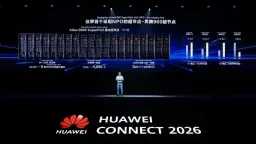
One of the most important technologies Huawei could bring to Dubai is the Atlas 960E SuperPoD, unveiled in September.
Huawei describes it as the industry’s first SuperPoD based on Near-Packaged Optics, or NPO.
Instead of treating networking as something sitting around the AI processors, the architecture brings optical connectivity much closer to the computing system itself.
A single Atlas 960E SuperPoD can scale to 4,096 NPUs, with a unified memory pool reaching 256 TB.
Huawei says multiple SuperPoDs can then be connected into much larger SuperClusters.
Using its two-tier, four-plane Clos architecture, the company says the system can interconnect as many as 512,000 NPUs, while a multi-rail topology can push the architecture toward one million NPUs.
The numbers are striking, but the architectural shift behind them is more important.
AI infrastructure is beginning to resemble a giant distributed computer rather than a collection of servers.
Why One Million NPUs Matter
Huawei is preparing its infrastructure for a world in which frontier models could reach around 10 trillion parameters and where inference becomes as important as training.
Training a model is computationally expensive, but deploying millions of AI agents creates a different challenge.
Every agent may need context, memory, access to enterprise information and the ability to retrieve previous interactions quickly.
That means throwing more accelerators at the problem is not enough.
The processors need to communicate quickly with each other. Data has to move efficiently. Memory needs to be shared. Storage needs to feed processors without becoming a bottleneck.
Huawei’s UnifiedBus architecture is intended to address that problem by creating peer-to-peer connections between CPUs, NPUs, memory and SSDs.
The company says its latest architecture can increase interconnect bandwidth from the hundreds-of-gigabytes-per-second level into terabyte-per-second territory while reducing round-trip latency to around two microseconds.
AI Is Creating a New Kind of Memory Problem
Another Huawei technology worth watching at GITEX is OceanStor M900 Context Memory Storage.
It addresses a problem most people using ChatGPT-style applications never see: AI models need somewhere to keep the information required to remember and process increasingly long conversations and tasks.
Large-model inference generates what is known as a KV cache — essentially reusable information created while a model processes context.
As context windows grow beyond one million tokens and AI agents conduct longer multi-step tasks, KV cache can become enormous.
Keeping all of that information inside expensive accelerator memory is increasingly difficult.
Huawei’s answer is to turn storage into another layer of AI memory.
OceanStor M900 creates a petabyte-scale shared KV cache that can be accessed by SuperPoDs, allowing data to move between accelerator memory, DRAM and SSD storage depending on where it is needed.
The idea could become increasingly important as AI economics shift from the cost of training models toward the cost of serving enormous numbers of inference requests.
GITEX Could Become Huawei’s Middle East Showcase for AI Data Centers
There is another reason to expect AI infrastructure to dominate Huawei’s Dubai presence: the Middle East is rapidly becoming one of the world’s most aggressive markets for AI data-center investment.
Huawei has spent 2026 developing not only computing hardware but the surrounding data-center architecture.
Its AI data-center portfolio now stretches across computing, storage, data-center networking, interconnects, liquid cooling and power infrastructure.
The company has also introduced a grid-interactive AIDC strategy, reflecting a growing problem for the entire AI industry: computing power increasingly depends on electrical power.
AI data centers consume enormous amounts of energy, and the relationship between the data center and the electricity grid is consequently becoming part of AI infrastructure design.
At GITEX, Huawei therefore has an opportunity to present itself not simply as an alternative supplier of AI processors, but as a provider capable of building much of the infrastructure surrounding those processors.
The Bigger Battle Is About AI Sovereignty
GITEX itself is putting sovereign AI and the geopolitics of computing at the center of its 2026 agenda.
That makes Huawei’s presence particularly significant.
Governments and large enterprises increasingly want greater control over where AI workloads run, where data is stored and which technology stack powers critical digital infrastructure.
Huawei’s strategy fits directly into that debate.
Its Ascend NPUs, Kunpeng CPUs, SuperPoD architecture, OceanStor storage, networking technologies and AI data-center infrastructure give the company the components to propose an alternative full-stack computing environment.
Huawei is also attempting to make that ecosystem more accessible to developers.
Its CANN heterogeneous computing architecture has moved toward open-source development, while the company says it supports widely used projects and frameworks including PyTorch, Triton and vLLM.
The challenge is no longer merely producing powerful hardware. Huawei needs developers, enterprises and partners to build on it.
What to Expect From Huawei in Dubai
Huawei has not yet disclosed every product announcement planned for GITEX GLOBAL 2026, so it would be premature to claim that a specific new system will launch in Dubai.
But the direction is already unusually clear.
Expect the company’s presence to concentrate heavily on agentic AI, SuperPoDs, AI data centers, storage for large-scale inference, intelligent networking and the infrastructure required to deploy AI inside enterprises.
The recently unveiled Atlas 960E, UnifiedBus architecture and OceanStor M900 are particularly important technologies to watch because they represent Huawei’s attempt to solve the AI scaling problem at system level.
And that could make its GITEX booth a useful window into a much larger shift taking place across the technology industry.
The first phase of the generative AI race was largely about models.
The second became a race for GPUs and accelerators.
At GITEX 2026, Huawei will be arguing that the next race is about something bigger: turning entire data centers into AI computers.
related topics
 Empowering Future Cities and Securing Critical Infrastructure: IoT Misr Leads Cooling and...
 Huawei Launches 2026 AI City Report and Global Innovation Alliance
 Benya Group at Cairo ICT 2026: Digital Infrastructure, Fiber Optics and AI...
 Huawei at Cairo ICT 2026: AI, Cloud and Data Centers Shape the...
 Data Center Backlash Spreads From the US to Europe and Asia, Putting...
 Oracle Invokes Force Majeure on $18B 'Project Jupiter' AI Data Center Amid...
 Huawei Launches the World's First NPO-based SuperPoD – the Atlas 960E SuperPoD
 Huawei Unveils Grid-Interactive AI Data Center Solution to Maximize 'Tokens Per Watt'...
 South Korea and US Agree on $22.3B Texas Gas Project to Power...
 Japan Eyes $60 Billion Investment to Quadruple AI Data Center Capacity by...
 KEPCO Proposes $18B Advance Electricity Payment from Samsung and SK Hynix to...
 Anthropic Signs $35B Cloud Computing Deal with Nvidia-Backed Lambda for Texas AI...