Nutanix Bets on Egypt as Regional Hub After Hitting 150% of Its Local Target
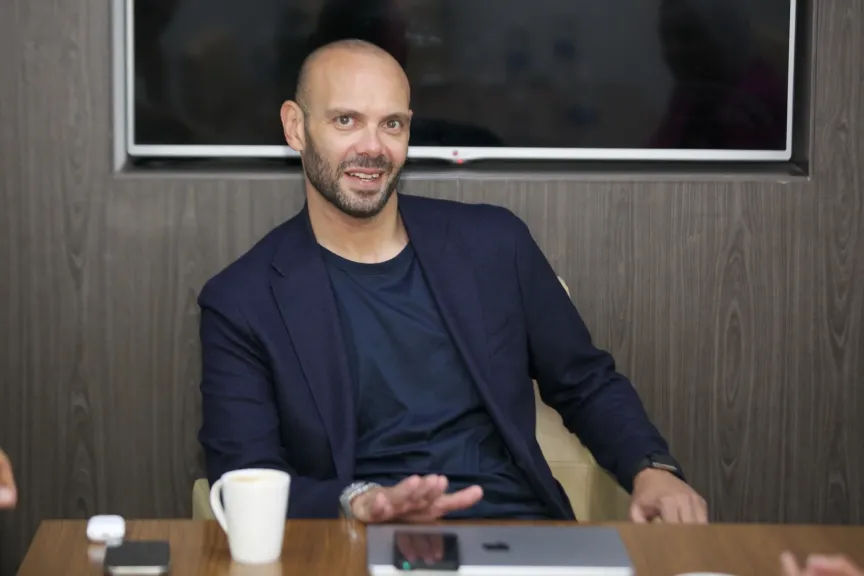
The shift represents a significant change from three years ago, when Nutanix had only five employees in Egypt and operated the market as part of a broader regional structure. Today, the local team has grown to 20 employees, with another 10 to 15 hires planned over the next year.
The company is also moving to establish a direct legal entity in Egypt, replacing a model under which employees were managed through human resources service providers.
For Mogeeb Abdelrazek, Regional Director for Egypt, Levant and Turkey at Nutanix, these investments reflect a longer-term ambition: Egypt should become a base for regional operations rather than simply another market for selling enterprise technology.
Egypt Hits 150% of Target as Local Operations Scale
Nutanix achieved 150% of its target in Egypt during its latest fiscal year, according to Abdelrazek, placing the market among the strongest performers against target across the Middle East and Africa.
That does not mean Egypt generates more business in absolute terms than larger markets such as Saudi Arabia or the UAE. Instead, it reflects the pace at which the Egyptian operation has expanded against the targets set for it.
The company’s partner ecosystem has grown even faster.
Nutanix started its expansion plan with five local partners. That network has now reached around 90 companies involved in selling, implementing and supporting its technologies.
The model gives Nutanix a footprint that extends beyond its own headcount, as distributors and systems integrators build technical and commercial teams around the company’s products.
More Than 200 Customers and Around 30 Banks Build the Local Base
Financial services have become one of the strongest pillars of Nutanix’s Egyptian business.
Around 30 banks now use the company’s technology, while more than 200 customers across the market rely on Nutanix private cloud solutions.
That customer base also illustrates how enterprise cloud spending is changing.
Projects are no longer limited to individual software licenses. Abdelrazek said some infrastructure and data center projects involving Nutanix and its technology ecosystem can reach tens of millions of dollars.
Banks, telecom operators, financial services companies and large enterprises are among the sectors driving demand.
The expansion is being supported by the broader shift toward modernizing data centers and giving enterprises more flexibility over where applications and data are operated.
Hybrid Cloud Is Becoming a Question of Control
Nutanix built its business around hyperconverged infrastructure, or HCI, which combines computing and storage resources through a software-defined architecture instead of managing multiple traditional infrastructure layers separately.
Its portfolio has since expanded to more than 16 products covering infrastructure, cloud management and modern applications.
The bigger proposition today is the ability to operate workloads across private data centers, public cloud environments and edge locations through a more consistent management layer.
That is becoming particularly relevant as enterprises rethink the assumption that everything should eventually move to public cloud.
Sensitive or regulated data may need to remain within local infrastructure, while other workloads can benefit from public cloud scalability.
Nutanix integrates with major cloud providers including Amazon Web Services, Microsoft and Google, allowing organizations to build hybrid environments rather than choose exclusively between on-premises infrastructure and public cloud.
The same debate increasingly intersects with digital sovereignty, as governments and critical industries seek greater control over sensitive data and technology infrastructure.
VMware Disruption Has Created an Opening
Changes in VMware’s licensing and commercial model following its acquisition by Broadcom have also altered the competitive landscape.
Abdelrazek said higher costs and changes to contractual structures have pushed organizations globally to reassess their virtualization and infrastructure strategies, creating opportunities for alternative platforms.
Nutanix has benefited from that reassessment as customers seek to reduce dependence on a single vendor and consider different infrastructure models.
Price, however, is only one part of the decision.
Enterprise customers running mission-critical systems also have to consider migration complexity, platform stability, technical support and whether a new architecture can support their future cloud and AI requirements.
Nine Years of Customer Satisfaction Becomes a Competitive Tool
Abdelrazek sees technical support as one of Nutanix’s most important differentiators.
The company says it has maintained a leading position in global customer satisfaction for nine consecutive years based on Net Promoter Score, or NPS, which measures customers’ willingness to recommend a company’s products and services.
For enterprise infrastructure vendors, support can become as important as the underlying technology.
A failure inside a bank, telecom operator or major enterprise can affect critical business systems, meaning customers are buying not only computing infrastructure but also the ability to keep it running and recover quickly when problems occur.
AI Push Adds Three Products Focused on Security and Governance
Nutanix’s next growth cycle is increasingly centered on artificial intelligence.
The company has directed substantial investment toward AI over the past three years and is using Cairo ICT 2026 to showcase its expanding platform for running enterprise AI workloads.
That investment has produced three additional products focused on protecting, governing and controlling AI applications, complementing Nutanix’s existing infrastructure for deploying and managing AI across private, public and hybrid cloud environments.
The strategy addresses an increasingly important enterprise concern.
Companies want access to AI models and applications, but banks, governments and other organizations handling sensitive information also need to know where their data is processed, who can access it and how AI workloads are governed.
For Nutanix, this creates an opportunity to position private and hybrid cloud infrastructure as part of the enterprise AI stack rather than treating AI as an entirely public-cloud workload.
Cybersecurity Changes the Infrastructure Conversation
The same shift is changing how Nutanix approaches security.
Abdelrazek argues that cybersecurity can no longer be added after infrastructure has been deployed. Protection, resilience and recovery have to be considered when the architecture itself is designed.
No infrastructure can realistically be described as completely immune from attack.
The priority is therefore to reduce exposure, limit the ability of an attack to spread and give organizations the capability to restore systems and data rapidly.
That also requires integration between core infrastructure, backup, disaster recovery and cybersecurity technologies rather than relying on a single product to provide complete protection.
Abdelrazek: AI Has Become a National Security Issue
The most significant change, however, may be how Abdelrazek views artificial intelligence itself.
He argues that AI has moved beyond being a corporate productivity tool and is becoming a factor in economic and technological power between countries.
“Artificial intelligence is no longer simply a business development option,” Abdelrazek said. “It has become a necessity connected to national security and technological sovereignty.”
The reasoning extends well beyond generative AI.
AI is increasingly entering cybersecurity, defense, medicine, education, scientific research and industrial systems. Countries that depend entirely on external technology could therefore face strategic vulnerabilities as these systems become more deeply embedded in critical infrastructure and decision-making.
For Abdelrazek, sovereign AI does not mean isolating a country from global technology. It means maintaining domestic expertise and sufficient control over critical systems and data while avoiding complete dependence on a single external source.
Egyptian Talent Is Central to the Regional Hub Plan
This is also where Nutanix’s Egypt expansion and its AI strategy converge.
Abdelrazek believes Egypt has the engineering talent, infrastructure, services and geographic position required to host regional operations for global technology companies.
The economic effect would extend beyond direct employment.
Global technology companies can train local engineers, transfer knowledge and create demand for specialists employed by distributors, integrators and other partners. Teams based in Egypt can also support customers abroad, creating another channel for technology-service exports.
Nutanix is now evaluating Egypt on that basis.
The company plans to add another 10 to 15 employees over the next year, while its move toward establishing a direct local entity signals that the expansion is intended to be structural rather than temporary.
Cairo ICT 2026 Shows Where Nutanix Wants to Go Next
Nutanix is participating in Cairo ICT for the third consecutive year, but its 2026 presence is larger as it showcases its latest cloud and AI technologies and prepares to announce additional projects and partnerships.
The exhibition comes at an important point in the company’s Egyptian trajectory.
Three years of expansion have taken Nutanix from five employees to 20, from five partners to around 90, to more than 200 private-cloud customers and around 30 banks. The Egyptian business has also reached 150% of its latest annual target.
The next stage is fundamentally different.
Nutanix is no longer trying simply to prove that Egypt can become a larger market for its technology. It is trying to prove that Egypt can become part of the infrastructure through which the company serves the wider region.
And as AI becomes embedded in critical systems, Abdelrazek believes the stakes are becoming bigger than corporate growth alone: countries will increasingly be judged not only by how much artificial intelligence they use, but by how much of the technology, data and expertise behind it they can control.
related topics
 Lulu Group Expands Dubai Presence with New Hypermarket and Three Projects in...
 Cairo ICT Marks 30 Years With “AI in Action” as Artificial Intelligence...
 Maqam Holding and Lulu Group Plan Major Retail Development in Abu Dhabi’s...
 European Alliance Led by NVIDIA to Shape the Future of Autonomous Driving...
 Mercedes-Benz and NVIDIA Expand Partnership to Develop Next-Generation Autonomous Driving
 VMware Introduces HyperArmor to Strengthen Security Across Cloud Infrastructure
 Cairo ICT Turns 30 With a Bigger Question: Can AI Move From...
 ZTE Egypt’s Ivan Yang: “We Are in Egypt for Egypt” as Company...
 Egypt Opens Government GPU Infrastructure to Universities to Power AI Research
 RAVEN-X, Aorta Vision and RoboCare Lead Winners at Egypt’s University Innovation Summit...
 Tesla Schedules Next-Gen Roadster Reveal for October 1 Amid Autonomous Pivot
 Tesla to Unveil Long-Delayed Next-Gen Roadster on October 1 Amid Strategic Pivot...