Egypt”s ICT Ministry and UNESCO Launch Second Round of AI Training for Government Employees
Egypt's Ministry of Communications and Information Technology, in cooperation with the United Nations Educational, Scientific and Cultural Organization (UNESCO), has launched the second round of its Artificial Intelligence Fundamentals Program for employees of the State's administrative apparatus.
The initiative aims to strengthen government employees' ability to adopt artificial intelligence technologies effectively and responsibly, supporting institutional performance and the development of public services.
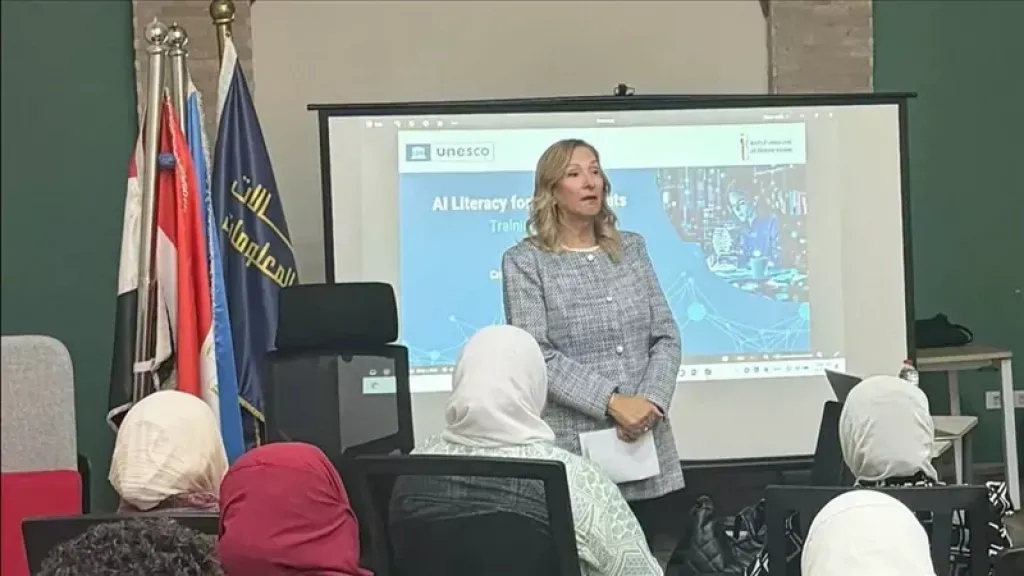
The first training sessions took place at the Creativa Digital Egypt Innovation Hub in Giza on November 9 and 10, 2026.
The sessions were attended by Hoda Baraka, Advisor to the Minister of Communications and Information Technology for Technological Skills Development and Supervisor of the National Center for Responsible AI, and Paul Coustere, Director of UNESCO's Regional Office for Egypt and Sudan and its Liaison Office with the League of Arab States, alongside representatives of several government institutions.
Building AI Capabilities Across Government Institutions
The program is designed to familiarize public-sector employees with artificial intelligence capabilities and applications, while helping them identify practical ways to integrate these technologies into their respective institutions.
The two-day training covered AI fundamentals, potential applications in government services, associated risks, ethical considerations, governance frameworks and responsible implementation practices.
Participants also examined public procurement considerations and due diligence requirements when acquiring AI systems, in addition to Egypt's efforts in responsible AI and emerging technology trends.
10 Government Entities Participate in the Training
The second round's first training course brought together representatives from 10 government entities.
These included the Industrial Development Authority, the Micro, Small and Medium Enterprise Development Agency, the Future of Egypt for Sustainable Development Authority, the Egyptian Customs Authority and the National Initiative for Industry Development.
Other participating institutions included the Information and Decision Support Center, the General Authority for the Suez Canal Economic Zone, the Suez Canal Authority, the Arab Organization for Industrialization and the Consumer Protection Agency.
Hoda Baraka: Skills Development Supports Egypt's AI Strategy 2025-2030
Hoda Baraka highlighted that human capacity development is a central pillar of Egypt's National Artificial Intelligence Strategy 2025-2030, which seeks to prepare qualified professionals capable of keeping pace with technological developments and benefiting from AI applications.
She emphasized the importance of equipping government employees with the skills needed to use AI effectively and responsibly, noting that these capabilities can improve work processes, increase productivity and enhance the quality of public services.
Baraka also stressed the importance of ethical standards, governance requirements and data protection in the adoption of AI technologies.
She added that the government's digital capacity-building efforts are aligned with presidential directives emphasizing training and professional development as key criteria for joining public-sector positions, with the Ministry working alongside the Central Agency for Organization and Administration to support this approach.
UNESCO Highlights Human Investment as a Foundation for Responsible AI
Paul Coustere stressed that unlocking artificial intelligence's potential requires sustained investment in human capabilities and stronger commitment to ethical and responsible technology use.
He explained that the training program translates recommendations from Egypt's AI Readiness Assessment Report into practical measures to strengthen the capabilities of government employees.
The report was prepared within the framework of UNESCO's Recommendation on the Ethics of Artificial Intelligence, with the aim of promoting AI applications that benefit society while respecting human rights.
First Round Trained 90 Employees from 25 Government Entities
The second round builds on the previous collaboration between the Ministry of Communications and UNESCO, following the completion of the program's first round, which was funded by the European Union.
The initial phase included three training courses covering AI fundamentals, ethics and governance, with approximately 90 participants representing 25 government entities.
The courses helped participants understand AI concepts and their applications in public administration, identify potential risks and ethical considerations, and explore governance frameworks and responsible adoption opportunities.
Three New Courses to Expand Government AI Training
The second round includes three additional training courses supported by UNESCO and organized in cooperation with the Ministry of Communications and Information Technology.
The Ministry's Institutional Development Sector is also contributing to the organization and coordination of the training activities.
The new phase aims to build on the outcomes of the first round and extend the program's reach to additional government institutions.
By bringing together entities with different responsibilities, the initiative also creates opportunities for knowledge exchange and the identification of practical AI applications tailored to each institution's operational needs.
The program supports Egypt's broader efforts to advance government digital transformation, strengthen institutional efficiency and improve public services through the effective and responsible adoption of artificial intelligence.
related topics
 Historic Cloud Milestone: ”Telecom Egypt (WE)” Earns Two ISO Certifications and Completes...
 Banque du Caire Reports EGP 13.11 Billion in Net Profit for First...
 Gold Prices Stabilize in Egypt on Wednesday as 24-Karat Gold Reaches EGP...
 US Dollar Holds Steady Against the Egyptian Pound Across Banks Ahead of...
 Cairo ICT 2026: ”AI in Education” Seminar Highlights Initiatives for School Coding...
 «مانيج إنجن» تحقق نموًا 40% في إيراداتها بمصر خلال 2025 وتستعرض استراتيجية...
 EGP 20 Billion Investment: Biography Partners with Absolute Hotel Services to Manage...
 Concurrent with Cairo ICT 2026.. saib Bank Signs 3-Year Partnership with ”BMB...
 Amazon Steps into the Future of Smart Security: Launching Flying Camera and...
 Ahmed Galal: Banking Finance Focuses on Developing Local Production and Boosting Export...
 Egyptian Talks with Morgan Stanley in Washington to Boost International IPOs and...
 Egypt Holds International Talks in Doha to Boost AI & Quantum Computing...