


GITEX 2026: NEXCOM Builds the Systems That Let AI Robots Move Safely
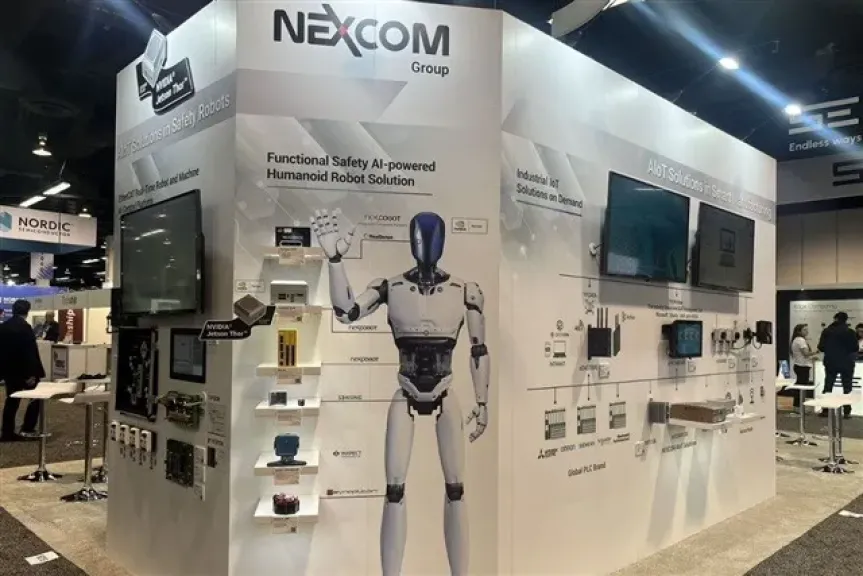
GITEX 2026: NEXCOM Builds the Systems That Let AI Robots Move Safely
Artificial intelligence has learned to write, code, generate images and hold increasingly sophisticated conversations.
The next challenge is far more physical.
What happens when AI is connected to robotic arms, cameras, motors and machines capable of moving through the real world?
A mistake made by a chatbot may produce an incorrect answer. A mistake made by an autonomous robot operating next to a worker can have physical consequences.
That distinction is becoming central to NEXCOM’s strategy as the Taiwanese industrial computing company heads to GITEX GLOBAL 2026 as the event’s Digital Sponsor.
Rather than developing another foundation model, NEXCOM is focusing on what happens when AI moves beyond the data center and into machines.
Its latest answer is RoboWIZ, an open AI robotics ecosystem designed to connect the technologies needed to transform artificial intelligence into controlled physical movement.
The platform arrives as humanoid and industrial robots become increasingly capable, but building a useful robot requires much more than installing a powerful AI processor inside a mechanical body.
The machine needs to see, understand, move with precise timing and, most importantly, know when to stop.
Physical AI Changes the Consequences of an Error
Most generative AI applications operate in a digital environment, where they manipulate information.
Robots manipulate the physical world.
That creates a fundamentally different engineering challenge.
Consider an industrial robot lifting a component beside a human worker. Its AI vision system may recognize the person and its model may understand the task, but the motor controlling the robotic arm still has to respond at precisely the right moment.
If the AI system hesitates, the motion controller cannot simply wait indefinitely for another response.
Physical machines operate against real-time deadlines.
This creates a need to combine two different computing worlds: probabilistic AI and deterministic industrial motion control.
NEXCOM is attempting to bring those capabilities together.
RoboWIZ Brings the AI Robotics Stack Together
NEXCOM introduced the RoboWIZ AI Robotics Platform in Taiwan in August and presented it internationally at NVIDIA GTC Berlin in October.
RoboWIZ is not a single robot. It is an open ecosystem designed to support different types of robotic systems.
The platform connects AI controllers from NEXCOM’s robotics subsidiary NexCOBOT with cameras, sensors, drives, motors, safety systems, cybersecurity technologies and robotics software from ecosystem partners.
This integration layer is important because the robotics industry already has powerful individual technologies, including AI processors, advanced cameras, robotic hands, motors and increasingly capable AI models.
The challenge is making all of those components operate together reliably.
RoboWIZ is NEXCOM’s approach to that problem.
Five Technologies Have to Become One Robot
NEXCOM organizes the RoboWIZ ecosystem around five major areas.
The first is AI core control, where computing platforms process information and make intelligent decisions.
The second is visual perception, which enables robots to understand their surroundings through cameras and sensors.
The third is real-time control, which translates decisions into precisely timed physical movements.
The fourth covers actuation and robot systems, including motors, joints, grippers and dexterous hands.
The fifth combines functional safety and cybersecurity.
A capable autonomous robot needs all five.
Without perception, it cannot properly understand its surroundings. Without real-time control, intelligent decisions may not translate into accurate physical movements.
Without safety systems, deployment around people becomes significantly more difficult.
Without cybersecurity, a connected autonomous machine introduces another potential attack surface.
This makes the transition from generative AI to physical AI considerably more complicated than placing a language model inside a robot.
RoboWIZ Supports Multiple Hardware Platforms
Another important element of the platform is its open architecture.
RoboWIZ is not designed around one fixed robot configuration.
Its AI control layer supports computing technologies from NVIDIA, Intel and Qualcomm, while ecosystem partners can integrate additional components through the RoboWIZ partner program.
That allows developers to select technologies according to the requirements of the machine they are building.
A warehouse robot does not necessarily require the same architecture as a humanoid robot.
A quadruped inspection robot has different movement requirements from a dual-arm industrial system, while a service robot operating around consumers may face different safety requirements.
NEXCOM is therefore building a modular ecosystem capable of supporting different forms of physical AI.
MARS400 T20 Brings NVIDIA Blackwell Into Robotics
A major computing component of NEXCOM’s robotics strategy is the MARS400 T20.
Introduced at NVIDIA GTC in March, the system is built around the NVIDIA IGX Thor platform and Blackwell architecture.
NEXCOM describes it as its first embodied AI builder based on IGX Thor.
When configured with an additional NVIDIA RTX PRO 6000 Blackwell Max-Q Workstation Edition GPU, the system can reach up to 5,581 FP4 TFLOPS.
That computing capacity is relevant because advanced robots increasingly need to perform multiple AI tasks simultaneously.
A humanoid, for example, may need to process several camera streams, identify objects, understand spoken instructions, determine its position, plan movement and continuously adapt its behavior to changes in the environment.
Unlike cloud-based applications, robots may need to perform much of that processing locally.
Why Robots Cannot Depend Entirely on the Cloud
Cloud AI provides enormous computing resources, but sending every robotic decision to a remote data center introduces challenges.
Latency is one.
Connectivity is another.
A robot cannot become unable to operate safely simply because an internet connection is interrupted.
Privacy can also matter when cameras continuously capture industrial facilities, hospitals, homes or other sensitive environments.
Edge AI addresses these challenges by moving intelligence closer to the machine.
Robots can process critical information locally while using cloud resources when appropriate.
For NEXCOM, this extends its long-standing focus on industrial and edge computing.
The edge is no longer simply collecting information from machines. It is increasingly becoming the place where machines make decisions.
The Safety System May Be as Important as the AI Processor
Raw AI performance is only one part of the MARS400 T20 strategy.
NEXCOM combines NVIDIA’s AI computing capabilities with its own technologies for real-time motion control, functional safety and cybersecurity.
Its robotics business has described this approach as a humanoid robot safety brain.
The concept addresses one of the biggest challenges separating impressive robotics demonstrations from large-scale deployment.
A humanoid robot may appear highly capable in a controlled demonstration, but factories and public environments are rarely controlled.
People move unexpectedly, objects change position, sensors can fail and software can behave unpredictably.
Robots therefore need mechanisms capable of identifying dangerous conditions and responding independently of higher-level AI reasoning.
AI Can Reason, but Motors Need Deterministic Timing
The difference becomes particularly clear in motion control.
An AI model can take varying amounts of time to produce a response, and that variability is acceptable in many software applications.
A motor-control loop cannot operate in the same way.
If a robotic joint must respond within a specific time window, the control system requires predictable timing.
Technologies such as EtherCAT therefore become important.
NEXCOM’s RoboWIZ ecosystem includes Synapticon, whose SOMANET technology combines servo drives, motion control, communications and functional safety for robotic joints and actuators.
The AI system can determine what the robot should do, while the real-time control system ensures that the physical machine performs the action with the timing required by the mechanical system.
That distinction is fundamental to embodied AI.
Computer Vision Gives Physical AI Its Eyes
RoboWIZ also incorporates technologies from companies including Stereolabs and RealSense.
Stereolabs provides ZED stereo cameras and 3D perception software.
Stereo vision allows machines to estimate depth by comparing information from multiple cameras, helping robots understand where objects are located in three-dimensional space.
That capability is essential for physical AI.
A robotic hand reaching for a component needs to know its position. A mobile robot must identify obstacles, while a humanoid operating around people needs spatial awareness.
AI models can then use that visual information to make decisions about the physical environment.
Safety Has to Be Built Into the Robot From the Start
NEXCOM’s partner ecosystem also includes Reynolds & Moore, which specializes in functional safety engineering.
Its work covers areas including risk assessment, safety-system design, validation and certification support.
This highlights another major difference between software AI and physical AI.
Software features can often be updated continuously.
Industrial robots, however, operate within safety standards and engineering requirements governing machines that can physically interact with people.
NEXCOM describes its approach as “Safe by Design.”
The principle is that safety should not be added after an intelligent robot has already been developed. It should be integrated into the architecture from the beginning.
Cybersecurity Becomes Part of Physical Safety
Connecting AI to machines also changes the meaning of cybersecurity.
Compromising a conventional computer may expose information.
Compromising an autonomous machine could potentially affect physical behavior.
Robots can contain cameras, microphones, wireless connections, industrial networks, operating systems, AI models and multiple software components.
Each introduces another potential attack surface.
As robots become more autonomous, protecting communication and control systems becomes increasingly connected to functional safety.
A malicious command should not be able to bypass mechanisms designed to keep a machine within safe operating limits.
That is why cybersecurity is one of RoboWIZ’s core layers rather than an optional feature added later.
NEXCOM Is Also Working With Qualcomm on Embodied AI
NVIDIA is not the only semiconductor company involved in NEXCOM’s robotics strategy.
In June, NEXCOM announced a strategic collaboration with Qualcomm Technologies aimed at accelerating embodied AI robotics development.
The collaboration focuses on combining Qualcomm computing platforms with NEXCOM’s expertise in real-time motion control and functional safety.
This reinforces the broader strategy behind RoboWIZ.
NEXCOM is not necessarily betting that every robot will use the same processor.
Instead, it is positioning itself around the surrounding capabilities that different computing platforms require to become functioning robotic systems.
That places the company between semiconductor platforms and robot manufacturers.
Humanoid Robots Are Only One Part of Physical AI
Humanoid robots attract significant attention because their shape makes technological progress easy to visualize.
But NEXCOM’s physical AI portfolio extends well beyond humanoids.
During 2026, the company demonstrated AI systems for industrial automation, transportation, logistics, smart cities and rail applications.
Its technologies can support machines operating in factories, warehouses and vehicles as well as humanoid systems.
That has important commercial implications.
Humanoids may eventually become a major computing platform, but specialized industrial machines already operate at large scale.
Improving their perception and decision-making could deliver practical value before general-purpose humanoid robots are capable of handling a wide range of tasks.
Smart Manufacturing Is Becoming Physical AI
Factories provide one of the clearest examples of how AI is moving into the physical world.
Traditional industrial automation is highly effective at repeating predetermined actions.
AI can introduce greater adaptability.
Vision systems can identify components, AI models can classify defects and robots can potentially adjust their behavior based on what they see instead of following only rigid sequences.
NEXCOM demonstrated dual-arm assembly, on-premises generative AI and humanoid safety technologies at COMPUTEX 2026.
The combination points toward factories where AI does more than analyze production data after an event.
It increasingly participates directly in the production process.
Rail Applications Show Why Edge AI Must Be Rugged
Transportation introduces another set of requirements.
NEXCOM introduced Physical AI edge computing systems for rail applications during 2026.
Computers installed inside trains or alongside railway infrastructure operate in environments very different from conventional data centers.
They may face vibration, temperature changes, limited space and strict reliability requirements.
At the same time, AI workloads can involve real-time video analytics, passenger safety, infrastructure monitoring and autonomous decision-making.
This is where NEXCOM’s industrial computing heritage becomes particularly relevant.
Physical AI needs intelligence, but that intelligence must also be capable of operating reliably in the physical environment where it is deployed.
Why GITEX Is an Important Stage for Physical AI
The Middle East is investing heavily in AI, smart manufacturing, logistics, autonomous mobility and robotics.
That creates a natural market for technologies surrounding physical AI.
Warehouses can deploy intelligent machines, airports can automate logistics and inspection, energy companies can use autonomous systems in challenging environments, and factories can combine machine vision with robotic control.
Smart-city infrastructure can also move more AI processing to the edge, while service robots may increasingly appear in hospitality, retail and public environments.
All of these applications share a requirement that generative AI does not face in quite the same way.
The intelligence must interact reliably with the physical world.
What to Expect From NEXCOM at GITEX GLOBAL 2026
NEXCOM is confirmed as GITEX GLOBAL 2026’s Digital Sponsor, although the company has not yet published a complete list of GITEX-specific product launches.
Its 2026 roadmap nevertheless provides a clear indication of the areas likely to attract attention.
RoboWIZ is the most obvious technology to watch.
The platform was introduced only months before GITEX and received its international showcase at NVIDIA GTC Berlin on October 22.
The MARS400 T20 provides the NVIDIA IGX Thor foundation for advanced embodied AI.
The company’s collaboration with Qualcomm demonstrates a broader multi-platform approach.
Meanwhile, its emphasis on functional safety, real-time control and cybersecurity addresses the difficult engineering challenges that emerge when AI begins controlling machines.
For years, the technology industry has focused on building AI systems capable of understanding the world.
Robotics changes the objective.
Understanding is no longer enough.
The machine must decide, move and interact with people without creating unacceptable risks.
NEXCOM’s GITEX story is therefore not simply about giving robots more intelligence. It is about building the systems that can make that intelligence safe enough to leave the laboratory.
related topics
 Strategic Partnership Between ”HUMAIN” and ”Napster” to Launch a New Generation of...
 Kamil Hilali Joins AHOY Board as Independent Director
 Figure AI Melts Down Its Humanoid Robot Fleet After Training It to...
 Huawei Debuts All-New Berry Purple FreeClip 2 in Egypt: Blending Chic Elegance...
 Global Humanoid Robot Sales Hit 7,000 Units in 2025 as IFR Initiates...
 QNB Group Marks First Blue Pledge Anniversary with Inaugural Marine Life Awareness...
 Ericsson and Vodafone Egypt Deploy AI-Powered RAN Processor 6672 to Boost 5G...
 Galbot Deploys Humanoid Robots to Manage 24/7 Retail Stores in China Pilot
 Unitree Shares Slump 45% After 5x Post-IPO Surge on Shanghai Bourse, Sparking...
 Chinese Humanoid Robots Shatter Usain Bolt's 100m Record at the World Humanoid...
 Baher Abdel Aziz: Gold Remains a Key Hedge Against Global Market Volatility
 Fujitsu, Nvidia and Japan’s Robotics Leaders Join Forces to Advance ‘Physical AI’