


Fujitsu, Nvidia and Japan’s Robotics Leaders Join Forces to Advance ‘Physical AI’
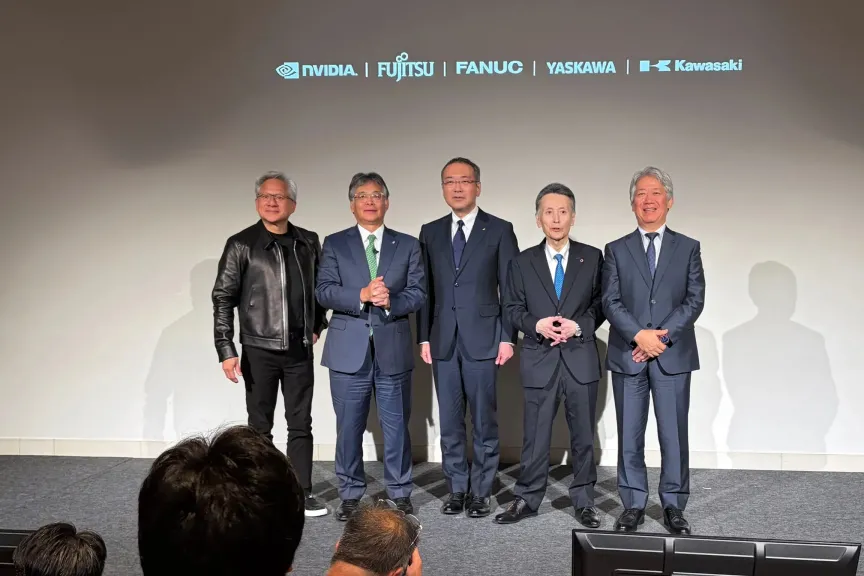
TOKYO — Fujitsu is spearheading a new Japanese initiative to develop intelligent robots powered by Nvidia technology, bringing together some of the country’s largest industrial robotics manufacturers as Japan seeks to strengthen its position in the global artificial intelligence race.
The initiative, announced in Tokyo on Thursday and reported by The Associated Press, includes Fanuc, Yaskawa Electric and Kawasaki Heavy Industries. It builds on a partnership unveiled by Fujitsu and Nvidia last year and is expected to enter its first implementation phase later in 2026.
The collaboration will focus on so-called «physical AI», a field that combines artificial intelligence with machines capable of sensing their surroundings, making decisions and acting independently rather than merely following pre-programmed instructions.
The companies said the technology could support a new generation of robots designed to operate safely alongside people in factories, hospitals and homes.
Fujitsu Chief Executive Takahito Tokita and Nvidia Chief Executive Jensen Huang announced the initiative alongside senior executives from the three Japanese robotics groups.
The participating companies are seeking to combine Nvidia’s AI computing capabilities with Japan’s established strengths in precision engineering, industrial automation and robotics manufacturing.
Executives said intelligent robots could help Japan address its worsening labour shortage, particularly as the country’s ageing population increases demand for healthcare, elderly support and automated services.
Potential applications could include assisting older people who live alone, supporting medical and care workers, and carrying out industrial tasks in sectors struggling to recruit sufficient employees.
Huang said Japan’s manufacturing culture made it particularly well suited to developing autonomous machines, where reliability and precision are critical because independently moving robots could present safety risks.
He highlighted Japan’s reputation for high-quality manufacturing and concepts such as «kaizen», or continuous improvement, as important foundations for the development of physical AI systems.
The companies did not provide a firm timetable for when the robots could become widely available in workplaces or everyday life. However, they said the first phase of the collaboration was expected to begin later this year.
No decision has been made on establishing a joint venture, although executives indicated that such a structure could be considered at a later stage.
The initiative comes as Japan steps up efforts to close the gap with the United States and China in artificial intelligence, while seeking to use its longstanding leadership in industrial robotics as a competitive advantage in the emerging physical AI market.