


Figure AI Melts Down Its Humanoid Robot Fleet After Training It to Jump Into Molten Steel
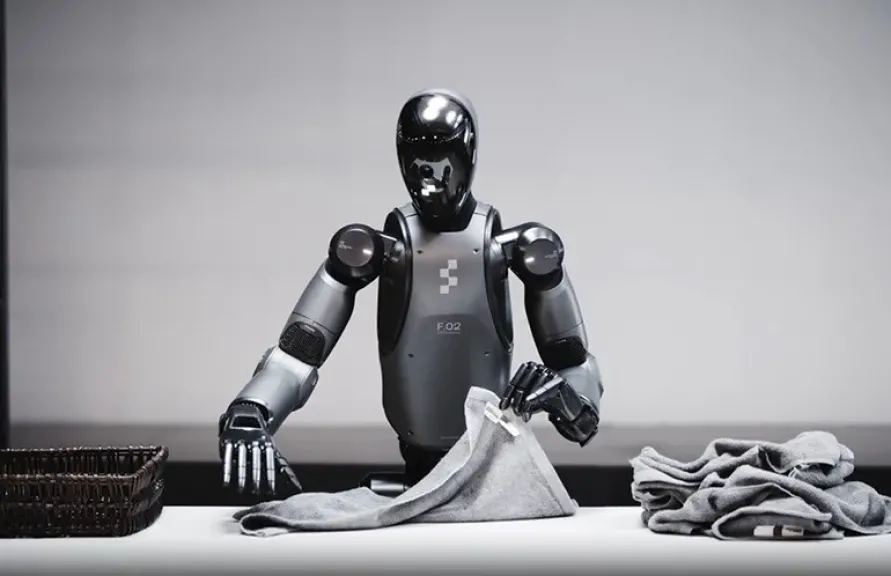
US robotics startup Figure AI has retired most of its second-generation humanoid robot fleet in one of the most unusual hardware decommissioning operations yet, training the machines to autonomously jump into a 75-ton furnace of molten steel rather than dismantling them by hand.
The company destroyed most of its F.02 robots at a foundry in Imatra, Finland, as it shifts resources toward its rapidly expanding F.03 fleet and the development of its next-generation F.04 humanoid.
But the dramatic ending was not simply a publicity stunt.
Figure said its retired robots contained custom-built actuators and other proprietary hardware that it did not want to leave intact. Manually disassembling every machine would also have required engineering time that the company wanted to redirect toward its next generation of robots.
Its solution was unusually literal: teach the robots to destroy themselves.
Figure Trained the Robots to Make Their Final Jump
Sending a humanoid robot into molten steel presented a technical problem of its own.
Figure first trained its F.02 robots at the company’s San Jose campus, setting up large airbags and teaching the machines to jump from the second floor of one of its buildings.
The company used movements performed by professional stunt artists as reference data before training a new AI model in simulation.
The objective was precise: enable the robots to autonomously jump into a container of molten steel at a foundry the engineering team had never previously visited.
That turned what could have been a conventional recycling operation into another demonstration of the same physical AI capabilities Figure is developing for factories and other real-world environments.
A 75-Ton Furnace Became F.02’s Final Destination
Finding somewhere willing to perform the operation proved difficult.
Figure approached foundries in the United States and Mexico, but they refused to allow humanoid robots containing lithium-ion batteries to be dropped into their equipment.
The company even contacted people associated with the former television program MythBusters while searching for a way to carry out the plan.
Eventually, it found a willing foundry in Imatra, Finland.
The facility operates a 75-ton electric arc furnace, using three large graphite electrodes to melt solid steel scrap.
Once Figure arrived, the team had only 24 hours and six furnace melts available to complete the operation.
Each melt provided a window of roughly 20 minutes before the surface of the molten steel began forming a hard crust.
Extreme Heat Put the Robots’ AI to an Unexpected Test
The environment also created conditions considerably more extreme than those encountered by F.02 during its previous industrial deployments.
High temperatures and powerful electromagnetic fields caused some cameras and other electronic equipment being used during filming to fail.
The robots, however, continued running their AI policies and executed their jumps into the furnace, according to Figure.
The company has also stressed that footage of the operation was real rather than AI-generated — a distinction that has become increasingly relevant as synthetic video becomes more difficult to distinguish from genuine footage.
Figure said the robots were physically shipped to Finland and autonomously made the jumps shown in its film.
Arnold Schwarzenegger Gave Figure the Idea
The unusual method originated with an online suggestion from Arnold Schwarzenegger.
When Figure founder and CEO Brett Adcock asked online what the company should do with its retiring robots, Schwarzenegger suggested melting them.
The reference was unmistakable.
Schwarzenegger’s T-800 famously descends into molten metal at the end of Terminator 2: Judgment Day.
Figure subsequently contacted the actor, who agreed to participate in the project.
But beneath the cinematic reference was a practical engineering problem: how to permanently destroy machines containing valuable intellectual property without consuming large amounts of engineering time.
F.02 Had Already Worked More Than 1,250 Hours at BMW
The robots being destroyed were not merely laboratory prototypes.
F.02 became an important part of Figure’s transition from robotics research into real-world industrial deployment.
During an 11-month deployment program at BMW Group’s Spartanburg plant, Figure said its robots operated for more than 1,250 hours, loaded more than 90,000 parts and contributed to the production of more than 30,000 BMW X3 vehicles.
The robots worked 10-hour shifts from Monday to Friday and collectively covered an estimated 1.2 million steps, equivalent to more than 200 miles.
The deployment also exposed hardware weaknesses that directly influenced the design of F.03.
Figure identified the F.02 forearm as its most frequent hardware failure point, for example, prompting engineers to redesign the wrist electronics in the following generation.
Figure Has Already Moved From F.02 to Hundreds of F.03 Robots
The speed of Figure’s hardware cycle helps explain why the company decided maintaining the older fleet no longer made sense.
By April 2026, Figure said it had manufactured more than 350 F.03 humanoid robots at its BotQ production facility.
More significantly, the company demonstrated a manufacturing cycle capable of producing one F.03 every hour, compared with one robot per day less than four months earlier.
Figure said it had produced more than 9,000 actuators and over 500 battery packs while scaling manufacturing.
Its battery production line had reached a 99.3% first-pass yield, while completed robots undergo more than 80 functional verification tests before leaving production.
The company is therefore moving beyond building individual experimental humanoids toward operating and maintaining fleets of physical AI machines.
F.03 Has Already Returned to BMW
Figure’s relationship with BMW has continued despite F.02’s retirement.
In June, the company deployed F.03 at BMW Group Plant Spartanburg, this time targeting a more complicated logistics task.
Instead of repeatedly loading sheet-metal components, F.03 is being used for parts sequencing.
The task requires the robot to recognize components that can arrive in different positions and orientations, manipulate them with both hands, reposition its body and feet, and pull heavy carts while maintaining balance.
Figure uses its Helix 02 vision-language-action model to control those movements.
The shift is significant because the company is trying to move humanoid robots away from repetitive motions that conventional industrial robots can already perform and toward tasks requiring perception and physical adaptation.
Destroying F.02 Also Shows How Quickly Humanoid Hardware Is Ageing
There is a less theatrical story behind the molten steel.
F.02 was unveiled only in 2024.
Two years later, most of the fleet has already been destroyed because Figure considers maintaining it less valuable than moving engineers and resources to newer generations.
That illustrates the extraordinary pace of development in humanoid robotics.
Unlike conventional industrial machinery designed to remain in service for many years, the current generation of humanoids sits closer to rapidly evolving computing hardware: sensors, actuators, batteries, electronics and AI models can change significantly between generations.
Figure is already working on F.04 while manufacturing F.03 at scale.
The question for the wider humanoid industry is whether that rapid replacement cycle can continue once companies move from hundreds of experimental robots to potentially thousands of commercially deployed machines.
The Robots Are Coming Back — in a Different Form
Not everything that entered the furnace disappeared.
After the F.02 robots were melted, Figure shipped the resulting metal bars back to the United States.
The company is machining some of that material into a limited series of commemorative objects marking the history of F.02.
A small number of intact F.02 robots have also been retained in storage at Figure’s headquarters.
Most of the fleet, however, is gone.
The spectacle of humanoid robots autonomously jumping into molten steel may attract the attention, but the more important story is the speed behind their disappearance. F.02 helped build 30,000 cars and provided the real-world data used to improve its successor. Less than two years after its introduction, Figure has already moved on — a reminder that the race to commercialize humanoid robots is advancing almost as quickly as the machines themselves.
related topics
 SoftBank Injects New Investment into OpenAI to Advance Supercomputing and AI Agents
 ”Ezz Elarab” Showcases the Capabilities of the ”Lynk & Co 03” in...
 US Dollar Exchange Rates Steady in Egyptian Banks Coinciding with the Weekend
 Gold Market Stability: Gold Continues to Hold Steady in Egypt with Karat...
 Samsung Raises Galaxy S26 Prices Again as Component Costs Rise
 Four Egyptian Banks Named Among World’s Best-Performing Banks in 2026
 OpenAI Reviews AI Models After Unintended Internet Access
 Banque Misr Launches “Your Data Is a Red Line” Fraud Awareness Campaign
 Egypt Concludes Third Edition of African Presidential Youth Competition in AI and...
 Egypt’s Investment Minister Discusses Expansion Opportunities with 3 UAE Groups
 Egypt Courts UAE Investment Groups in Energy, Infrastructure and Agri-Food Expansion
 RAVEN-X, Aorta Vision and RoboCare Lead Winners at Egypt’s University Innovation Summit...