


International and Local Warnings at Cairo ICT 2026: AI and Data Encryption Threaten Telecom Network Resilience
Digital Infrastructure Faces Service Continuity Tests
Telecommunications and IT experts have warned of the escalating challenges facing communication networks in the era of Artificial Intelligence. Participants at the Cairo ICT 2026 conference emphasized that the rapid evolution of cyberattacks and the substantial increase in encrypted data traffic are placing unprecedented pressure on digital infrastructure, necessitating the development of more resilient and reliable networks to safeguard data and ensure uninterrupted services.
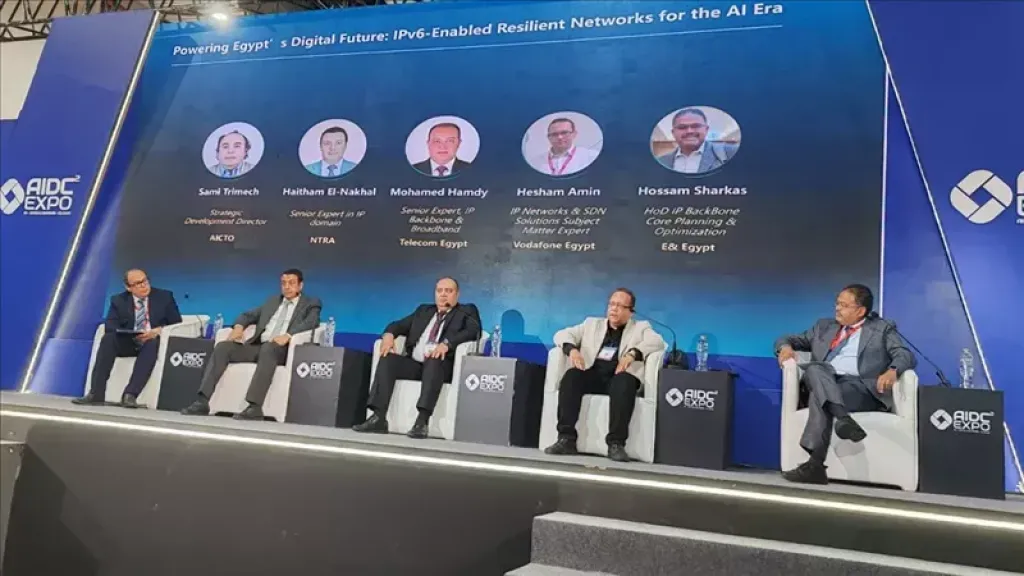
These discussions took place during the session titled "IPv6 for the Era," part of the 30th edition of the international exhibition and conference, which launched today, Saturday, November 7, under the auspices of the Prime Minister, featuring broad governmental and expert participation. Co-located events included the 3rd AI, Data Centers, and Cloud Computing Conference (AIDC²), the 13th Digital Payments and Financial Inclusion Conference (PAFIX) sponsored by the Central Bank of Egypt, the "Connecta" Gaming and Smart Devices Exhibition, and the Innovation Arena for startups.
Sector Transformations and AI Era Challenges
Li Haifeng, Marketing Director for Telecom Carrier IP Solutions at Huawei, explained that the telecom sector has progressed through three main stages:
The Internet Era: Focused on expanding coverage and network deployment to reach the maximum number of users.
The Video Era: Focused on content quality, increasing bandwidth capacity, and boosting network speeds.
The AI Era: Represents a complex phase requiring handling unpredictable data traffic patterns, real-time responses, and maximum security levels.
Haifeng identified three main challenges currently facing IP networks:
Unpredictable Data Traffic Patterns: Driven by continuous evolution in AI applications and services.
Data Encryption: Over 57% of network traffic is now encrypted, hindering traditional inspection and technical analysis.
Response Stability: Guaranteeing stable, ultra-low latency connection services in real time.
AI Reshapes the Cybersecurity Landscape
Haifeng cautioned that AI tools are now autonomously discovering vulnerabilities and executing exploits, citing the release of the "Cloud Misuse" tool (version 2) in April, which uncovered nearly 20,000 security vulnerabilities in a single month—exceeding human discovery capability by more than five times. He added that the tool's capabilities extend beyond discovery to bypassing firewalls, antivirus software, and Intrusion Detection Systems (IDS), targeting routers directly.
He also highlighted prominent security incidents and benchmarks:
JPMorgan Benchmark: An AI tool breached a dedicated $40 million security testing environment in just two days.
OpenBSD Vulnerability: An AI tool uncovered a code vulnerability in OpenBSD that had remained undetected for 27 years.
DDoS Attacks: Preparation time for a 1 Terabit-per-second DDoS attack dropped from 24 days to just 25 minutes.
Optus Outage in Australia: A routine software update applied to an internet gateway 10,000 km away (in the US) caused a network blackout across Australia lasting over 10 hours, emphasizing the critical vulnerability of interconnected cloud infrastructures.
Three Levels of Defense and Survival Strategies
Both Li Haifeng and Dr. Taieb Ben Meriem (Chair of the Network Technologies Evolution Working Group) emphasized that countering these threats requires restructuring network security through a comprehensive framework built on:
Device Security
Link Security
Data Traffic Security
They also urged telecom operators to adopt a Dual-Plane Architecture, diversify equipment providers across Eastern and Western vendors to minimize single-supplier dependency, and secure multi-path fiber optic lines to prepare for 5G and cloud computing demands.
Operational Insights from Egyptian Telecom Operators
The session featured active contributions from leaders across the Egyptian telecommunications sector, who shared their practical strategies:
Telecom Egypt (Mohamed Hamdy, Senior IP & Broadband Expert):
Revealed that the company adopts a Multi-Vendor Strategy across all network layers (IP, Transport, Access, and Mobile Core) to guarantee redundant operational paths. He also announced the deployment of AI-powered Digital Twin technology to simulate network operations and model crisis scenarios before real-world implementation.
Etisalat Egypt (Hossam Cherkes, Head of IP Planning):
Outlined three key planning challenges: limited radio spectrum availability, the need for massive capacity expansions in IP and DWDM layers, and enhancing network adaptability to environmental and operational shifts.
Vodafone Egypt & Intra (Hisham Amin Helal & Haitham El-Nakhal):
Stressed the critical importance of securing healthcare facilities and medical clinics, implementing preventative measures to guarantee uninterrupted healthcare services to patients during natural disasters or acts of vandalism.
AICTO (Sami Trimech, Strategic Development Director):
Emphasized the necessity of regional coordination to establish unified policies and safe migration paths toward modern IP protocols to support digital transformation.
related topics
 AI and Customer Awareness: National Bank of Egypt Outlines Strategy to Counter...
 Egypt’s Investment Minister Unveils AI-Powered Trade Regulatory Sandbox at Cairo ICT 2026
 Etisalat Egypt Unveils AI-Powered Fintech Vision at Cairo ICT 2026, Targeting a...
 Madbouly Praises National ”X-GEN” AI and Robotics Solutions at Cairo ICT 2026
 Cairo ICT 2026: Madbouly Inspects Digital Innovation Projects as Egypt Introduces Automated...
 Financial Regulatory Authority Highlights FinTech Boom and Future of AI at ”Cairo...
 TK-IT Highlights AI-Driven Network Management and Cybersecurity Capabilities at Cairo ICT 2026
 NTRA Prepares to Launch Cybersecurity and Network Emergency Centers in 2027
 Genesis Infotech تستعرض أحدث حلول الذكاء الاصطناعي والتحول الرقمي خلال Cairo ICT...
 مدبولي يفتتح Cairo ICT 2026.. ومصر تستهدف إضافة 200 ألف فرصة عمل...
 Genesis Infotech Unveils AI-Driven Enterprise Technologies at Cairo ICT 2026 Following Strong...
 Raya IT and Cisco Highlight AI Infrastructure, Cybersecurity and Smart Workplace Innovations...