Workday Launches UAE Operations as AI Transforms HR and Finance
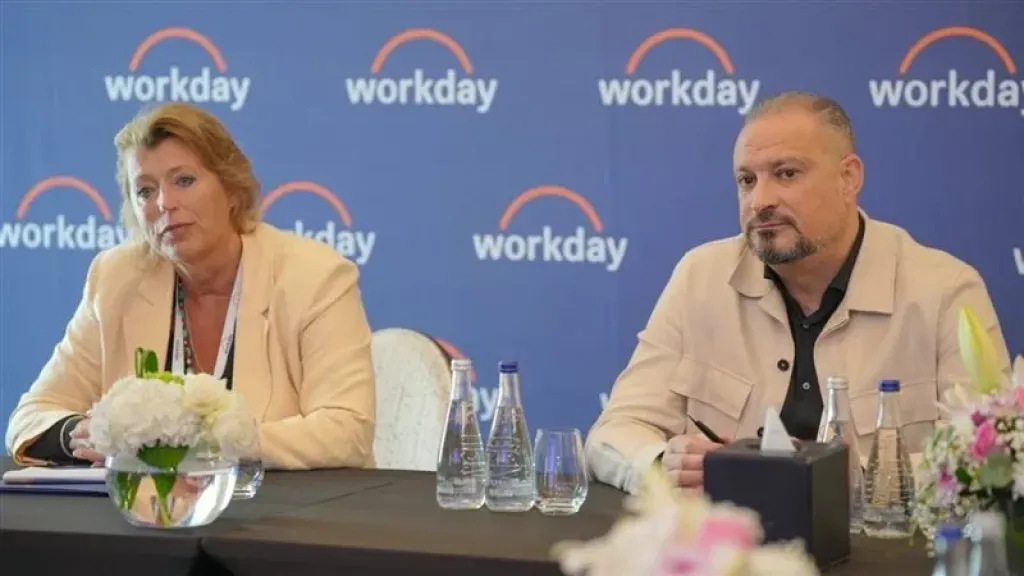
Workday Launches UAE Operations as AI Moves Deeper Into HR and Finance
Workday has officially launched operations in the United Arab Emirates and opened a new office in Dubai, turning a regional expansion plan announced a year ago into a permanent local presence as companies accelerate the use of artificial intelligence across HR, finance and enterprise operations.
The US enterprise software company is establishing dedicated regional operations alongside expanded local leadership, with Dubai becoming a hub for customer engagement, partnerships and recruitment.
The expansion puts Workday closer to UAE organizations at a time when the company is repositioning its traditional cloud software business around AI agents capable of carrying out increasingly complex tasks across human resources, finance and IT.
But research released alongside the UAE launch also highlights an important challenge facing that transition: AI is already saving employees significant amounts of time, yet much of that benefit can be offset by the work required to check and correct what the technology produces.
90% of Surveyed UAE Employees Use AI Every Week
Workday’s new UAE research found that 90% of employees surveyed use AI at least once a week.
Of those surveyed, 58% said they use the technology several times each week, while 18% use it every working day.
More than half of directors and C-suite executives surveyed also use AI weekly.
The figures point to a market where artificial intelligence is moving beyond isolated experiments and becoming part of everyday workflows — an important factor behind Workday’s decision to establish a permanent local presence.
Employees surveyed said AI saves them an average of 3.6 hours per week.
Yet the study also reveals a less obvious cost.
AI Saves 3.6 Hours — but Employees Spend 3.4 Hours Fixing Its Work
Employees reported spending an average of 3.4 hours every week clarifying, correcting or rewriting AI-generated output.
That creates an important distinction between AI adoption and AI productivity.
The two figures cannot simply be subtracted to calculate a net productivity gain because they are separate survey averages rather than employee-level measurements.
They nevertheless illustrate one of the major problems companies face as generative AI moves into core business processes: producing an answer quickly does not necessarily mean that answer is immediately usable.
For HR and finance in particular, where errors can affect salaries, recruitment, financial reporting or sensitive employee information, human oversight remains important.
That helps explain why Workday is positioning its AI strategy around combining automation with controls, enterprise data and human decision-making rather than simply replacing existing workflows with standalone generative AI tools.
UAE Companies Are Using AI Gains for More Than Cost Cutting
The study also provides insight into what organizations are doing with the time and efficiency generated by AI.
Around 33% of respondents said AI efficiencies are being used to handle greater workloads without increasing headcount.
Another 32% said the benefits are being directed toward training, upskilling and reskilling employees.
A further 32% reported using efficiencies to improve workload management, flexibility and employee wellbeing.
Only 24% said AI-related savings were being used primarily to reduce costs.
That distinction is important for Workday because its products sit directly at the intersection between technology investment and workforce management.
If companies use AI not simply to cut headcount but to redesign jobs and skills, HR platforms increasingly become part of how that transition is managed.
Workday Is Bringing AI Agents Into Core Enterprise Workflows
Workday has been expanding beyond conventional human capital management and financial software toward what it describes as an enterprise AI platform.
Its Workday Illuminate technology is designed to bring AI into HR and finance processes using the company’s underlying business data.
The strategy increasingly includes specialized AI agents capable of handling particular tasks rather than relying solely on employees navigating conventional software screens.
Workday’s UAE platform currently promotes agent-based capabilities across HR, finance and IT alongside human capital management, payroll and employee-experience tools.
This is strategically different from introducing a general-purpose AI assistant into an organization.
Workday’s advantage — and the challenge it is attempting to exploit — is that enterprise AI becomes considerably more useful when it can understand the organizational context surrounding employees, jobs, finances and business processes.
Dubai Becomes Workday’s Local Base for Middle East Expansion
The UAE launch completes a process that Workday began publicly outlining in September 2025, when it announced plans to establish a Dubai office as part of a wider Middle East expansion.
The company has now moved from that planned presence to operational launch.
Its Dubai office is located in Dubai Internet City and will support regional customer relationships, partnerships and local recruitment.
Workday President for EMEA Angelique De Vries-Schipperijn described the UAE as an important market in the company’s growth strategy, citing the scale of transformation underway across organizations in the country.
Zakaria Haltout, Group Vice President for the Middle East, Turkey and Africa, is also leading Workday’s expansion across the wider region.
The Middle East has become increasingly important to the company as cloud adoption, AI investment and large-scale digital transformation programs create demand for enterprise software modernization.
Local Presence Matters in Enterprise Software
Opening an office may appear less technologically significant than launching a new AI product, but for enterprise software companies it can materially change their ability to compete.
Large organizations buying HR and financial platforms typically enter relationships that can last for years and affect thousands of employees.
Implementation can involve payroll systems, workforce data, financial processes, integrations, regulatory requirements and organizational change.
A permanent UAE operation therefore gives Workday a local commercial and partnership base as it competes for major enterprise customers.
However, the launch announcement does not disclose the size of the local workforce or identify new UAE customers associated with the expansion. It also does not provide detailed information on local data-hosting arrangements.
Those details will be important in determining how Workday’s new regional presence translates into actual deployments.
UAE Launch Comes as Workday Pushes AI Across Its Global Business
The Dubai expansion forms part of a broader international AI strategy.
Workday has been investing in AI capabilities, expanding partnerships and introducing specialized agents across different business functions.
The company has also strengthened its EMEA presence through initiatives including an AI Centre of Excellence in Dublin and its EU Sovereign Cloud strategy.
Its UAE entry gives that strategy a stronger Middle Eastern base.
The opportunity is significant because HR and finance represent two areas where companies generate enormous amounts of structured enterprise data — precisely the kind of information AI systems can potentially use to automate workflows and support decisions.
But Workday’s own UAE research also demonstrates why simply deploying AI is not enough.
With 90% of surveyed UAE employees already using AI weekly, the next stage of competition is unlikely to be about convincing companies to experiment with the technology. It will be about proving that AI can deliver reliable business outcomes without creating almost as much work checking its output as it saves in the first place.