


Egyptian Prime Minister Meets CBE Governor to Discuss Economic Reforms and Financial Stability
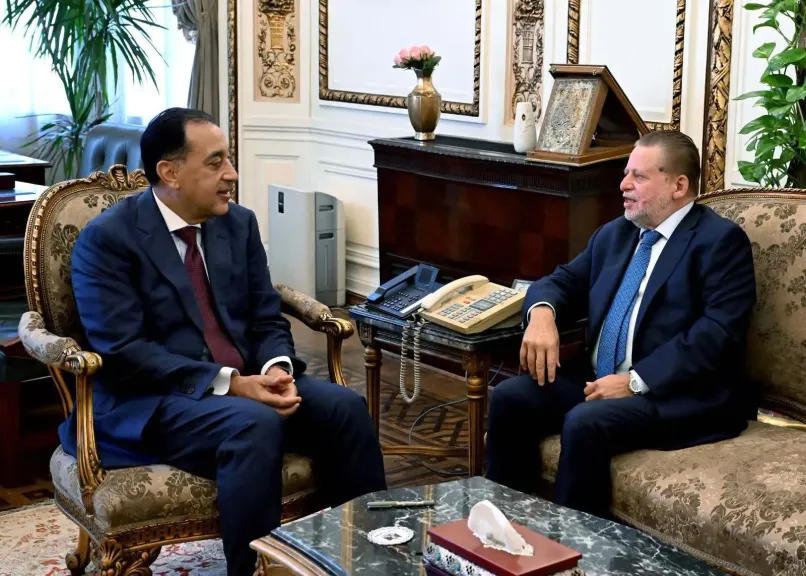
Egyptian Prime Minister Mostafa Madbouly met with Central Bank of Egypt (CBE) Governor Hassan Abdalla to discuss key economic priorities and strengthen coordination between the government and the central bank.
The meeting focused on economic developments and measures aimed at supporting financial and monetary stability, as well as preparations for Egypt’s National Economic Transformation Program.
Discussions also covered the performance of the Egyptian economy, particularly joint efforts to continue reducing inflation rates and increase foreign-currency inflows. The two sides emphasized the importance of maintaining safe levels of foreign-exchange reserves to secure the country’s strategic needs for essential commodities.
The meeting also addressed ongoing efforts to strengthen strategic commodity reserves through continued coordination between the government and the Central Bank of Egypt.
During the meeting, Abdalla reviewed his participation at the 48th Annual Meetings of the Association of African Central Banks (AACB), held in Nairobi from September 13 to 18, 2026. The meetings brought together governors of 34 central banks out of the association’s 41 members, representing 53 African countries.
Abdalla also highlighted his participation in the 14th Meeting of the Council of Governors of central banks participating in the Pan-African Payment and Settlement System (PAPSS), which was held in Nairobi on the sidelines of the AACB annual meetings.
He said that Egypt’s participation reflects its efforts to strengthen banking relations at the regional level and enhance economic and trade cooperation with African countries.
The CBE Governor also discussed his participation in a high-level conference on “Artificial Intelligence Applications in Central Banking Practices,” organized by the Central Bank of Kenya in Nairobi to mark the institution’s 60th anniversary.
The conference focused on three main areas: the use of artificial intelligence in monetary policy and financial stability; the development of banking supervision and the enhancement of financial integrity; and AI governance and the management of associated risks.
The discussions also examined the potential of AI to process large and diverse datasets and support economic forecasting and analysis.
related topics
 Egypt’s PM Reviews ICT Infrastructure, Digital Transformation and AI Projects
 CBE Governor Hassan Abdalla Participates in African Central Bank Governors’ Meetings in...
 US Dollar Holds Steady Against Egyptian Pound at Major Banks on September...
 CBE Governor Participates in 14th PAPSS Governing Council Meeting in Nairobi
 Egypt’s Foreign Trade Rises 20.2% to $104.9 Billion in First Seven Months...
 Egypt’s Central Bank Governor Highlights AI’s Role in Advancing Central Banking at...
 Saudi Arabia’s $5.3 Billion Deposit with Egypt’s Central Bank Due in October
 QNB Egypt CEO Mohamed Bedeir Expresses Gratitude for Condolences on the Passing...
 Egyptian Pound Ticks Down Slightly Against US Dollar as Egypt-Saudi Trade Reaches...
 Egyptian Pound Holds Steady Against US Dollar and Gulf Currencies as Annual...
 US Dollar Ticks Up Slightly Against Egyptian Pound as Urban Inflation Eases...
 Egypt’s Central Bank Sells EGP 97.55 Billion in Treasury Bills