


ICT Minister, EBA Discuss Investment Opportunities in Egypt’s Outsourcing Sector
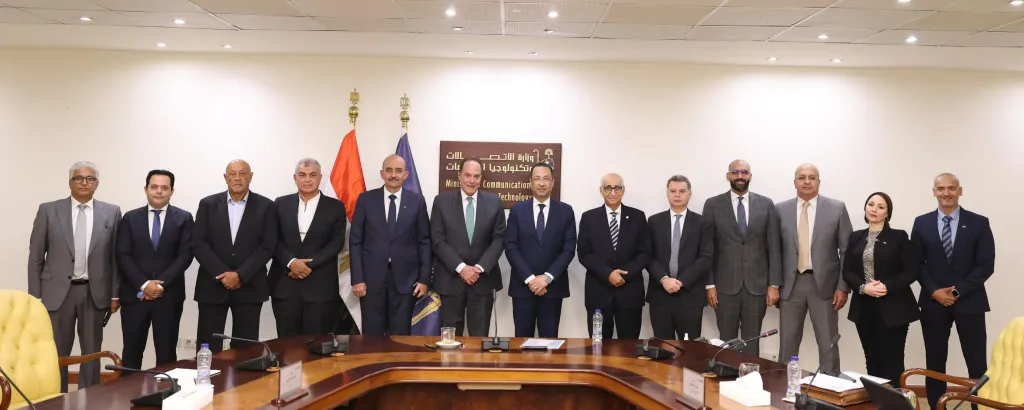
ICT Minister, EBA Discuss Investment in Outsourcing
Minister of Communications and Information Technology Raafat Hendy has held an expanded meeting with a delegation from the Egyptian Businessmen's Association (EBA), headed by Vice Chairman of EBA and Chairman of the Real Estate Development and Construction Committee Fathallah Fawzi. Also attending were CEO of the Information Technology Industry Development Agency (ITIDA) Ahmed Elzaher, and Assistant ICT Minister for Digital Transformation Mahmoud Badawi.
Talks centered on deepening cooperation between MCIT and EBA, investment prospects in the outsourcing sector, and an update on several ongoing digital transformation projects.
The ICT Minister called the meeting an important one, describing EBA as a national institution that brings together many of Egypt's leading businesspeople. Keeping that dialogue going matters, he said: regular coordination between MCIT and EBA helps the government stay attuned to what the business community needs and keeps digital transformation efforts on track.
On the numbers, Hendy said roughly 245 digital services are now live on the Digital Egypt platform, with a plan to push that past 400 by 2030. He also flagged Egypt Pass, the new digital identity platform which lets citizens handle transactions that once required an in-person visit, such as powers of attorney, notarization, and other verification-heavy processes, entirely online.
Domestic phone manufacturing has grown fast, too: production rose from 3 million handsets in 2024 to about 10 million in 2025. This year, MCIT wants to reach 14 to 15 million units, enough to cover most of Egypt's estimated 18 to 20 million-unit domestic demand, with room left over for exports.
Training programs are expanding as well. Hendy said MCIT keeps scaling up its digital training and capacity-building efforts across age groups and specializations, with the goal of getting young Egyptians ready for jobs at home and abroad.
He pointed to a wave of new Egyptian AI applications built around the idea of "digital sovereignty," among them Karnak Chat; Bel Masry, a system that converts text to speech and back again in Modern Standard Arabic and colloquial Egyptian across 50 languages; and Loghat, an app for learning English.
Infrastructure work continues on multiple fronts. The ministry is still expanding fiber-optic coverage across Egypt's governorates, and it's laying cable in villages reached by the presidential Haya Karima (Decent Life) initiative. By year's end, Hendy said, MCIT hopes to roll out a full data center strategy developed jointly with other government bodies. Cybersecurity, he added, stays near the top of the list, protecting state systems and infrastructure, along with the ground Digital Egypt has already gained.
Outsourcing exports hit $5.1 billion by the end of 2025, and MCIT is aiming for $8 billion by 2028. Hendy described the sector as fertile ground for investment right now, pointing to the growing appetite among global outsourcing firms to expand their Egypt operations.
Elzaher backed that up with numbers of his own: the outsourcing workforce has grown from roughly 90,000 people in 2021 to more than 195,000 today. That kind of growth, he said, is something ITIDA wants to keep building on in the years ahead.
Much of it comes through partnerships, cooperation agreements with local and international firms designed to expand operations and add jobs. The most recent batch, signed with 55 global companies, is projected to generate around 75,000 new positions. And the growth isn't limited to Cairo, Elzaher noted; it's spreading across the governorates, giving companies access to talent outside the capital and helping distribute jobs and investment more evenly around the country.
The meeting also touched on the National Real Estate ID system, one of the ministry's newer tools for protecting state assets and streamlining services. Badawi explained that the underlying law gives every property, residential unit, and plot of land in Egypt its own unique ID code, a safeguard against duplicate transactions and disputed ownership.
According to Badawi, MCIT has already assigned ID numbers to every building nationwide and covered a large share of individual real estate units by linking the system to utility records.
For the EBA delegation, the takeaway was clear: MCIT isn't just running the telecom sector anymore. Members praised its broader role in pushing technology into government institutions across the board, calling it a real driver of progress in Egypt's digital infrastructure and a key step toward phasing out paper-based operations. They also welcomed the ministry's push to bring different government bodies together under a single digital window, a move they said cuts red tape and protects the interests of developers and investors alike.
related topics
 Collaborative Funded Projects Program
 MCIT Concludes Soft Skills Training Program Under ‘Tawar w Ghayar’ Initiative
 MCIT Initiatives Trainees Take Top Honors at Startup Teen 2026
 Fixed Egypt (FEDIS) Renews ISO 27001 Certification for Third Consecutive Year, Highlighting...
 Vodafone Business, Elsewedy Electric, and Cassava Technologies Launch $1B Data Center and...
 AI Startup Velents Expands Regional Footprint into Bahrain via Strategic Partnership with...
 White House Sparks Debate with Interactive Kids' Games Section Promoting Trump Agenda
 Egypt Hosts INTOSAI Global Seminar on Frugal AI; MCIT Showcases Efforts in...
 Haier Expands Egyptian Presence with Al Ahly Sponsorship and Global Fan Festival...
 e& Egypt Named Egypt’s Best-Performing Mobile Network by P3, Earns P3 Test...
 HPE Launches ”Saudi Made” AI Initiatives and Expands Local Manufacturing Capabilities at...
 Aramco and Aramco Digital Forge Global Tech Partnerships at LEAP 2026 to...