


HUMAIN Launches Voice AI Supporting Najdi and Hijazi Dialects.. When Will AI Truly Understand Arabic?
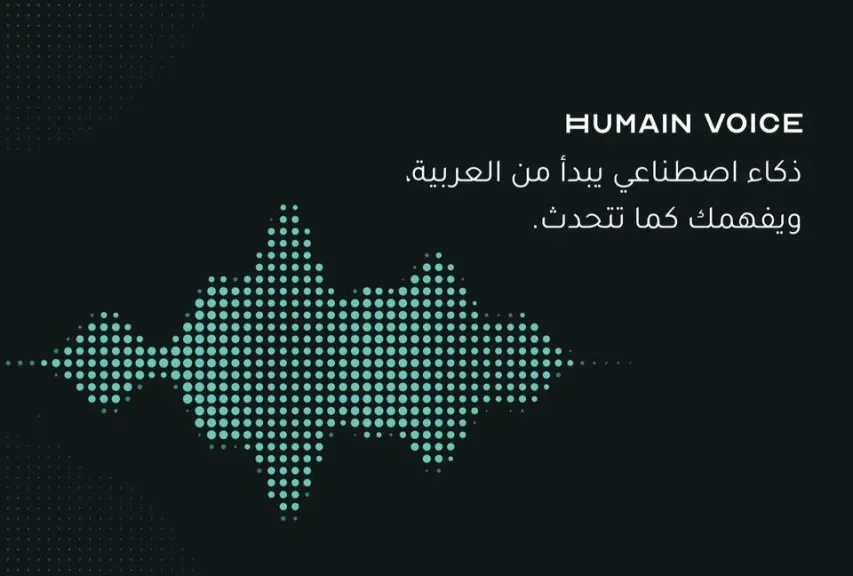
Saudi AI company HUMAIN, a subsidiary of the Public Investment Fund (PIF), has launched HUMAIN Voice, an Arabic-first speech AI platform designed to help machines understand and interact with people using their natural spoken language. Announced on November 19, 2026, the platform supports Saudi dialects, including Najdi and Hijazi, alongside Gulf and other Arabic dialects, English, and natural Arabic-English code-switching. The launch comes as competition intensifies to develop AI systems that address the linguistic characteristics of Arabic-speaking markets rather than treating Arabic as an additional language capability.
HUMAIN Voice combines three core technologies: automatic speech recognition (ASR), text-to-speech (TTS), and intelligent voice agents. Together, these capabilities allow developers and businesses to build applications that can listen to users, interpret spoken input, and respond through natural-sounding speech or perform specific tasks. The platform also supports switching between Arabic and English within the same conversation, addressing a common communication pattern among many Arabic speakers.
Moving Beyond Arabic Speech Recognition
The challenge of Arabic voice AI extends beyond recognizing words and converting speech into text. Arabic dialects differ in vocabulary, pronunciation, sentence structure, and local expressions. A word or phrase can carry different meanings depending on the speaker's region and conversational context. These differences make it harder for AI systems to interpret spoken Arabic accurately, particularly when users switch between formal Arabic, colloquial expressions, and English.
HUMAIN says its platform was developed with Arabic as a foundational language rather than an extension of systems originally designed for English. According to the company's platform information, HUMAIN Voice supports more than 15 dialects, including Saudi, Gulf, Egyptian, Levantine, and Maghrebi varieties, with automatic dialect detection. However, the breadth of advertised language support does not by itself establish accuracy. Independent testing will be important in determining how reliably the platform handles regional expressions and different conversational settings.
Alongside the platform launch, HUMAIN introduced HUMAIN-Voice-Lite-80M, an automatic speech recognition model containing 80 million parameters. It is designed to process Arabic, English, and mixed-language speech. The company released the model's weights under the Apache 2.0 license, allowing developers and researchers to use, modify, and distribute the technology under the license's terms. Its lightweight design and support for CPU and GPU environments are intended to provide greater flexibility for developers deploying speech recognition applications.
Implications for Digital Services and Content Production
The platform's potential applications extend well beyond conventional voice assistants. Businesses could use its voice agents to develop customer service systems capable of responding in the caller's own dialect, rather than relying on rigid automated menus or interactions limited to formal language. Potential applications include banking, government services, healthcare, hospitality, and enterprise operations. HUMAIN says its agents can support full-duplex speech-to-speech conversations, allowing them to listen and respond naturally with low latency.
The technology could also affect digital media and content production. Speech recognition and text-to-speech capabilities can support automated narration, dubbing, interview transcription, podcast production, and audio versions of news articles. Media organizations and independent creators could potentially produce different audio versions of the same content for audiences using different Arabic dialects. The commercial value of these applications, however, will depend on pronunciation quality, contextual accuracy, and the ability to preserve the cultural nuances of each dialect.
Arabic AI Competition and the Importance of Benchmarking
HUMAIN enters a field where research into Arabic speech recognition and dialect processing is advancing rapidly. A systematic review published in March 2026 examined 82 studies on Arabic and Saudi dialect speech recognition and identification. It highlighted persistent challenges, including imbalanced dialect datasets, limited large-scale Saudi speech resources, and difficulties in generalizing model performance across different dialects and regions.
These challenges make independent performance testing particularly important. The success of HUMAIN Voice will depend not simply on the number of dialects it claims to support, but on its accuracy across real-world recordings, its ability to understand local expressions, and its performance under background noise, rapid speech, and language switching. HUMAIN has said it will publish evaluation results for its lightweight model through the Open Universal Arabic ASR Leaderboard, potentially allowing developers and researchers to compare its performance with other systems. Actual benchmark results and testing methodology will be essential to assessing its competitive position.
The launch reflects a broader shift in Arabic AI development: the challenge is no longer limited to generating Arabic text, but increasingly involves understanding how people actually speak. Najdi and Hijazi support gives HUMAIN a clear starting point in the Saudi market. The wider test will be whether such technologies can reliably serve the diversity of Arabic speakers across the region and turn dialect recognition from a product feature into a dependable everyday experience.
related topics
 Madbouly: Awqaf Ministry's New AI Center to Modernize Religious Discourse and Shield...
 GITEX 2026: Telnyx Brings AI Voice Agents to the Middle East
 WideBot Teams Up with ”El Daheeh” for Free Arabic AI Educational Series,...
 LEAP Riyadh 2026 Eyes More Than $15 Billion in Investment Deals
 LRNOVA Launches the First Specialized Arabic AI Model for Educational Videos and...
 MENA Startups Raise $12.7 Million in a Week, Led by Saudi AI...
 Saudi Arabia’s AI Market Set for Explosive Growth, Projected to Hit $16.9...
 Egypt’s Streaming Boom: NTRA Reports 67% Growth in Online Viewership with 52...
 WideBot Partners with Ahmed El-Ghandour to Launch AI Educational Series “Mind Hosted...
 Snap Signs MoUs with Qatar Government to Boost Content Creation and Digital...
 Video Games Overtake Streaming as the Largest Digital Media Spending Sector in...
 Local Content Creators Are Challenging Hollywood, Say Global Experts at 1 Billion...
