NVIDIA Leadership Change Puts Taiwan Suppliers Under Pressure as TSMC, ASE Retain Their Edge
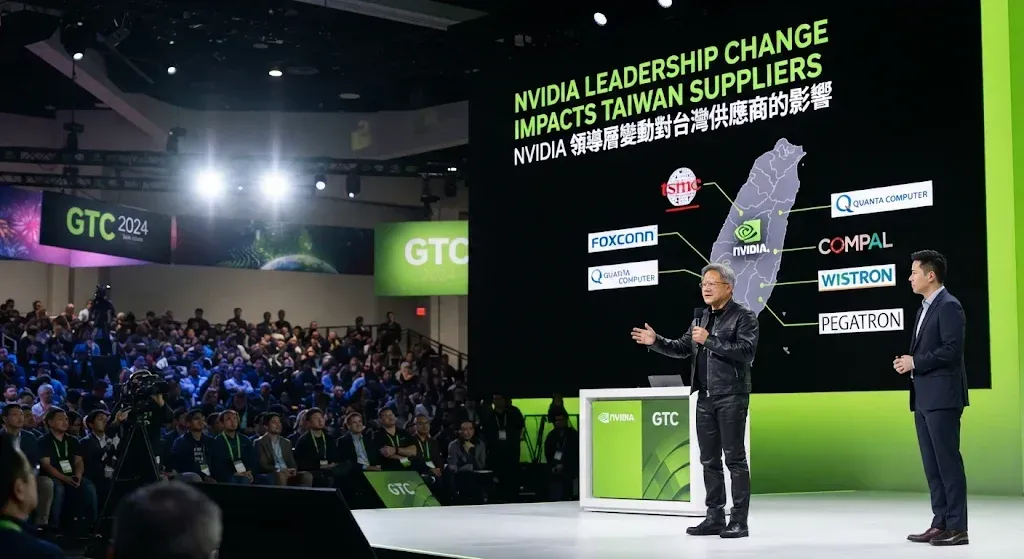
Jensen Huang's departure as NVIDIA's former CEO following an extramarital affair scandal could reshape the company's relationships with Taiwan's semiconductor and server supply chain. With Chief Financial Officer Colette M. Kress serving as interim CEO, suppliers may face tighter procurement policies, tougher price negotiations and potential order reallocations.
The change could also bring an end to the high-profile "trillion-dollar banquets" Huang repeatedly hosted in Taiwan for AI and semiconductor supply-chain partners.
Huang Feng-kai, a former government fund manager, said on a financial news program that the impact will depend largely on suppliers' technological advantages and ability to withstand pricing pressure.
During his tenure, Huang maintained direct contact with more than 60 NVIDIA departments and adopted a relatively flexible approach toward Taiwanese suppliers. Kress, known for her focus on cost control, could take a stricter approach, putting pressure on suppliers' gross margins.
TSMC and ASE retain strong competitive positions
Taiwan Semiconductor Manufacturing Company (TSMC) and ASE Technology Holding are among the suppliers least vulnerable to immediate disruption. Their advanced manufacturing, packaging and testing capabilities, combined with limited capacity and technological advantages, make them difficult to replace. Both companies serve major customers, including NVIDIA and AMD.
The components and materials segments also enjoy strong positions because of supply shortages. Gold Circuit Electronics (2368), a key supplier of printed circuit boards for NVIDIA's high-end servers, is among the companies benefiting from tight supply.
Copper-clad laminate manufacturers Elite Material (2383) and Taiwan Union Technology (6274) also retain short-term advantages as customers face limited alternatives.
Chassis and rail manufacturers face pricing risks
Mechanical component and chassis suppliers could face greater pressure because the market has numerous manufacturers and relatively low technological barriers.
Chenbro Micom (8210), InWin (6117) and Chenming Electronic (3013) could become targets of price negotiations or order transfers as NVIDIA's new management seeks lower procurement costs.
King Slide Works (2059), a server-rail manufacturer with gross margins of 70% to 85%, may also face pricing reviews, particularly when next-generation server racks enter production. Nan Jun International and Fositek could benefit from orders transferred by existing suppliers.
The competitive reshuffling could extend to server contract manufacturers, including Hon Hai (2317), Quanta (2382), Wistron (3231), Gigabyte (2376) and Supermicro.
13 Taiwanese companies positioned to benefit from AMD and ASIC growth
Beyond NVIDIA, institutional investors see opportunities for AMD and application-specific integrated circuit (ASIC) developers to expand their market positions as cloud service providers diversify computing resources.
They identified 13 Taiwanese companies with exposure to both opportunities: TSMC, MediaTek (2454), Alchip-KY (3661), Global Unichip (3443), Wiwynn (6669), Inventec (2356), Elite Material, Nan Ya PCB (8046), Unimicron (3037), Kinsus (3189), King Yuan Electronics (2449), ASE Technology Holding and Powertech Technology (6239).
All 13 recorded positive cumulative revenue growth during the first ten months of the year.
Elite Material led with 114.06% growth, followed by Global Unichip at 106.36% and Alchip-KY at 72.62%. Wiwynn increased 54.03%, Inventec 43.08% and TSMC 43.29%.
Other gains included 44.95% for Nan Ya PCB, 40.88% for Unimicron, 35.37% for Kinsus, 33.52% for King Yuan Electronics, 32.18% for ASE and 29.75% for Powertech Technology.
Institutional investors consider TSMC the strongest defensive player because NVIDIA, AMD and ASIC developers all depend on its advanced manufacturing capabilities. MediaTek, Alchip-KY and Global Unichip are also well positioned to capture custom-chip opportunities through their data-center, AI ASIC and system-on-chip capabilities.
Ultimately, NVIDIA's leadership transition is unlikely to affect all Taiwanese suppliers equally. Companies with advanced technology and scarce production capacity retain stronger negotiating positions, while chassis makers and contract manufacturers face greater exposure to cost-cutting and order reshuffling.
related topics
 Egypt Unveils New FDI Promotion Strategy Targeting 16 Economic Sectors, Investment Minister...
 OPPO Showcases Its Latest Innovations at Cairo ICT 2026 and Announces Recent...
 CONNECT PS Showcases AI-Powered Collaboration and Customer Experience Solutions at Cairo ICT...
 Egyptian Tax Authority Unveils 33 Measures to Ease Compliance, Offering Immediate VAT...
 Fixed Misr FEDIS Showcases Nine Digital Solutions at Cairo ICT 2026 to...
 Digital Transformation in Healthcare: New Draft Law and Smart Strategies to Upgrade...
 Geidea Aims to Double Its Merchant Base in Egypt by 2027 and...
 Justice and Communications Ministries Introduce Online Legal Power-of-Attorney Service in Egypt
 Egypt Prepares for Second Phase of National AI Strategy, Targets More Investments...
 CIB Showcases Its Latest Digital Solutions at Cairo ICT 2026
 saib Bank Showcases Latest Digital Solutions and Offers Valuable Prizes to Visitors...
 Sumsub and Jelou AI Bring Identity Checks into WhatsApp-Based Financial Onboarding