Beyond Traditional Filtration: The Science Behind Safer and Smarter Household Water Systems
Turning on a household tap may seem like the final step in a simple process, but drinking water undergoes a much longer journey before reaching consumers.
It begins at a natural or engineered water source, passes through treatment plants and distribution networks, and eventually enters the plumbing systems inside residential buildings. At every stage, factors affecting water quality may emerge.
The question is whether centralized treatment alone is sufficient to guarantee water quality all the way to the consumer.
The World Health Organization (WHO, 2017) identifies safe drinking water as a cornerstone of public health. Yet growing industrial activity, agricultural pollution, and emerging contaminants are creating additional challenges for conventional water treatment infrastructure.
Among these contaminants are microplastics, pharmaceutical residues, and endocrine-disrupting substances. Even water that has undergone effective treatment may be exposed to secondary contamination through deteriorating pipelines, potentially introducing lead, copper, and rust.
Understanding the Main Sources of Water Pollution
Water quality can be affected by three broad categories of contamination.
1. Microbial pollution
Bacteria such as Escherichia coli and Salmonella, as well as enteric viruses, are associated with waterborne diseases. Microorganisms can also form biofilms inside distribution and household plumbing networks.
2. Chemical pollution
Heavy metals and other toxic elements, including lead, arsenic, and mercury, may accumulate in the human body and contribute to long-term damage affecting the nervous system, kidneys, and liver.
3. Plastic pollution
Microplastics and nanoplastics have become an emerging research concern after being detected in various water sources, including bottled drinking water.
The Hidden Plastic Content of Bottled Water
Bottled water is often perceived as a reliable alternative to tap water. However, research suggests that plastic packaging itself may contribute to the presence of microscopic plastic particles in drinking water.
In a study published in 2018, Mason and colleagues analyzed 259 bottled water samples collected from nine countries. Plastic particles were detected in approximately 93% of the bottles, with an average concentration of 325 particles per liter.
A separate study published by Qian and colleagues in 2024 used more sensitive analytical methods and estimated approximately 240,000 plastic particles per liter, predominantly nanoplastics.
Researchers have investigated possible links between exposure to these particles and biological processes such as oxidative stress, inflammation, and changes in the intestinal microbiome.
However, these findings should be interpreted carefully. Many proposed health effects are based on laboratory experiments and observational evidence, and their actual impact on human health remains uncertain.
In its 2019 assessment, the WHO concluded that available evidence did not indicate an apparent health concern from microplastics at the levels currently detected in drinking water, while emphasizing the need for further research, particularly concerning nanoplastics.
Therefore, bottled water remains an important option when it is the only safe drinking water available, especially since the risks of dehydration and waterborne infections are established.
How Household Filtration Has Advanced
The development of domestic water filtration systems has moved through several technological generations.
Sand and ceramic filters were among the earliest approaches, primarily designed to remove suspended particles and visible impurities.
Activated carbon introduced another level of treatment by helping reduce chlorine, unwanted odors, and certain organic compounds.
The industry subsequently adopted membrane-based technologies, including ultrafiltration and reverse osmosis, which are now frequently combined with other filtration components in multi-stage household systems.
Why Water Testing Matters More Than the Number of Filter Stages
A common misconception is that a filter with more stages automatically produces safer water.
In reality, the appropriate filtration technology depends on the contaminants present in the source water.
Total dissolved solids (TDS) is one useful measurement, but it cannot independently determine whether drinking water is microbiologically or chemically safe.
A proper assessment should also consider turbidity, chlorine, hardness, iron, and potential microbial contamination.
A representative household filtration system may incorporate four treatment stages:
- Sediment filtration: Removes suspended particles, rust, and other physical impurities larger than five microns.
- Activated carbon treatment: Reduces free chlorine and certain volatile organic compounds, improving taste and odor.
- Mineral and pH adjustment: Uses materials such as coral sand to support mineral content and modify water acidity.
- Ultrafiltration: Uses membranes with pore sizes between 0.01 and 0.2 microns to retain certain microorganisms and suspended contaminants, depending on membrane performance and validated specifications.
The effectiveness of each stage depends on its design, operating conditions, and independent testing.
Exploring Multi-Stage Systems and Pi-Water Technology
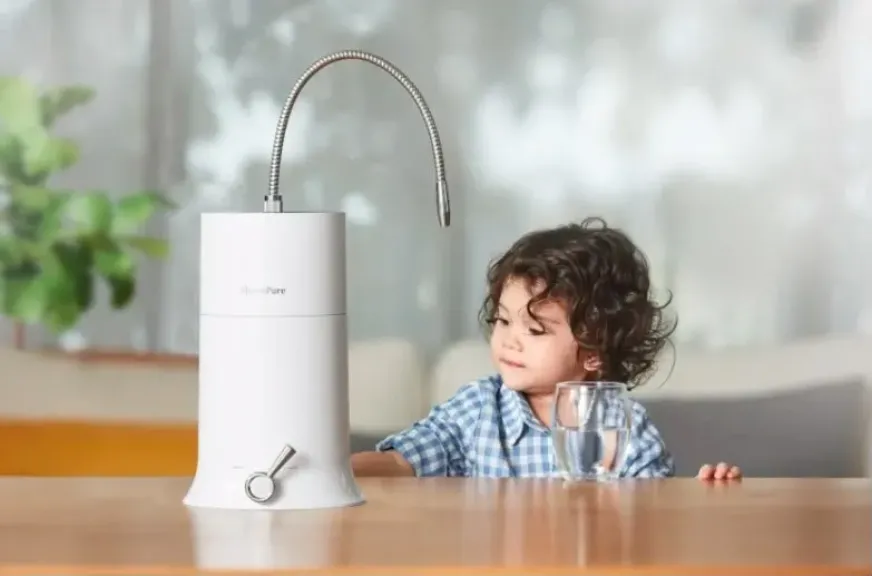
The HomePure Nova Pi-Plus is one example of a commercially available nine-stage filtration system.
Its components include sediment filtration, activated carbon, coral sand, bio-ceramic balls, far-infrared balls, negative-ion balls, silver-ion antibacterial carbon powder, an UltraTech 35+ membrane, and an antibacterial silver stone.
The manufacturer presents the system as a solution for improving drinking water quality and also promotes its ability to produce what it describes as Pi-Water, or functional water.
This process involves passing water over bio-ceramic materials containing ferrous and ferric iron ions (Fe²⁺/Fe³⁺).
Functional water research examines whether specific treatment methods produce measurable changes in water characteristics, including oxidation-reduction potential (ORP).
Some early scientific publications have investigated possible biological effects of specially treated water, including antioxidant-related mechanisms. Nevertheless, such findings should not be interpreted as proof of medical benefits.
In particular, claims about immune system enhancement, therapeutic effects, or improved cellular hydration require independent clinical research involving human participants.
The distinction between measurable chemical properties and proven health outcomes remains essential when evaluating commercial water treatment technologies.
Comparing Reverse Osmosis and Ultrafiltration
Environmental performance is becoming an increasingly important consideration when selecting household water treatment equipment.
Reverse osmosis (RO) can effectively reduce dissolved salts and various other contaminants, but its operation involves certain resource costs.
Depending on the system and operating conditions, approximately 50% to 70% of incoming water may be discharged as reject water. RO systems also generally require electricity to power a pressure pump.
Ultrafiltration (UF), on the other hand, can operate using available water pressure without an electric pump in suitable installations. Some systems are designed to use nearly all incoming water without generating a concentrated reject stream comparable to RO wastewater.
Manufacturers also report cartridge service lives reaching 5,000 liters for certain products, although actual replacement intervals depend on water quality, consumption, and operating conditions.
The two technologies are not interchangeable. Ultrafiltration cannot remove dissolved salts, making reverse osmosis more suitable for applications requiring significant reductions in salinity.
The broader lesson is that water treatment should be assessed through several performance indicators, including purification effectiveness, water recovery, electricity requirements, and consumable materials.
Intelligent Water Filters: From Manual Replacement to Real-Time Monitoring
Smart filtration systems are introducing digital monitoring capabilities into household water treatment.
Integrated sensors can track electrical conductivity, water pressure, flow rates, and leakage indicators. Some advanced systems also use usage data to estimate cartridge lifespan and predict when maintenance will be required.
Smartphone notifications can alert users when filtration performance declines or when a replacement component is needed. Certain devices can also automatically stop water flow when a leak is detected.
These technologies may help reduce unnecessary cartridge replacements and prevent avoidable water losses.
Nevertheless, smart monitoring comes with important technical considerations:
- Measurement accuracy: TDS readings alone cannot establish the absence of harmful microorganisms or chemical contaminants.
- Sensor maintenance: Sensors may drift over time and require periodic calibration.
- Cybersecurity: Connected devices collect household usage information, making encryption and software updates important.
- System reliability: Safe operation should not depend entirely on continuous internet connectivity or electricity.
Building a More Sustainable Future for Drinking Water
Household water treatment is increasingly shifting toward integrated solutions that combine advanced filtration, digital monitoring, and more efficient resource management.
Multi-stage ultrafiltration may offer an attractive option in situations where dissolved salt removal is unnecessary, while reverse osmosis remains important for water sources with elevated salinity.
No single technology can address every water quality challenge.
The most effective approach begins with reliable water testing, followed by selecting a suitable treatment system and verifying its actual performance through independent assessments.
A sustainable household water treatment strategy should ultimately prioritize six factors: drinking water safety, treatment efficiency, energy conservation, water waste reduction, intelligent monitoring, and scientifically verified performance.
As water scarcity and contamination pressures continue to grow, these principles will play an increasingly important role in the development of safer and more sustainable household water solutions.