Egypt, ITFC Explore Export Financing, Startup Support and Development of Up to 20 Investment Zones
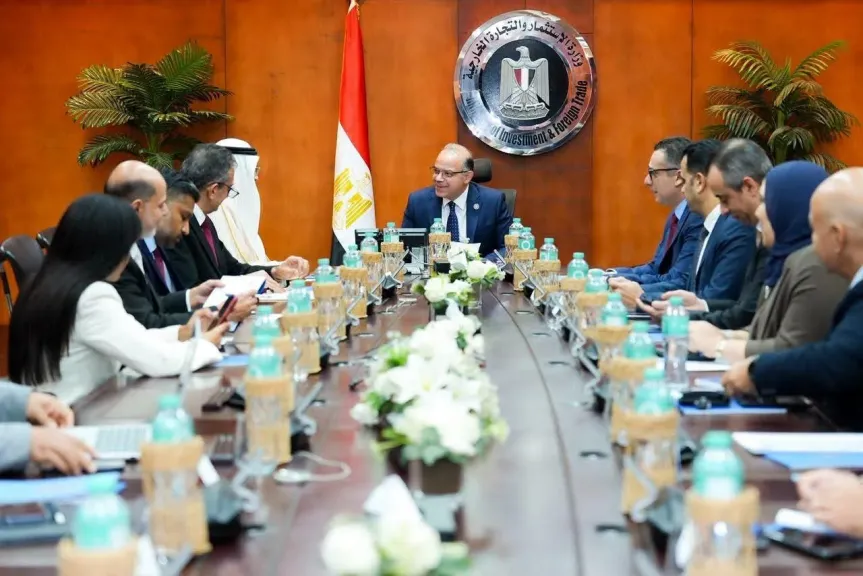
Egypt’s Minister of Investment and Foreign Trade, Dr. Mohamed Farid, held talks with Eng. Adeeb Yousuf Al-Aama, CEO of the International Islamic Trade Finance Corporation (ITFC), on expanding cooperation in export financing, startup support and investment zone development, while exploring the use of technology and artificial intelligence to advance foreign trade.
The meeting was attended by Dr. Mohamed Awad, CEO of the General Authority for Investment and Free Zones (GAFI); Minister Plenipotentiary Alaa El-Beheiry, head of the General Authority for Exhibitions and Conferences; and Hatem El-Nawawy, CEO of the General Authority for Export Development Center.
Fintech and AI Solutions to Expand Export Opportunities
Farid highlighted the importance of working with the ITFC to support the establishment and operation of a regulatory sandbox for financial and trade technology, known as the Fintech Sandbox. The platform is intended to develop innovative solutions based on data, technology and AI to support commercial and marketing activities and improve Egyptian companies’ access to international markets.
He said AI tools and digital agents could help exporters reach non-traditional markets and expand their overseas sales.
The minister also called for attracting startups and entrepreneurs to develop technology-based solutions for the exporting community, alongside providing the necessary financing for companies participating in the sandbox. This would help turn innovative ideas into practical and scalable business models.
Export Factoring and Financing Channels
The discussions also covered expanding the role of factoring companies through dedicated credit lines for export-related factoring operations. Such facilities would enable factoring providers to supply exporters with the liquidity they need while expanding their financing portfolios.
Farid said export-focused factoring could broaden Egypt’s exporter base and support foreign currency inflows. He also raised the possibility of involving the Sovereign Fund of Egypt as a central financing institution to receive international funding and channel it to factoring companies.
The ministry is prepared to coordinate with the relevant authorities to activate this model and facilitate access to funding for companies seeking to expand export financing activities.
Plans for 15 to 20 Investment Zones
On investment zone development, Farid stressed the need to establish more small and medium-sized zones near population centers across Egypt’s governorates, helping localize economic development and create jobs, particularly for women.
He noted that women account for between 60% and 70% of the workforce in some of these zones, highlighting their contribution to women’s economic empowerment and the creation of employment opportunities suited to local communities.
The government is targeting the development of 15 to 20 geographically distributed investment zones, each covering between 20 and 80 feddans. The zones are expected to accommodate industrial, logistics, manufacturing and service activities through rental arrangements and long-term usufruct rights.
The minister said several land plots had been allocated in coordination with the Ministry of Investment and Foreign Trade in preparation for development. He also emphasized accelerating implementation through partnerships with specialized entities under the public-private partnership (PPP) model, allowing both developers and the government to participate in financing and infrastructure development.
Building Sector Expertise and Young Talent
Farid stressed that investment promotion efforts should go beyond presenting investment opportunities to include detailed knowledge of priority sectors, their requirements and related supply chains.
He noted that the foreign direct investment strategy prepared by the ministry in cooperation with the World Bank identified 16 priority sectors. This requires strengthening the capabilities of investment promotion teams and equipping them with the necessary technical and commercial expertise.
The minister also highlighted the importance of specialized training programs and professional certification for young talent to improve workforce capabilities and support the implementation of joint cooperation objectives.
ITFC to Develop Tailored Financing Programs for Egyptian Exporters
For his part, ITFC CEO Adeeb Yousuf Al-Aama reaffirmed the corporation’s commitment to strengthening its partnership with Egypt to boost exports and develop trade financing and development tools.
He said the corporation is seeking to broaden cooperation with Egypt in the coming period, particularly through the 2026–2027 Egypt Country Program under the Arab-Africa Trade Bridges (AATB) initiative.
Al-Aama added that the ITFC is working on tailored financing programs to improve the efficiency of export-oriented projects and help Egyptian companies enter new markets, enhancing their competitiveness and expanding the global reach of Egyptian products.
He also emphasized continued support for exporting companies to develop their operations and improve efficiency, as well as capacity-building initiatives for young professionals through specialized training and certification programs.
Incentives to Encourage Exporters and Entrepreneurs
Concluding the meeting, Farid said Egypt aims to make exporting a more attractive field for young people and entrepreneurs by encouraging innovation and developing commercial and technological solutions that generate economic returns and increase exports.
He added that successful companies could receive additional incentives, including opportunities to participate in trade missions and international exhibitions, discounts on services provided by GAFI, and access to data and information supporting their business activities.
related topics
 Raya Digital’s Strong Presence at Cairo ICT 2026 Featuring Over 40 AI...
 Governance and Security of Enterprise AI Take Center Stage at ”Multi-Agent Systems”...
 Day Two of PAFIX 2026 Kicks Off: Financial Inclusion, AI, and Cybersecurity...
 Geidea Aims to Double Its Merchant Base in Egypt by 2027 and...
 AI Reshapes the Future of Digital Financing at Cairo ICT 2026’s PAFIX...
 Central Bank of Egypt: AI and Alternative Data Are Essential Pillars for...
 ESLSCA University Launches 4th Executive Education Summit in New Cairo with Top...
 CIB Looks Toward the Future of Digital Banking and AI at Cairo...
 Osama Kamal at PAFIX Opening: Financial Inclusion in Egypt Has Become a...
 Ericsson and Vodafone Egypt to boost 5G radio network performance with AI-native...
 Cairo ICT 2026: AIDC² Conference Outlines AI and Data Center Roadmap Across...
 Strategic Partnership Between Telecom Egypt and e-finance to Drive Digital Transformation and...