”AI Factories” at Cairo ICT 2026: A Global Race to Build Ultra-Infrastructure Driving the Future Economy
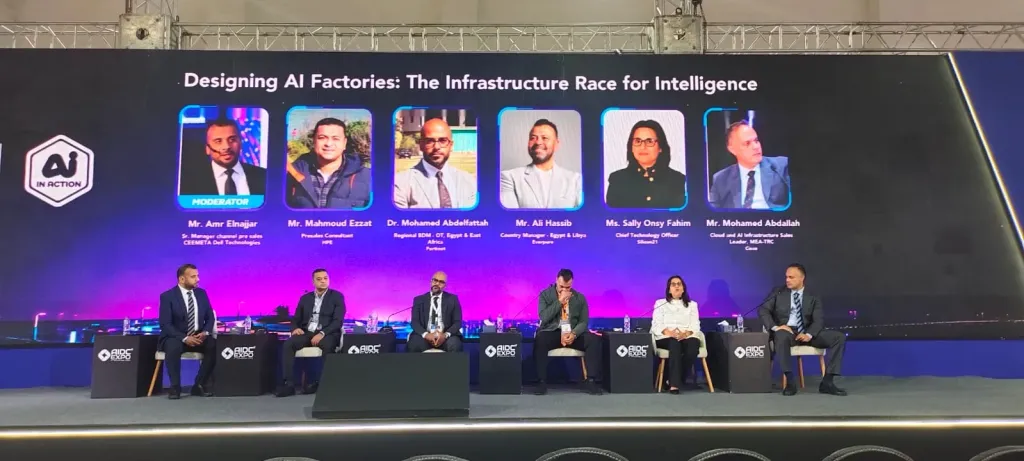
During a specialized panel titled “AI Factories: A Global Race to Build Infrastructure Producing the Intelligence of the Future” at Cairo ICT 2026, international technology leaders discussed the global shift toward integrated infrastructure capable of absorbing the rapid expansion of AI applications. Experts emphasized that global competition is no longer limited to model and algorithm development, but now hinges on high-performance compute capabilities, advanced data centers, specialized storage, and secure operational technology.
Integrated Infrastructure: The Key to Scaling AI Startups
Amr El-Najjar (Dell Technologies) noted that many AI startups fail to transition from Proof of Concept (PoC) to commercial execution due to traditional infrastructure bottlenecks rather than algorithmic deficiencies. He highlighted that adopting an "AI Factory" model—which unifies compute, storage, networking, and data pipelines into a single integrated system—eliminates silos and enables seamless scalability.
Fabric Architecture: Redefining Modern AI Data Centers
Mahmoud Ezzat (HPE) explained that AI data centers differ fundamentally from traditional cloud facilities by relying on Fabric Architecture. Segmented into GPU Fabric (utilizing Clos architecture), Compute Fabric, and Storage Fabric, these environments allow seamless scale-out to thousands of GPUs managed by a central orchestration engine acting as a single supercomputer.
Securing Operational Technology (OT): Defending Critical Infrastructure Against Indirect Attacks
Mohamed Abdel-Fattah (Fortinet) stressed that securing Operational Technology (OT) in vital sectors like utilities, transport, and manufacturing is a top priority for emerging nations. He warned that cyberattackers are shifting focus toward "indirect attacks" targeting physical sensors and industrial logic controllers (PLCs) rather than traditional IT servers, requiring adherence to standards like IEC 62443 and NIST 800-82 alongside AI-driven proactive defense systems.
Data Readiness First: The Prerequisite for Hardware Investment
Ali Haseeb (Everpure) warned that enterprises failing to adapt to intelligent transformation face extinction. He highlighted a common pitfall: heavy investment in hardware while neglecting data readiness. The essential first steps are data discovery, cleansing, and consolidation to properly feed Enterprise LLMs and deliver reliable business intelligence.
Upskilling Talent & Evolving Distributors into Value-Added Partners
Sally Onsy Fahim (Silicon 21) stated that technology distributors must evolve into value-added partners offering clear feasibility studies and integration support. She emphasized addressing Egypt's skills gap through partnerships with educational academies to nurture specialized local talent equipped for complex AI workloads.
$1.7 Trillion in Global AI Infrastructure & Unified Network Fabrics
Mohamed Abdallah (Cisco) highlighted that AI factories now span cloud, hybrid, and edge environments, with global infrastructure investments expected to reach $1.7 trillion. Building an observatory, unified network and security fabric is critical to merging legacy workloads with modern AI demands efficiently and securely.
related topics
 Day Two of PAFIX 2026 Kicks Off: Financial Inclusion, AI, and Cybersecurity...
 Geidea Aims to Double Its Merchant Base in Egypt by 2027 and...
 AI Reshapes the Future of Digital Financing at Cairo ICT 2026’s PAFIX...
 AI and the Future of Media: Cairo ICT 2026 Experts Highlight the...
 Human Oversight Remains Critical as AI Transforms Enterprise Operations, Experts Say at...
 «آيسكور» تحصد جائزة «أفضل تطبيق مؤسسي للذكاء الاصطناعي» (Enterprise AI Deployment Award)...
 إطلاق «فهيم» بدعم وزارة التربية والتعليم خلال «Cairo ICT 2026» المنصة تعليمية...
 نائب محافظ المركزي المصري يعلن ارتفاع الشمول المالي إلى 79% بإجمالي 56.4...
 Dubai Media Academy Wins ”AI in Arab Media” Award at Cairo ICT...
 آيسكور تطلق شركة iservices خلال 2027 لتقديم خدمات الذكاء الاصطناعي وتحليل البيانات...
 CIB Looks Toward the Future of Digital Banking and AI at Cairo...
 Osama Kamal at PAFIX Opening: Financial Inclusion in Egypt Has Become a...