


ICT Minister, AmCham Digital Transformation Committee Discuss Collaboration to Attract Investments
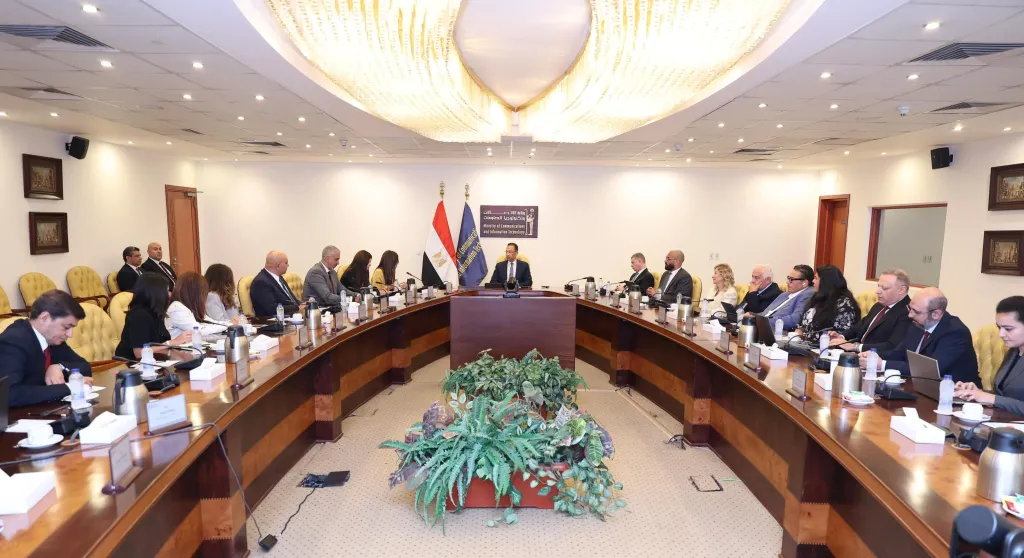
Minister of Communications and Information Technology Raafat Hendy has met with the Digital Transformation Committee of the American Chamber of Commerce in Egypt (AmCham Egypt). Discussions focused on the ICT sector’s future priorities and explored ways to create a more investment-friendly environment and attract greater investment to the sector.
The meeting reviewed the Ministry of Communications and Information Technology’s (MCIT) efforts to accelerate the adoption of AI, advance digital infrastructure development projects, and expand data center and cloud computing capabilities. It also highlighted MCIT’s commitment to creating an enabling regulatory and investment ecosystem and shaping a digitally-skilled workforce.
During the meeting, the ICT Minister emphasized that the Ministry’s work is centered around five key pillars: digital transformation, the local development of technology and job creation, digital infrastructure, digital capacity building, and legislation and governance.
Hendy explained that under the digital transformation pillar, MCIT continues to expand access to digital government services through the Digital Egypt platform, which currently offers 242 services, with plans to exceed 270 services by the end of this year and reach around 450 services by 2030. The Ministry has also introduced a digital identity system and is expanding the use of electronic signatures, while continuing to digitize operations in government entities to enhance efficiency, improve the business environment, and attract investments.
The ICT Minister explained that the local development of technology and job creation pillar is built on three main components. The first is the outsourcing industry and digital services exports, with outsourcing exports reaching approximately $5.2 billion in 2025 and targeted to increase to $8 billion by 2028. The second component focuses on the local manufacturing of electronics, particularly mobile phones, with production increased from 3 million devices in 2024 to 10 million by the end of 2025. The sector aims to exceed 15 million units in 2026, reach a production capacity of 30 million by 2028, and increase the local component ratio to around 45%.
Hendy added that the third component focuses on AI, a strategic priority for MCIT. He explained that Egypt launched the second edition of the National AI Strategy in early 2025, while the Applied Innovation Center (AIC) developed the Arabic LLM “Karnak,” as well as applications in healthcare, agriculture, and education.
Regarding the digital infrastructure pillar, the ICT Minister explained that a new spectrum block was allocated to mobile network operators (MNOs) last February. Hendy highlighted ongoing efforts to expand mobile coverage, roll out 5G services, and extend fiber-optic networks. He noted that fiber-optic cables were installed in more than 1,250 villages under the Decent Life presidential initiative.
He further stated that MCIT partners with relevant entities to develop a national data center strategy, as data centers represent a key element of digital sovereignty, amid growing interest from local and international investors in this sector. He affirmed that cybersecurity remains a top priority for the Ministry, alongside expanding the use of AI and leveraging data.
The ICT Minister added that MCIT follows a comprehensive approach for developing digital talent through a number of initiatives, most notably the Digital Egypt Generations initiatives, the programs of the Information Technology Institute (ITI) and the National Telecommunication Institute (NTI), WE Applied Technology Schools, and Egypt Informatics University (EUI). He stated that the next phase will focus on enhancing training quality, expanding advanced training programs, and developing specialized skills to meet job market needs.
He added that the Ministry seeks to develop the legislative framework governing the ICT sector and is keen to actively contribute to discussions at international forums, strengthening Egypt’s global leadership in ICT.
Moreover, Hendy highlighted that the ICT sector recorded a 20.3% growth rate in the third quarter of the previous fiscal year, marking the highest growth rate among all sectors. The sector currently contributes around 6% to GDP, with plans to increase this share to 8% by 2030.
For their part, AmCham members underscored the importance of continued collaboration between MCIT, AmCham’s Digital Transformation Committee, and the private sector to support digital transformation while ensuring digital sovereignty requirements are met. They also expressed their commitment to partnering with MCIT to advance future priorities.
They commended MCIT’s efforts to accelerate digital transformation, enhance Egypt’s digital competitiveness, and launch initiatives to develop digital skills and build a digital talent pool. They also praised the Ministry’s efforts to develop data centers across Egypt and strengthen their competitiveness. They further emphasized the importance of promoting freelancing.
The meeting was attended by CEO of the Information Technology Industry Development Agency (ITIDA) Ahmed Elzaher, Assistant ICT Minister for Digital Transformation Mahmoud Badawi, Advisor to the ICT Minister for Technology Talent Development Hoda Baraka, Advisor to the ICT Minister for Data Governance Suzanne El Akabaoui, Vice President for Regulatory Affairs and Market Governance at the National Telecom Regulatory Authority (NTRA) Amr Abbas, as well as senior officials from MCIT.
Representing AmCham were Board Member of AmCham and CEO of Raya Information Technology Marwa Abbas, Chair of the Digital Transformation Committee and General Manager of Microsoft MEA Growth Markets Mirna Arif, Co-Chair of the Digital Transformation Committee and Business Executive Director at Vodafone Egypt Mahmoud ElKhateeb, Co-Chair of the Committee and CEO of Mideast Communication Systems (MCS) Tarek Shabaka, CEO of AmCham Sylvia Menassa, Chief Operating Officer Dina Nawar, and Public Policy Officer Haneen Nigmeldin.