Arab African Advisory Group Concludes EU-Funded Project to Bolster Egypt”s Economic Clusters Regulatory Framework
The Arab African Advisory Group for Consulting has successfully concluded the implementation of a project aimed at supporting the regulatory framework for economic clusters in Egypt. The project is a key component of the "Euromed Clusters Forward" program, funded by the European Union. The initiative is designed to enhance the capacity of economic clusters across Southern Mediterranean countries, driving innovation, competitiveness, sustainable economic growth, and job creation.
€7.8 Million in European Funding to Support Economic Clusters The Euromed Clusters Forward program operates with a €7.8 million budget allocated over four years. It is implemented through the Anima Investment Network in collaboration with Berytech, and features the participation of seven countries: Egypt, Palestine, Jordan, Lebanon, Tunisia, Morocco, and Algeria. The program aims to develop the economic cluster ecosystem and foster collaboration between the private sector, government entities, and research institutions to support innovation and competitiveness in Southern Mediterranean economies.
12-Month Project Implementation in Egypt The Arab African Advisory Group executed the regulatory framework support project in Egypt over a 12-month period, commencing in June 2025. The project focused on three primary pillars: establishing an institutional framework to lead the cluster development agenda, reviewing regulatory frameworks to propose incentives that encourage cooperation among cluster members, and raising awareness of the critical role clusters play in driving economic growth and competitiveness.
Analyzing the Status Quo and Leveraging Global Practices The project relied on a comprehensive study and analysis of Egypt's current cluster ecosystem, drawing on international best practices. This was complemented by extensive consultations with government and private sector representatives, as well as international development partners.
163 Active Economic Clusters in Egypt The project highlighted that Egypt boasts a robust base of economic clusters. According to a 2024 survey by the United Nations Industrial Development Organization (UNIDO), there are 163 active economic clusters in Egypt. These range from natural clusters built around traditional crafts and local resources to state-supported models operating within industrial and investment zones.
Promising Models in Damietta, Robiki, and Shaq El Thu'ban The report pointed to Egypt's success in developing several promising models, notably the furniture manufacturing cluster in Damietta, the Robiki Leather City, and the Shaq El Thu'ban marble cluster. It emphasized that while these models have proven their ability to boost employment and exports, they still require more integrated regulatory frameworks and collective incentives to enhance their competitiveness and ensure long-term sustainability.
Challenges Facing Egypt's Economic Clusters The project identified several challenges hindering the cluster ecosystem in Egypt, most notably the absence of a unified institutional framework to govern cluster affairs and the lack of a clear legal definition for clusters within existing business legislation. Additional challenges include a shortage of specialized cluster management organizations, weak linkages with universities and R&D centers, and the pressing need for a national system to monitor cluster performance and measure the impact of supportive policies.
Global Benchmarks in Cluster Development The project reviewed leading global experiences in cluster development. The German model highlighted the importance of private sector participation in governance and drafting innovation agendas. Singapore’s experience underscored the value of linking incentives to performance indicators, R&D, and productivity. Meanwhile, the Indian model showcased the vital role of shared service centers in providing infrastructure and services that individual enterprises cannot afford independently.
Key Project Recommendations The project concluded with a set of practical recommendations to upgrade Egypt's economic cluster ecosystem. Foremost among these is the launch of a national initiative or the formation of a supreme committee, chaired by the Prime Minister, comprising relevant government bodies, the private sector, and development partners, to unify policies and coordinate cluster-related efforts.
The project also recommended developing a multi-level governance structure, including a strategic oversight committee, a technical secretariat for follow-up and execution, sectoral working groups, and local support units in the governorates. Furthermore, it called for introducing a clear legal definition of economic clusters into existing laws, such as the Investment Law and the MSME Development Law No. 152 of 2020, paired with collective incentives to encourage collaboration among cluster members.
A National Digital Registry for Economic Clusters Other recommendations included establishing a national digital registry for economic clusters with a progressive accreditation system based on performance and economic impact. The project also advised shifting from individually subsidizing enterprises to supporting the collective efficiency of clusters. This could be achieved through government procurement incentives, tax reductions for joint R&D expenditures, and the establishment of shared service centers equipped with Industry 4.0 technologies.
Bridging the Gap Between Industrial Clusters and Academia The project stressed the necessity of strengthening the ties between industrial clusters, universities, and scientific research centers. This alignment is essential for fostering innovation, developing higher value-added products, and elevating the competitiveness of Egyptian economic clusters.
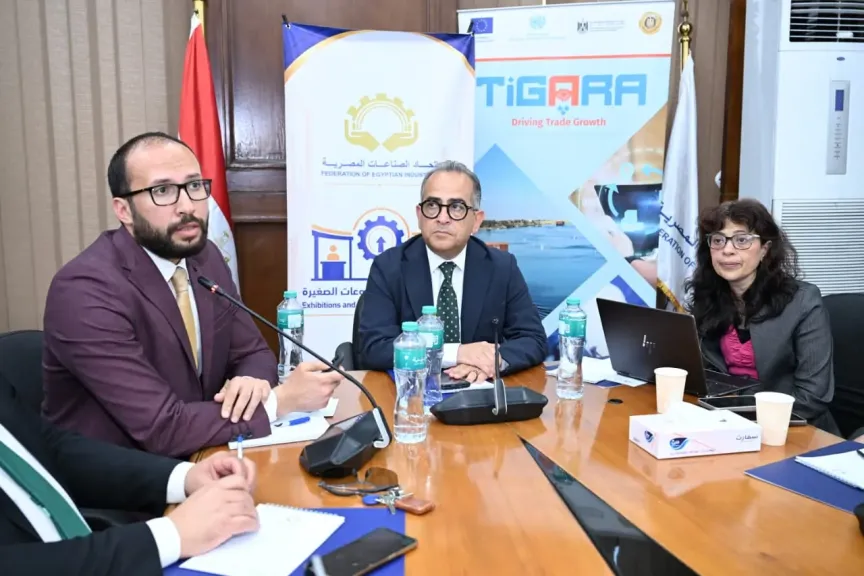
Workshops in Collaboration with FEI and UNIDO During its implementation, the project organized two high-level workshops in collaboration with the Federation of Egyptian Industries (FEI) and UNIDO. Attended by business community representatives, cluster members, government officials, and development partners, the workshops focused on discussing challenges and opportunities, and formulating proposals to enhance the competitiveness of Egypt's economic clusters.
The Arab African Advisory Group affirmed that the project's outputs represent a vital step toward building a more cohesive economic cluster ecosystem in Egypt, supporting the transition from isolated, individual initiatives to a collaborative developmental model that maximizes economic value.