


Egypt’s Digital Exports Surge 124% as ICT Sector Leads Economic Growth, Says Minister Amr Talaat
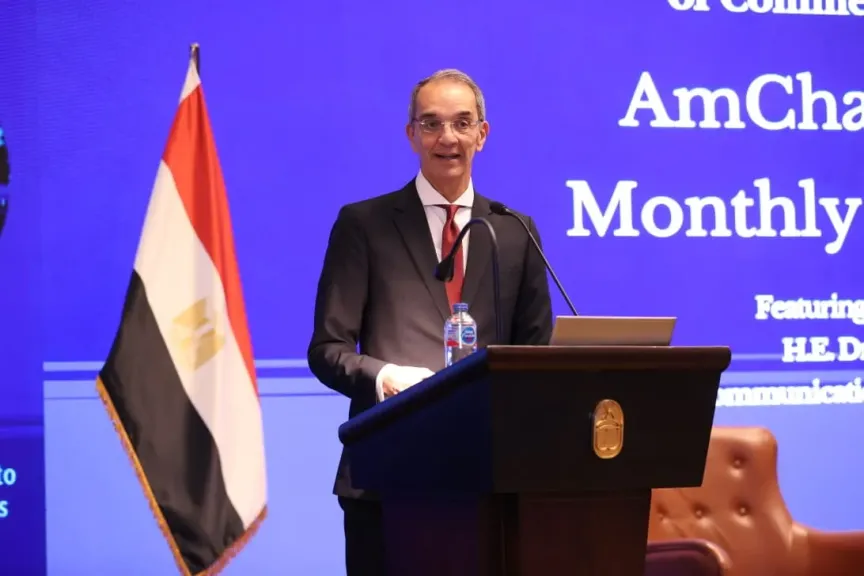
Egypt’s Information and Communications Technology (ICT) sector has recorded sustained and accelerated growth over the past seven years, maintaining its position as the fastest-growing sector in the national economy, according to Amr Talaat, Minister of Communications and Information Technology.
Speaking during the monthly meeting of the American Chamber of Commerce in Egypt, Talaat said the sector has achieved annual growth rates ranging between 14% and 16%, while its contribution to Egypt’s GDP doubled from 3.2% to 6% this year. He noted that digital exports rose by 124% to reach USD 7.4 billion, up from USD 3.3 billion in 2018, while outsourcing exports doubled over the past three years, increasing from USD 2.4 billion in 2022 to USD 4.8 billion in 2025.
Talaat explained that the number of outsourcing companies operating in Egypt has grown from 90 to 240, operating more than 270 delivery centers nationwide. He added that Egypt’s Digital Strategy is built around four main pillars: fostering digital innovation, enhancing digital services for citizens, boosting GDP and export growth, and creating jobs within the digital economy. These pillars are supported by two key enablers: robust digital infrastructure and a supportive legislative framework.
The minister highlighted the government’s strong focus on building digital capabilities and developing qualified ICT talent, describing human capital as a cornerstone of Egypt’s digital transformation and a key factor in attracting global technology companies. He revealed that the annual number of trainees in ICT specializations has increased 200-fold over the past seven years, rising from 4,000 trainees in fiscal year 2018-2019 to 500,000 in the previous fiscal year, with a target of training 800,000 individuals in the current fiscal year.
He added that Egypt’s digital skills strategy is based on both formal education and vocational training, ensuring alignment between academic programs and labor market needs. Talaat also noted the graduation of the first cohort from Egypt University of Informatics in the New Administrative Capital, as well as the expansion of WE Applied Technology Schools from a single school in 2021 to 27 schools across all governorates.
Talaat further outlined the diversification of training delivery models, including in-person training, digital platforms, and blended learning approaches. He pointed to the Mahara-Tech platform, which offers specialized digital training content across multiple technology domains, in addition to initiatives focused on freelancing, entrepreneurship, and upskilling non-ICT professionals through artificial intelligence tools. He also referenced the “Digitopia” competition, launched to discover and nurture digital creativity talent.
On artificial intelligence, the minister said Egypt launched its National AI Strategy in 2019, contributing to the country’s rise by 46 positions in the Government AI Readiness Index. The second phase of the strategy, launched earlier this year, focuses on six pillars: data, skills, ecosystem, infrastructure, applications, and governance. He noted that AI-powered systems have already been deployed for early breast cancer detection and for converting spoken court proceedings into written text.
Talaat also reviewed Egypt’s progress in strengthening its position as a global outsourcing hub, citing the signing of agreements in November with 55 local and international companies to expand operations in Egypt, creating around 75,000 new jobs over the next three years. This follows earlier agreements with 29 companies in 2022, initially targeting 34,000 jobs, which expanded to 60,000 jobs implemented by the end of 2024.
He revealed that 15 global brands are currently manufacturing mobile phones in Egypt with a local value-added component of approximately 40%. Production capacity increased from 3.3 million units in 2024 to 10 million units in 2025.
The minister also highlighted developments in the Digital Egypt Platform, which now offers 210 government services, serves more than 10 million users, and processes around 2 million transactions per month.
On infrastructure, Talaat said Egypt has invested USD 6 billion since 2019 to upgrade fixed and mobile internet networks, including USD 2.7 billion for mobile services and USD 3.3 billion for fixed broadband. These investments increased average fixed internet speeds by 16 times to 91.3 Mbps, placing Egypt first in Africa for average fixed broadband speed, compared to 40th place in 2018. The second phase of the project includes nationwide fiber-optic expansion and connecting around 4,500 “Haya Karima” villages to fiber networks.
He added that Egypt has launched 5G services, Wi-Fi Calling, Internet of Things (IoT) services for connected vehicles, and a governance framework for telemarketing calls. Egypt currently serves as a major global data hub, with more than 90% of data traffic between Asia and Europe passing through the country via 21 international submarine cables, six of which are under construction.
Talaat also highlighted the legislative and regulatory framework supporting the sector, including the Cybercrime Law, Personal Data Protection Law, Egypt’s Responsible AI Charter, the Cloud-First Policy, and the Open Data Policy.
For his part, Sherif Kamel, former President of the American Chamber of Commerce in Egypt, praised the Digital Egypt Strategy, describing the ICT sector as a key driver of economic growth, innovation, inclusion, and global competitiveness. He said the strategy has strengthened public-private partnerships, enhanced telecommunications services, simplified government services, and empowered youth and institutions to compete in a rapidly evolving digital economy.
The meeting was attended by senior government officials and industry leaders, including representatives from the Ministry of Communications and Information Technology, the IT Industry Development Agency, Telecom Egypt, the Information Technology Institute, the National Telecommunication Institute, and executives from major global technology companies operating in Egypt.