


Egypt’s National AI Council Reviews 2026 Strategy
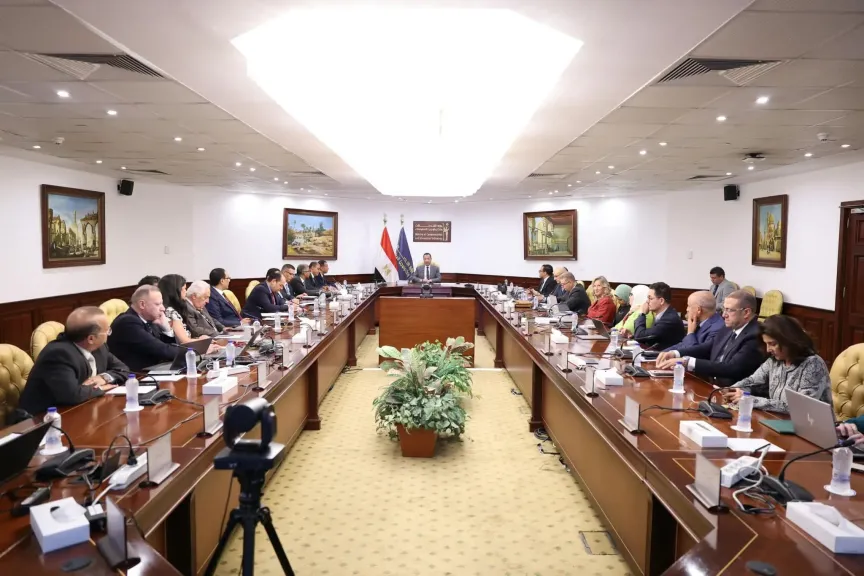
Egypt’s National Council for Artificial Intelligence, Quantum Computing, and Emerging Technologies has approved a report reviewing progress under the second edition of the National Artificial Intelligence Strategy 2025–2030 during the first half of 2026.
The meeting, chaired by Minister of Communications and Information Technology Raafat Hindi, focused on strengthening Egypt’s capabilities in artificial intelligence (AI) and quantum computing, developing responsible AI governance frameworks, and supporting the implementation of the national AI strategy.
Hindi highlighted efforts to expand public awareness and digital capacity-building programs in AI, increase Egypt’s participation in international AI forums, and strengthen cooperation with global technology companies through new partnerships and agreements.
He also emphasized efforts to attract investment in AI infrastructure and data centers, support technology localization, create specialized employment opportunities for young people, and encourage international companies to establish and expand AI-focused centers of excellence in Egypt.
The minister also highlighted several AI-powered applications developed by the Ministry of Communications and Information Technology’s Applied Innovation Center, including the large language model “Karnak,” the “Loghat” application for English-language learning, and the “Belmasry” platform, which offers speech-to-text, machine translation, and text-to-speech capabilities.
The council reviewed achievements across key areas of the National AI Strategy, including governance, technology and applications, data, infrastructure, the AI ecosystem, and capacity building. The achievements include the launch of the “Sia” educational application and an intelligent judicial assistant, as well as more than 40 AI applications across the government and banking sectors.
The meeting also addressed presidential directives concerning AI governance and responsible use of generative AI within government entities. The council further reviewed Egypt’s technical and coordination role in advancing AI cooperation at the Arab and African levels.
In addition, the council reviewed the main features of Egypt’s National Quantum Computing Strategy 2027–2030, which aims to establish an integrated, secure, and sustainable national ecosystem for quantum technologies. The strategy focuses on developing talent and scientific research, expanding access to supporting infrastructure, accelerating high-impact national applications, and promoting innovation across academia, government, and industry.
The council also discussed several AI governance tools, including guidelines for government procurement of AI systems and a policy for the responsible use of generative AI in government entities.
Another key initiative is the Egyptian Charter for Responsible Artificial Intelligence for Children, a national policy framework designed to govern AI systems affecting children in Egypt. The framework seeks to protect children from risks such as harmful content, exploitation, bias, and privacy violations, while using AI to support learning, creativity, inclusion, and equal opportunities.
The charter is based on the Egyptian Constitution, the Child Law, the Personal Data Protection Law, and relevant international agreements. It also emphasizes involving children in the design and evaluation of AI systems that affect them.
related topics
 Huawei Announces 'Service Day' in Egypt, Offering Free Repair Labor from October...
 Trump Replaces 'Artificial Intelligence' with 'Super Intelligence' in US Government Lexicon
 US and China Share Mounting Concerns Over Military AI Risks, Says The...
 NVIDIA CEO Jensen Huang Reveals the Strategy Behind His Signature Black Leather...
 Macron Launches Global Coalition for Child Protection in the AI Era at...
 Spanish PM Pedro Sánchez Urges AI Accountability for Impact on Minors at...
 Meta to Unveil Camera-Free Smart Glasses at Connect Conference Amid Privacy Scrutiny
 Australia Says OpenAI Agent Breached Government Health Data Portal in Potential Global...
 OpoFinance Rebrands to 'OPO' in the UAE, Unveils AI Trading Integration at...
 Egyptian Pound Holds Steady Against the US Dollar at Banks on Thursday
 Egypt’s ICT Minister Opens FDC Summit 2026, Witnesses Cybersecurity MoU Signing
 Egypt’s ICT Minister Reviews Plans for 80MW Kemet Data Center