


ICT Minister Raafat Hendy: Egypt Moves from AI Readiness to Impact as Data Center Push Accelerates
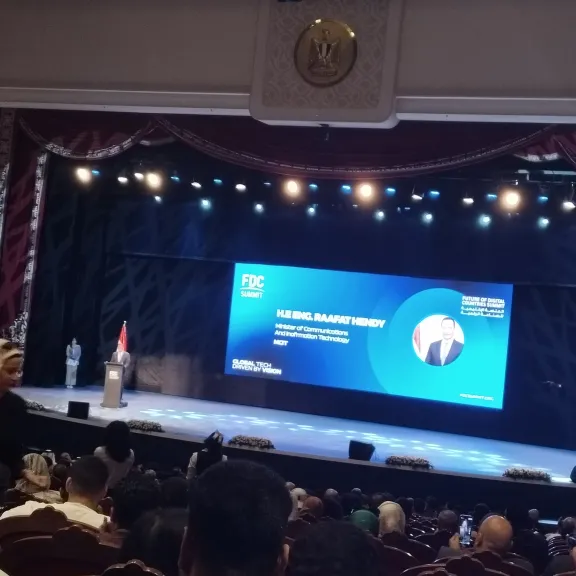
Egypt is moving into a new phase of its artificial intelligence strategy focused on turning technological readiness into measurable economic and social impact, Minister of Communications and Information Technology Raafat Hendy said on Tuesday.
Speaking at FDC Summit 2026, Hendy said the country’s digital strategy is increasingly centered on building a digital economy that creates jobs, transforms public services and strengthens digital sovereignty, particularly as AI becomes more deeply integrated into government and economic activity.
The minister said Egypt has made significant progress in AI readiness over recent years, advancing 59 positions in an international AI readiness ranking and reaching the top position in Africa.
The next stage, he said, is about “achieving impact,” as Egypt implements its national AI strategy through 2030 and expands the adoption of AI technologies across the economy and society.
Hendy said the strategy targets building an ecosystem of around 220 AI companies, while enabling 36% of citizens to use AI-powered tools by 2030.
Computing power becomes the next challenge
Egypt’s AI ambitions, however, will depend on more than software and talent.
Hendy said the next phase requires access to high-performance computing capacity, putting data centers at the heart of the country’s AI and digital economy plans.
He described data centers as a critical artery of the digital economy, supporting the continuity of government services while providing the computing infrastructure needed for AI and increasingly data-intensive digital applications.
The government is currently preparing a national data center strategy aimed at expanding domestic capacity and attracting investment into advanced digital infrastructure. The strategy is also expected to address future storage and computing requirements and strengthen Egypt’s ability to host and process data locally.
Hendy said around 20 submarine cables pass through Egypt, carrying international data traffic between Europe and Asia, giving the country a strategic advantage as it seeks to expand its role in the global data economy.
The government’s ambition is increasingly focused on extracting greater economic value from that connectivity by expanding data centers and data-processing capabilities, rather than relying solely on Egypt’s position as a transit route for international traffic.
That direction is consistent with the ministry’s recently stated goal of converting Egypt’s geographic position and international submarine cable network into greater capacity to host and process data, attract cloud providers and global technology companies, and serve local, regional and international markets.
Local AI and digital sovereignty
Hendy also highlighted Egypt’s push to develop homegrown AI technologies as part of its broader digital sovereignty agenda.
Among those initiatives is Karnak Chat, an Egyptian AI application developed as part of efforts to build local technological capabilities and reduce dependence on imported digital technologies.
The ministry has previously identified Karnak Chat alongside other locally developed AI applications as part of its digital sovereignty strategy.
Digital sovereignty, Hendy indicated, is increasingly linked not only to locally developed applications, but also to where data is stored and processed and whether Egypt has sufficient domestic computing infrastructure to operate critical digital and AI services.
Cybersecurity expands to emerging technologies
The rapid expansion of AI, data centers and digital government services is also reshaping Egypt’s cybersecurity priorities.
Hendy said the country is strengthening its cybersecurity capabilities to protect data, maintain business continuity and preserve trust in digital services, while preparing for new risks emerging from technologies including artificial intelligence and quantum computing.
The broader strategy reflects a shift in Egypt’s digital agenda: from expanding connectivity and putting government services online to building the computing, data and security infrastructure needed for an AI-driven economy.
Hendy said the ICT sector remains a government priority as its contribution to the economy continues to expand, with the sector recording growth of around 24%, according to figures cited by the minister during his FDC Summit address.