


Middle East Banking Innovation Summit 2026 Charts Banking’s Shift From Digitalization to AI
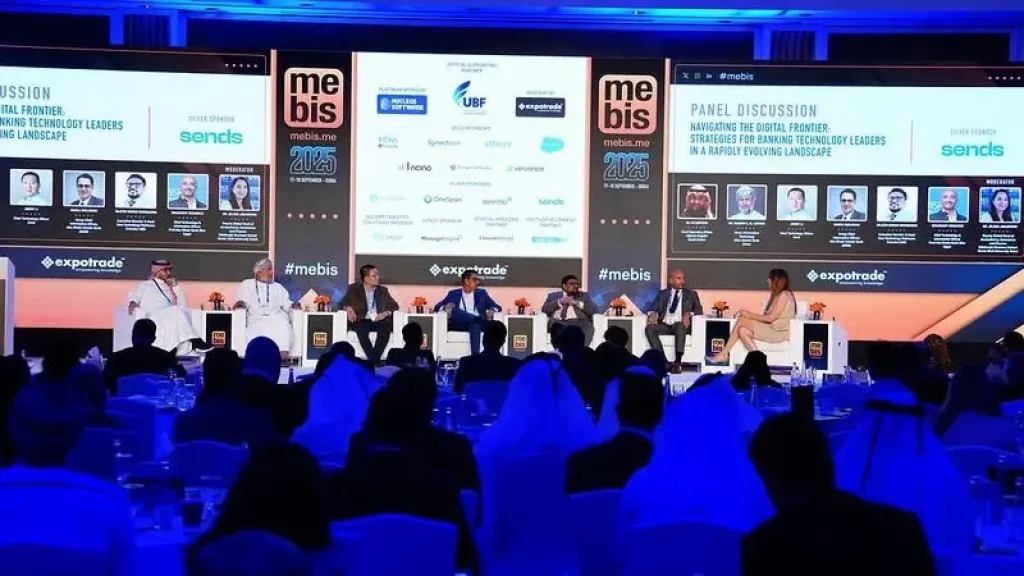
The Middle East Banking Innovation Summit 2026 (MEBIS) opened in Dubai on Wednesday with artificial intelligence taking center stage, reflecting a wider shift across the region’s banking industry from simply digitizing traditional services toward using AI to reshape how banks operate, manage risk and interact with customers.
Now in its 17th edition, the two-day summit is being held on September 16–17 at Jumeirah Emirates Towers, bringing together more than 400 banking executives, over 60 speakers and representatives from more than 100 banks, alongside technology companies and fintech specialists.
The agenda suggests that the next phase of banking transformation will look very different from the first. Mobile apps, online banking and digital payments are no longer the end goal. Banks are increasingly looking at how generative AI, agentic AI, intelligent automation and advanced data analytics can be embedded directly into everyday operations.
From digital banks to intelligent banks
For much of the past decade, digital transformation in banking centered on moving services from branches to smartphones, modernizing core systems and allowing customers to complete transactions remotely.
MEBIS 2026 reflects the next stage of that transition.
Discussions are moving toward AI systems capable of assisting employees, analyzing large volumes of financial data, automating complex workflows and creating more personalized interactions with customers.
The summit is placing particular emphasis on Generative AI and Agentic AI, including how autonomous or semi-autonomous AI agents could be deployed inside regulated financial institutions.
That represents a potentially bigger change than adding another digital channel. Instead of merely changing where a banking transaction takes place, AI could increasingly change how the work behind that transaction is performed.
AI is only as useful as the data behind it
The summit also highlights a less visible challenge facing banks: data.
Deploying sophisticated AI models requires institutions to improve data quality, governance, lineage and controls, particularly when algorithms are being used in areas connected to financial decisions.
That is why data strategy and governance feature alongside AI as one of the summit’s main themes.
The focus reflects growing recognition that banks cannot scale AI simply by purchasing new software. Their underlying technology architecture, data infrastructure and governance systems must also be prepared for it.
Cloud computing and system integration are consequently another major part of the 2026 agenda, as banks seek to connect legacy infrastructure with newer AI and digital platforms.
Cybersecurity becomes more critical as AI expands
The move toward more intelligent banking also creates new risks.
MEBIS 2026 is examining cybersecurity, fraud prevention and digital trust alongside AI adoption, with banks facing the challenge of accelerating innovation without weakening security or regulatory controls.
As more financial processes become automated and interconnected, cyber resilience is increasingly moving from an IT function to a core business requirement.
The same applies to responsible AI. Banks need mechanisms to determine how models reach conclusions, who is accountable for automated actions and where human intervention remains necessary.
The issue becomes particularly important as the industry explores AI agents capable of performing multi-step tasks rather than simply answering customer questions.
Payments and open banking enter the same ecosystem
AI is not the only technology reshaping banking.
The summit is also examining real-time payments, tokenization, instant settlement, open banking, embedded finance and APIs, reflecting the growing integration between traditional banks and wider digital ecosystems.
Instead of customers necessarily visiting a bank’s own digital platform, financial services can increasingly be embedded inside retail, technology and other third-party applications.
That changes the competitive landscape.
Banks are no longer competing only with other banks on branches, rates or mobile applications. They are increasingly competing over data, customer experience, ecosystem partnerships and the ability to integrate financial products into other digital services.
The next banking race is about intelligence
The composition of MEBIS 2026 provides a snapshot of how dramatically the banking technology conversation has changed.
Digital banking remains important, but it now sits alongside AI agents, intelligent automation, cloud architecture, data governance, cybersecurity, tokenization and embedded finance.
For Middle Eastern banks, the challenge is therefore moving beyond the question of whether services should be digital.
The emerging question is how much intelligence can safely be built into those digital services — and how much of a bank’s operations can ultimately be redesigned around AI.