


CIRA Education’s Saxony Egypt University Partners with Labour Ministry to Bridge Egypt’s Skills Gap
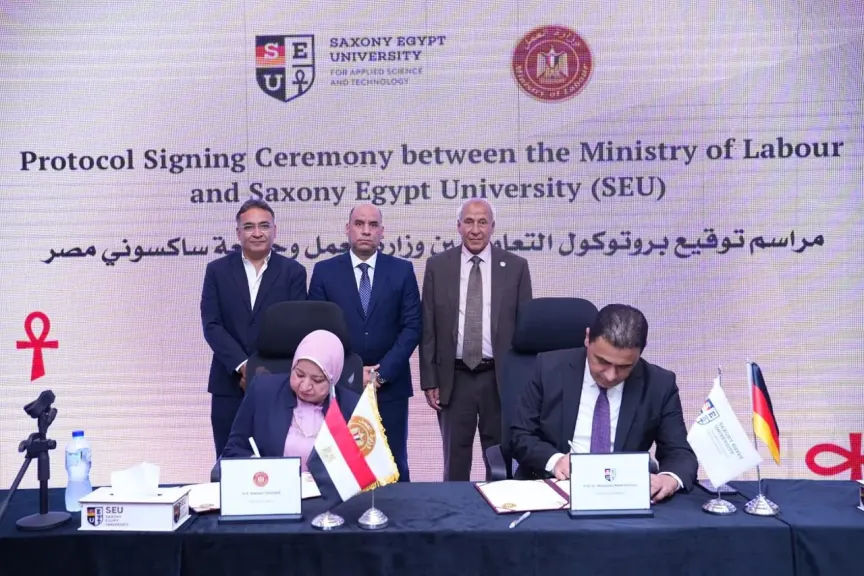
CIRA Education’s Saxony Egypt University for Applied Sciences and Technology (SEU) has signed a cooperation protocol with Egypt’s Ministry of Labour to expand access to applied technology education and vocational training, with programmes designed around the skills increasingly demanded by employers across key sectors of the Egyptian economy.
The agreement brings together the Ministry’s network of training centres and SEU’s industry-focused education model, creating new pathways for young people and professionals to acquire practical skills linked directly to employment opportunities.
The protocol was signed in the presence of Minister of Labour Hassan Raddad El-Mashad and senior representatives from both sides, as part of efforts to strengthen Technical and Vocational Education and Training (TVET) and develop a workforce capable of responding to changing labour-market requirements.
The partnership comes as Egypt continues to tackle a persistent mismatch between available skills and employers’ needs. Youth unemployment among people aged 15 to 24 stood at an estimated 18.3% in 2025, while industries ranging from manufacturing and mobility to services continue to seek candidates with specialised technical qualifications.
Under the agreement, the Ministry of Labour will identify and nominate eligible trainees and determine the level of financial support provided to them, while SEU will design and deliver the programmes, supervise training, conduct assessments and issue certificates accredited by both parties.
Training will take place at SEU’s campus as well as Ministry of Labour training centres, extending the university’s applied education model to a wider pool of learners. Around 60% of SEU’s curriculum is dedicated to practical training, reflecting the German dual-education approach on which the university’s academic model is based.
One of the partnership’s early priorities will be developing a dedicated training centre for the electric vehicle trade, responding to the growing need for specialised technical capabilities as mobility technologies evolve.
From classrooms to real-world skills
SEU opened its doors to students in September 2024 with a focus on narrowing the gap between academic education and the practical capabilities required by industry. The university has since developed partnerships with academic institutions and industry players to bring employers closer to the education and training process.
The new protocol takes that model beyond the university campus by allowing SEU’s accredited instructors to deliver programmes through the Ministry’s training-centre network.
A joint committee will oversee implementation and regularly identify the skills and specialisations most needed by employers, determine trainee numbers, develop course content and review programme performance. This structure is intended to allow training programmes to evolve as industries and workforce requirements change.
“At CIRA Education, we believe education creates the greatest impact when it connects directly to opportunity,” said Dr. Hassan El Kalla, Chairman of CIRA Education.
“This protocol reflects that principle in practice, extending our applied learning model beyond the University’s campus and into the Ministry’s own centres, and it underscores our long-term commitment to supporting Egypt’s workforce development agenda,” he added.
Mohamed El Kalla, CEO of CIRA Education, said the agreement takes an existing relationship with the Ministry of Labour to a more practical and scalable level.
“By combining the Ministry’s reach and insight into workforce needs with CIRA’s experience in applied education, we can create pathways that support young people and working professionals alike, while advancing Egypt’s national priorities for technical and vocational education,” he said.
An industry-driven training model
Dr. Mohamed Abdel-Rahman, President of Saxony Egypt University, said SEU was established around the principle of bridging education and industry, with students spending much of their time in workshops and laboratories rather than relying predominantly on classroom instruction.
“This protocol gives that mission a practical framework beyond the University’s campus,” Abdel-Rahman said. “We will bring to the Ministry’s centres our instructors, our equipment standards, and an industry-aligned training model that employers recognise.”
Rüdiger School, President of SIS Middle East, said building practical and STEM capabilities at earlier stages of education can create a pathway that ultimately translates into stronger employment prospects.
“Preparing young people for the future starts long before university,” he said. “At Saxony International School, we build the foundations in applied learning and STEM that make partnerships like this possible later on.”
The joint committee is expected to begin identifying the first priority specialisations, setting admission criteria and finalising the training schedule ahead of the first intake.
SEU is part of CIRA Education’s higher education platform and was established through Al Ahly CIRA, a joint venture between CIRA Education and Al Ahly Capital Holding. Founded under Presidential Decree No. 308 of 2024, the university follows an applied education model developed in cooperation with institutions and industry partners in Saxony, Germany.
CIRA Education currently serves more than 73,000 students through 30 schools and three universities across nine Egyptian governorates, while its higher education platform includes 32 faculties across Badr University in Cairo, Badr University in Assiut and Saxony Egypt University.