Egypt Seeks Deeper Partnership with India Across Digital Technology, Industry and Infrastructure
Egypt is looking to broaden its economic engagement with India through stronger investment partnerships, industrial integration, and expanded cooperation in technology and infrastructure.
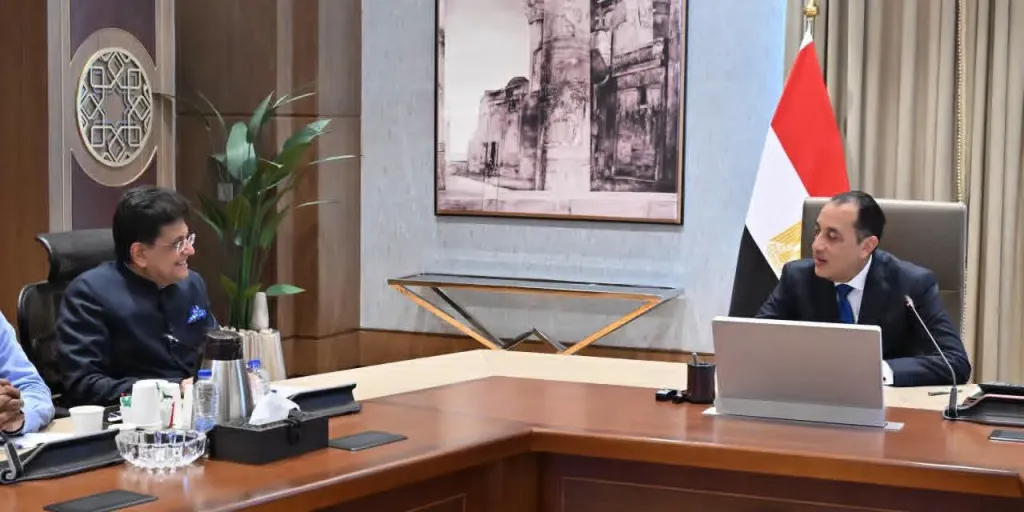
The issue was discussed during a meeting between Egyptian Prime Minister Mostafa Madbouly and Indian Commerce Minister Piyush Goyal in Egypt's New Administrative Capital, attended by Investment and Foreign Trade Minister Mohamed Farid and representatives of the two countries.
The talks focused on translating the political momentum between Cairo and New Delhi into practical business opportunities and new joint investments.
Egypt Looks to Double Trade with India
Madbouly said economic relations between the two countries have gained further momentum since Egypt and India established a strategic partnership in 2023.
Bilateral trade stood at around $6.6 billion in 2025, and Egypt aims to raise it to approximately $12 billion in the coming years.
The prime minister added that Indian investments in Egypt currently total around $4.5 billion, stressing that the government is prepared to support existing investors and facilitate the entry of new Indian businesses.
Major Indian Investors Support Egypt's Industrial Sector
The Egyptian prime minister cited TCI Sanmar, Aditya Birla, and Uflex as examples of Indian companies that have established significant industrial operations in Egypt.
He noted that chemical and petrochemical industries account for a substantial portion of Indian investments, while highlighting opportunities to diversify cooperation into additional manufacturing activities.
He also reaffirmed the government's commitment to improving the business environment, updating regulatory frameworks, and facilitating investment procedures.
Digital Technology and Automotive Manufacturing Offer New Opportunities
Both countries identified several sectors with strong potential for expanded cooperation, including information and communications technology, pharmaceuticals, healthcare, food security, renewable energy, textiles, automotive manufacturing, and chemical industries.
Madbouly emphasized that stronger industrial integration would allow both sides to benefit from their respective economic strengths.
He also highlighted Egypt's geographical and trade advantages, describing the country as a gateway for Indian companies looking to expand into African and Middle Eastern markets.
Suez Canal Zone Could Host Dedicated Indian Investments
Egypt has welcomed discussions on allocating an industrial area for Indian companies within the Suez Canal Economic Zone.
The proposed initiative would provide Indian investors with access to Egypt's strategic location and developed infrastructure, while supporting the establishment of new industrial projects.
The two sides also discussed cooperation between Egypt's Sovereign Fund and India's National Investment and Infrastructure Fund (NIIF), with the aim of expanding institutional investment partnerships and financing projects of mutual interest.
India Seeks Broader Cooperation in Infrastructure and Clean Energy
Indian Commerce Minister Piyush Goyal emphasized the significant untapped potential in economic relations between the two countries.
He proposed identifying priority sectors through specialized working groups and organizing reciprocal trade delegations to connect Egyptian and Indian businesses.
Areas under consideration include port development along the Suez Canal, shipbuilding, railway projects, infrastructure development, renewable energy, and green hydrogen production.
The minister also highlighted opportunities in automotive manufacturing, tourism, and the exchange of expertise in museum development and management.
Preferential Trade Deal Under Consideration
During the meeting, Mohamed Farid presented the outcomes of discussions held with several Egyptian ministries, highlighting agreements to establish joint working groups to examine new mechanisms for advancing bilateral trade and investment.
The discussions also addressed potential Indian investments in real estate development, tourism, and hotel management, alongside proposals for a specialized Egyptian-Indian investment zone.
Both sides concluded by agreeing to work toward a more ambitious framework for bilateral trade and examine the possibility of a preferential trade agreement, while continuing coordination through the Joint Trade Committee and the Egyptian-Indian Business Forum.
related topics
 Egypt Targets Greater Chinese Investment in Technology and Digital Transformation
 MCIT and Ministry of Higher Education Partner to Launch ”Athar” Initiative to...
 Smart Trade and Integrated Logistics Solutions: 7X Showcases the Future of Fintech...
 Strategic Partnership Between Mastercard and Bank of Jordan to Lead Digital Transformation...
 Egypt University of Informatics Prepares to Launch International-Standard Master's Program in Digital...
 Commercial International Bank (CIB) Appoints Yasser Abdellah as Chief Executive Officer of...
 Korra Reports EGP 5.09 Billion in Revenue for the First Nine Months...
 Partnership Between Egyptian Microfinance Federation and ”MHE” to Enhance Cybersecurity and Technological...
 ADIB-Egypt Named ”Best Islamic Financial Institution in Egypt 2026” for the Ninth...
 With the Participation of 10 Countries.. NTRA Organizes a Training Program on...
 AVEVA recognised as a finalist of 2026 Microsoft Sustainability Changemaker Partner of...
 UAE’s Presight Invests in South Korea’s Dtonic to Advance Smart City and...