


Strategic Partnership Between Agricultural Bank of Egypt and GIZ to Boost Agricultural Innovation and Support Smallholder Farmers in Upper Egypt
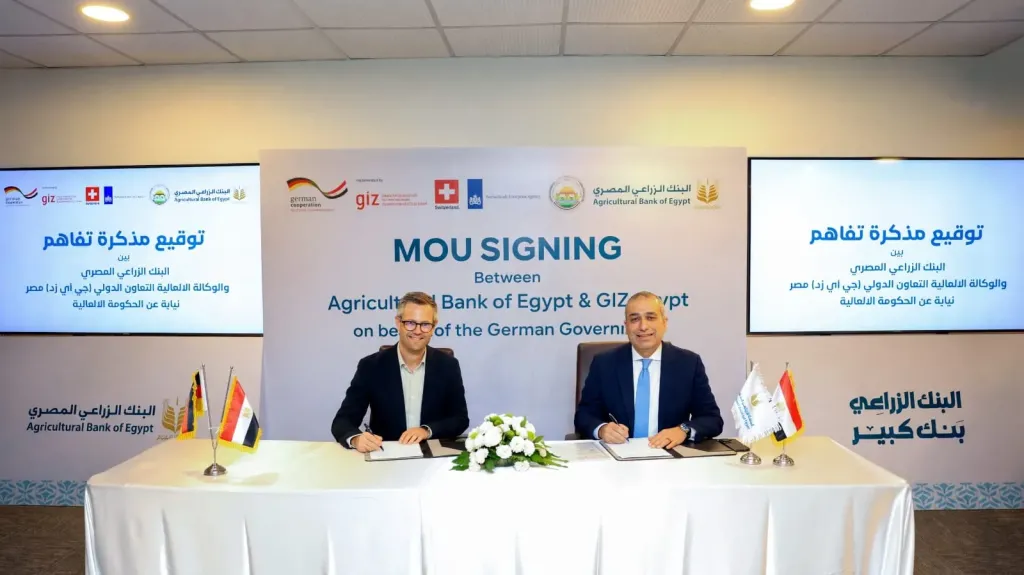
The Agricultural Bank of Egypt (ABE) and the Deutsche Gesellschaft für Internationale Zusammenarbeit (GIZ Egypt), acting on behalf of the German Government, have signed a joint cooperation agreement to enhance financial and technical services under the second phase of the Agricultural Innovation Project (AIP). The initiative aims to boost production capacities, improve the income of smallholder farmers in Upper Egypt, and promote sustainable agricultural development and financial inclusion in rural communities.
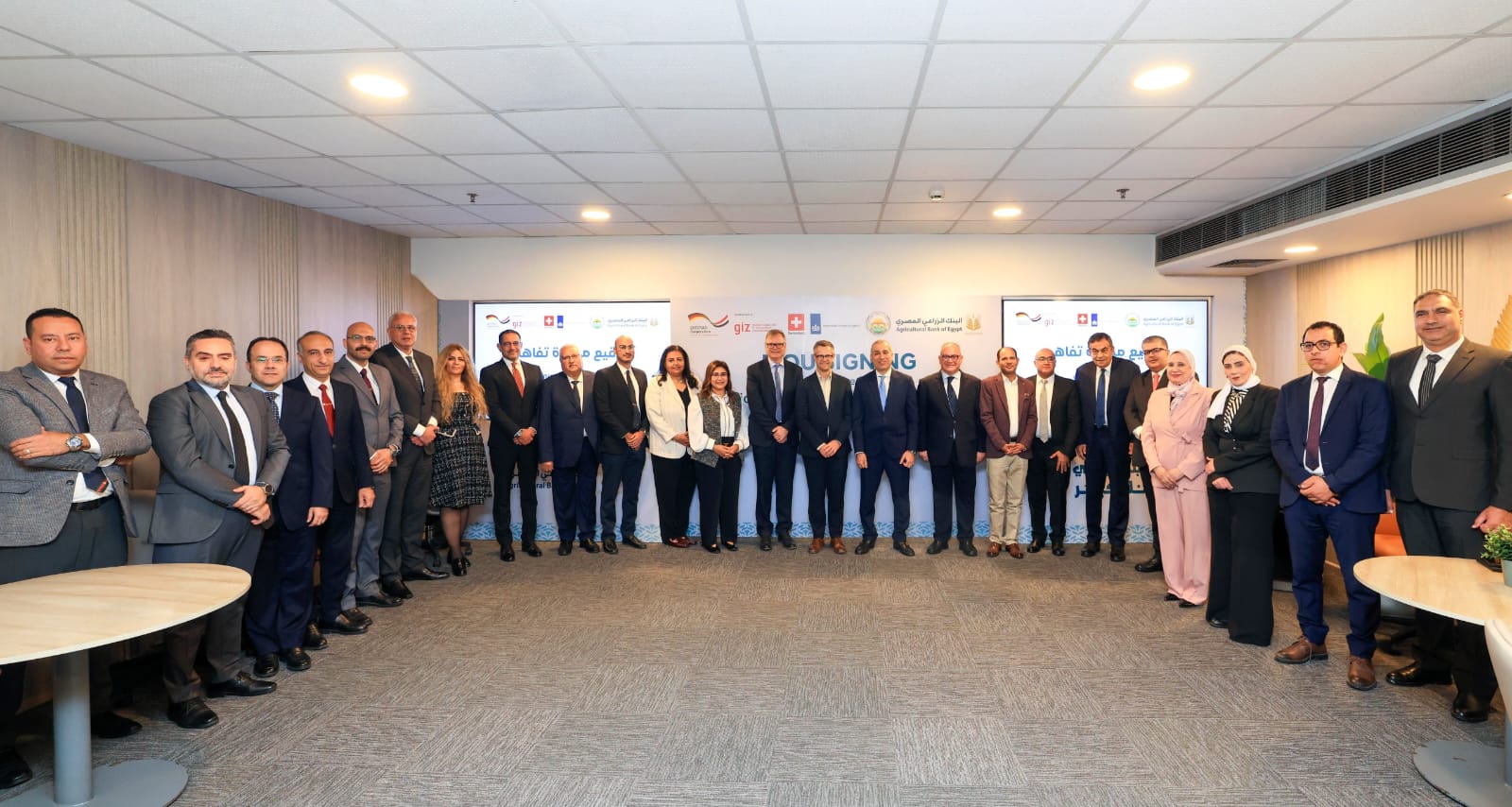
The agreement was signed by Mohamed Abou El-Soud, CEO of the Agricultural Bank of Egypt, and Andreas Rupp, Deputy Country Director of GIZ Egypt. The signing ceremony was attended by Sami Abdel-Sadek, Deputy CEO of ABE; Sherif Mahrous, Head of Sustainability and Sustainable Finance at ABE; Tarek Abou Bakr, Head of the Medicinal and Aromatic Plants Division at the Agricultural Export Council; and Dr. Youssef El-Adawy, representing the Ministry of Agriculture. A high-level delegation from GIZ also attended, including Steffen Schmidt, Head of the Agricultural Innovation Project (AIP); Mohamed Nabil, Deputy Project Manager; Nihal Hassan; Hassan El-Badawy; and Nahir Khairy.
High-Return Crops and Innovative Financing Solutions
The agreement seeks to introduce innovative financing solutions that support agricultural value chains for high-market-value crops, with a particular focus on medicinal and aromatic plants, onions, garlic, peppers, sesame, and tomatoes. Support also extends to startups and micro, small, and medium enterprises (MSMEs) operating in the agricultural sector by integrating technical assistance with specialized financing to promote Good Agricultural Practices (GAP) and climate change adaptation.
Ambitious Targets to Enhance Farmer Income and Productivity
Implemented as part of the Ministry of Agriculture and Land Reclamation’s ongoing efforts in cooperation with GIZ—and co-financed by the Swiss and Dutch governments—the Agricultural Innovation Project outlines clear targets, including:
Increasing the average income of approximately 6,000 smallholder farmers by up to 20%.
Boosting the productivity of 8,600 farmers through the adoption of innovative agricultural methods.
Supporting the growth of 98 agricultural companies and enterprises, while expanding climate-smart agriculture across thousands of feddans.
Encouraging land consolidation, optimizing resource efficiency, and strengthening credit risk management.
Integrating Technical Training with Banking Finance
Under the terms of the partnership, the Agricultural Innovation Project will nominate farmers who have completed its technical training programs to access ABE’s financing services, while providing technical expertise to tailor financial products to agricultural production cycles. In turn, the Agricultural Bank of Egypt will develop specialized credit products, conduct financial literacy programs, and train farmers on digital banking services and feasibility study preparation.
Leadership Vision from ABE and GIZ
Mohamed Abou El-Soud, CEO of the Agricultural Bank of Egypt, emphasized that genuine agricultural development requires an integrated ecosystem combining finance, knowledge, and technology. He noted that this partnership strengthens smallholder farmers' resilience against climate challenges, helps them meet local and global market standards, and creates economic opportunities to empower women and youth while advancing rural digital transformation.
Sherif Mahrous, Head of Sustainability and Sustainable Finance at ABE, stated that the partnership delivers a comprehensive package of financial, advisory, and capacity-building services, enhancing value chain efficiency in sectors with promising export potential.
For his part, Andreas Rupp, Head of Cluster Business & Green Transformation at GIZ Egypt, noted that facilitating access to tailored financing opens broader horizons for farmers to invest and achieve sustainability. He expressed his pleasure in partnering with ABE, highlighting its deep-rooted presence and extensive branch network across Egypt as key assets in turning these efforts into tangible results on the ground.
related topics
 NBE and ”Edina Ma'a Ba'ad” Launch Partnership to Empower 1,000 Amputees in...
 Egypt Post Signs Cooperation Protocol with MSME Finance Federation to Expand “Bareedy”...
 Financial Inclusion and Non-Bank Finance in Egypt: Digital Wallets, Online Lending and...
 Chaired by Dr. Islam Azzam, IOSCO’s GEMC approves 3 projects for 2027...
 Egypt's Digital Payments Future: InstaPay, Meeza and Card Tokenization Transform Consumers, Merchants...
 Credit Agricole Egypt Launches “Good News Today, Gold Tomorrow” Campaign with Returns...
 Allianz Egypt Launches Sharia-Compliant Gold Investment Portfolio in Partnership with Evolve Holding
 Central Bank of Egypt Enables Payment Card Tokenization on Android Devices
 Minister of Investment: 55 New Companies Enter Export System with $11M in...
 Investment Minister and Beni Suef Governor Witness Signing of 3 Protocols to...
 Egypt's Digital Banking Market Set for Three New Entrants: What Will onebank,...
 Souhoola Expands Alternative Data Analytics to Boost Financial Inclusion and Insures Customers...
