


Huawei Earns World’s First L4 Certification for Grid-Forming Energy Storage
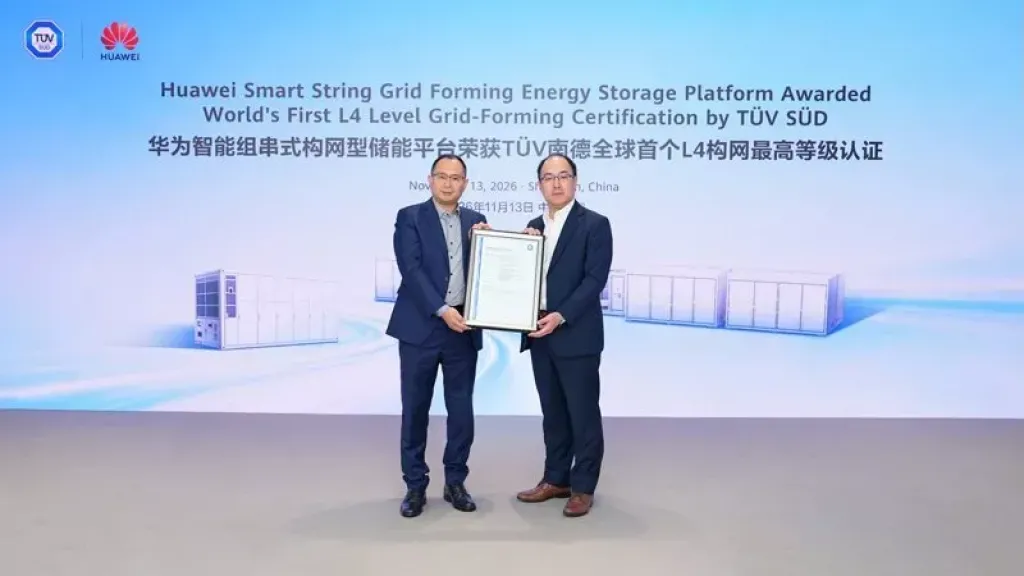
Huawei’s smart string energy storage platform with grid-forming technology has received the world’s first L4 certification, the highest level in the grid-forming capability classification, from Germany-based TÜV SÜD.
On Wednesday, November 25, 2026, TÜV SÜD announced the release of a detailed technical report assessing the capabilities and performance of grid-forming energy storage units and systems, alongside the certification of Huawei’s platform. The milestone advances the evaluation of energy storage technologies and their contribution to power grid stability.
Grid-Forming Technology and Modern Power Systems
The certification comes as renewable energy sources and power electronics become increasingly integrated into electricity networks, creating greater demand for technologies that can help maintain grid stability.
These capabilities include voltage and frequency support, inertia provision, and the mitigation of power oscillations—services traditionally provided mainly by synchronous generators.
Grid-forming energy storage systems combine electricity storage with active grid-support functions, expanding their role from energy storage units to important resources for modern power systems.
TÜV SÜD’s Five-Level Grid-Forming Classification
The report introduces a five-level framework, ranging from L0 to L4, to assess how devices and power stations contribute to grid support. The classification considers support capabilities, dynamic performance, technical verification, and the ability to improve grid resilience.
L0 represents conventional grid-following systems, which rely on an external grid reference and cannot independently establish the grid.
L1 covers local voltage-forming capabilities and voltage support, while L2 adds functions designed to strengthen regional grid resilience, including operation in weak grids and fault response.
L3 provides broader grid-forming capabilities under specified operating conditions, including inertia, frequency support, islanded operation, and basic black-start capability, while still requiring support from a limited number of synchronous generators.
L4: Advanced Grid Support and System Restoration
L4 is the highest classification level. In addition to the capabilities of lower levels, it includes damping wide-area oscillations, coordination among multiple energy storage units, and full system restoration.
The level focuses on voltage and frequency support, system resilience, fault response, advanced independent black-start operation, and seamless transitions between grid-connected and islanded modes. It also requires the ability to ride through faults while operating in islanded mode.
Huawei’s certification confirms that its platform meets L4 requirements for power system support, dynamic stability, and coordinated restoration.
Performance-Based Certification for Energy Storage
The certification marks a shift from checking whether specific technical functions are available to evaluating actual system performance against independently verifiable and testable criteria.
The assessment also extends beyond individual devices to the performance of complete energy storage stations. It covers grid-forming capabilities, voltage and frequency support, system strength, and fault response.
By measuring response speed, support levels, and operating limits, the report establishes a unified framework for comparing different technologies and assessing their suitability for modern electricity networks.
related topics
 Huawei and IPv6 Forum Launch African Initiative to Strengthen Telecom Network Security...
 Huawei Introduces 3 Smart Factories and a Hybrid Infrastructure to Advance AI...
 Huawei Overtakes Nvidia in China’s AI Chip Sales
 Egyptian Healthcare Authority Discusses Strategic Health Partnerships with Norwegian Ambassador
 Huawei Sells More Than One Million FreeClip Earbuds Across the Middle East...
 Egypt Signs $650 Million Contracts for 500MW Amunet 2 Wind Power Project
 Egypt Seeks Deeper Partnership with India Across Digital Technology, Industry and Infrastructure
 Egyptian Photographer Omar El-Tahan Named Among Top 100 in Huawei XMAGE Awards...
 Korra Reports EGP 5.09 Billion in Revenue for the First Nine Months...
 Huawei Unveils Official Design of Foldable Mate X8 Amid Anticipation Over Tech...
 Finance Minister Discusses Enhancing International Partnerships and Localizing Renewable Energy and Water...
 Huawei Leads the Future of AI and 6G in Qatar Through Its...
