


EBRD-Led Financing Backs Egypt’s Largest Solar Power Project with Battery Storage
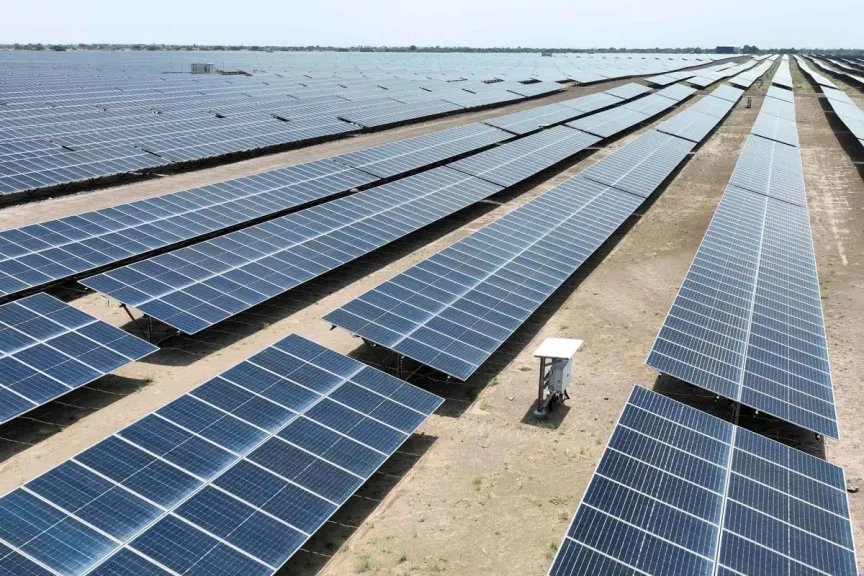
A consortium of development lenders led by the European Bank for Reconstruction and Development (EBRD) has committed up to $566 million in debt financing for the Nefr Minya renewable energy project in Egypt, supporting the development of a 1.2 GWp solar power plant equipped with a 600 MWh battery energy storage system.
The project, developed by Infinity Power and HA.U.N. Energy, is set to become the largest solar-plus-storage facility of its kind in Egypt and Africa.
The total project cost is estimated at $764 million, with debt financing covering nearly three-quarters of the investment. The remaining approximately $198 million will be provided through equity contributions.
$265 Million EBRD Financing Package
The EBRD’s financing package includes up to $265 million, comprising a $160 million A/B loan from the bank’s own resources, a $75 million B-loan provided by Bank of Jordan, and up to $30 million in concessional financing from the Climate Investment Funds’ Clean Technology Fund.
The remaining portion of the $566 million financing package will be provided by the German Investment Corporation, the Dutch Entrepreneurial Development Bank and Proparco, the development finance arm of France’s development agency.
The EBRD had previously disclosed plans for a $170 million senior loan for the project before the final syndicated financing structure was established.
In July, HA.U.N. Energy also secured a separate $30 million financing facility from the Africa and Asia Infrastructure Fund, which the company said would primarily support the Minya project and could contribute toward its equity investment.
Infinity Power and HA.U.N. Energy Lead Project Ownership
Infinity Power, a joint venture between Masdar and Infinity Energy, holds a 51% stake in Nefr Minya Renewable Energy, while HA.U.N. Energy owns the remaining 49%.
Based on the ownership structure, Infinity Power’s equity contribution is estimated at around $101 million, compared with approximately $97 million from HA.U.N. Energy.
The EBRD also holds interests in both platforms, giving it exposure to the project beyond its lending role.
Solar Power Combined with Large-Scale Battery Storage
The project will include a 1.2 GWp solar photovoltaic facility, equivalent to around 1 GW of alternating-current capacity, alongside a 600 MWh battery storage system.
The batteries will store electricity generated during daylight hours and release it during the evening peak-demand period, allowing the project to provide a more flexible source of power to Egypt’s electricity grid.
The plant will sell its electricity to the Egyptian Electricity Transmission Company under a 25-year power purchase agreement signed in November 2025.
According to the project sponsors, the facility is expected to avoid more than 1.5 million tonnes of carbon dioxide emissions annually and provide electricity for more than 1.4 million homes.
Commercial operations are scheduled to begin on September 30, 2027, after the project received Egypt’s golden license in August.
Nefr Minya Part of a Broader Solar-and-Storage Expansion
The Minya project is being developed alongside the Nefr Benban solar project near Aswan, which has a capacity of 200 MW and a 120 MWh battery storage system.
The Benban facility had been scheduled to enter commercial operations during the third quarter of 2026, although there has been no official confirmation that it reached commercial operation by the September 30 target.
Together, the two projects would provide approximately 1.2 GW of AC generation capacity and 720 MWh of battery storage.
Battery Storage Becomes Central to Egypt’s Solar Strategy
The Nefr Minya project highlights a broader shift in Egypt’s renewable energy strategy, with battery storage increasingly becoming an integral part of large-scale solar developments.
The project combines 1.2 GWp of solar capacity with 600 MWh of storage, enabling electricity generated during the day to be shifted toward periods of higher evening demand.
The development also reflects the growing importance of long-term, dollar-denominated power purchase agreements in supporting renewable energy investments in Egypt.
Egypt aims to increase the share of renewable energy in its electricity mix to 42% by 2030, while continuing to expand solar generation despite peak electricity demand increasingly occurring after sunset.
related topics
 QNB Egypt’s Assets Surge 236% in Five Years to EGP 1.113 Trillion
 Housing and Development Bank Launches Breast Cancer Awareness Initiative with Baheya Foundation
 Digital Banks in Egypt: How Will They Transform Everyday Financial Transactions?
 How to Invest in the Egyptian Stock Market With EGP 100 Using...
 InstaPay Egypt Guide: Transfer Limits, Security Tips and How to Handle Wrong...
 CBE Leads Regional Initiative to Embed Climate Risks in COMESA Central Bank...
 Zilla Capital Advises ATCO Pharma on Strategic Investment by RMBV’s RNAF III...
 Huawei Cloud and Fixed Solutions Partner to Launch the Personal Data Protection...
 Egypt and Talaat Moustafa Group Ink 11 Trillion EGP Deal for Four...
 Egypt Customs Introduces New Nafza Platform Requirements for Electronic Authorizations
 Gold Prices Climb in Egypt as 21-Karat Hits EGP 6,320 per Gram
 US Dollar Holds Steady Against Egyptian Pound at Banks Before Wednesday Trading