


FIFA Projects Record $15 Billion-Plus Revenue for 2023–2026 Cycle Driven by Expanded 2026 World Cup
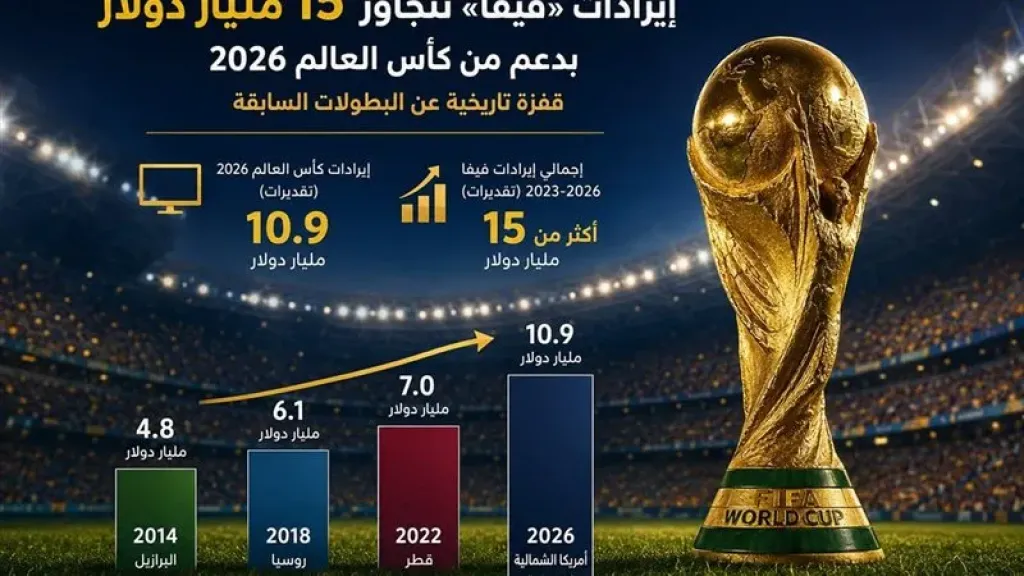
The International Federation of Association Football (FIFA) has achieved a historic surge in revenues, powered by robust commercial growth across its global competitions, led by the 2026 FIFA World Cup. Aggregate revenues for the 2023–2026 financial cycle are expected to surpass $15 billion—a record milestone reflecting the rapid commercial expansion of the global football industry.
An Expanded World Cup
This financial surge follows the expansion of the 2026 World Cup, hosted jointly by the United States, Canada, and Mexico. For the first time in history, the tournament will feature 48 national teams and 104 matches, significantly broadening FIFA's commercial scope across media broadcasting, corporate sponsorship, marketing, ticketing, and hospitality, while tapping into the high-value North American sports and entertainment market.
Infantino: Overall Cycle Revenue to Cross $15 Billion
FIFA President Gianni Infantino confirmed that the governing body expects total cycle revenues to cross the $15 billion mark, marking a new benchmark for the commercial valuation of FIFA-organized tournaments.
Clarification: The $15 billion figure represents FIFA’s total revenue across the entire four-year financial cycle (2023–2026), rather than income generated exclusively by the 2026 World Cup. The total encompasses commercial rights and operations from multiple events, including the 2023 FIFA Women's World Cup and the 2025 FIFA Club World Cup, alongside other institutional revenue streams.
Historical Revenue Growth
FIFA initially budgeted its 2023–2026 cycle target at approximately $11 billion—itself a major increase over previous periods—before revised commercial outcomes indicated revenues could top $15 billion.
This financial trajectory reflects steady multi-cycle growth:
2011–2014 Cycle: ~$5.7 billion
2015–2018 Cycle: ~$6.4 billion
2019–2022 Cycle (Qatar World Cup): $7.57 billion
Reaching more than $15 billion in the current cycle means FIFA’s revenue will have effectively doubled compared to the financial cycle preceding the 2022 Qatar World Cup.
The World Cup as the Primary Engine
The World Cup remains FIFA's principal revenue driver, with media rights, commercial sponsorships, licensing, ticketing, and hospitality constituting the primary income streams. The expansion from 32 to 48 teams and 64 to 104 matches provides a vastly larger inventory of live sports content for broadcast partners and global sponsors.
In this context, a specialized industry study projects that revenues directly generated by the 2026 World Cup alone could reach $10.9 billion—a 56% increase compared to the 2022 World Cup in Qatar (estimated at ~$7 billion).
The study estimates:
Broadcasting Rights: Projected to exceed $4.2 billion.
Commercial Sponsorships: Projected to top $2.8 billion.
Note: These tournament-specific estimates remain separate from FIFA's overall multi-event financial cycle revenue.
Digital Streaming Drives Media Rights Valuation
The ongoing digital transformation of sports broadcasting has played an increasingly vital role in bolstering the World Cup's commercial value, even as FIFA has not disclosed standalone figures for digital streaming alone.
According to FIFA’s 2026 budget allocations:
Broadcasting & Media Rights Target: $3.925 billion
Share of Annual Budget: Represents roughly 44% of the total $8.911 billion budgeted annual revenue.
This media allocation spans all delivery formats, including traditional linear television, OTT streaming services, and digital platforms. FIFA's expanding partnerships with digital-first media outlets mirror global shifts in sports consumption toward mobile devices, live-streaming apps, and digital platforms.
related topics
 Spain Secures Historic 2026 World Cup Title and Record-Breaking $50 Million Prize...
 e& Egypt Celebrates Egypt National Team’s Historic FIFA World Cup Achievement
 Orange Egypt Offers Free Mobile Internet to Celebrate Egypt's Historic FIFA World...
 Salah Masterclass Leads Egypt to a Stunning 3-1 Comeback Against New Zealand...
 talabat Egypt Launches “Predict and Feast”, Turning FIFA World Cup 2026™️ Match...
 beIN SPORTS Unveils Largest-Ever World Cup Broadcast Team for FIFA World Cup...
 Kaspersky Audit Reveals 17% of Public Wi-Fi Networks Insecure Across Mexico’s FIFA...
 TikTok Emerges as Primary Digital Hub for Football Fan Engagement Ahead of...
 Spotify Shares Surge 13% on Universal Music AI Partnership and Ambitious 2030...
 beIN Media Group Rebrands Streaming Service to ”TOD by beIN” Ahead of...
 Kia Drives Global Football Heritage with Premium Mobility Support for the FIFA...
 EGBANK Becomes Official Banking Sponsor of Egypt Padel Tour 2026