


Egypt’s Ministry of Justice Partners with I-Score and Community to Digitize Alimony Enforcement and Legal Claims
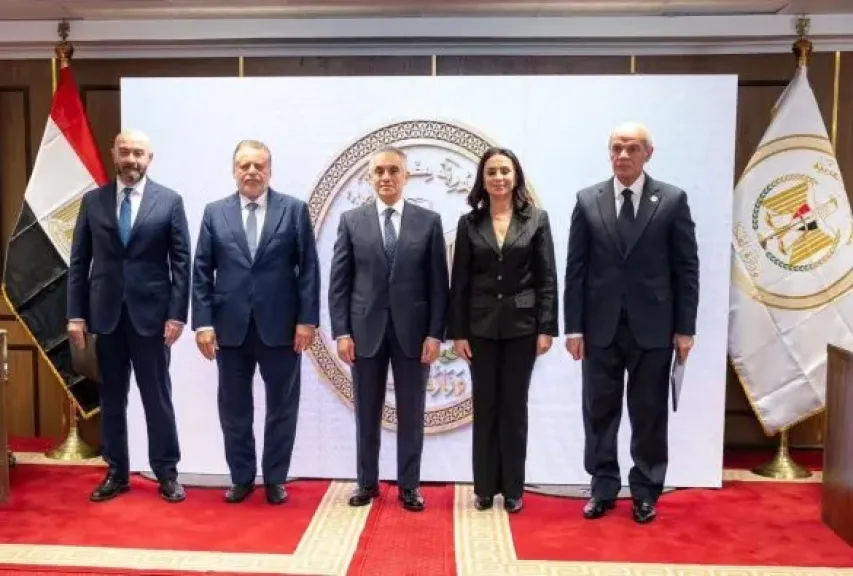
The Egyptian Ministry of Justice has officially signed two milestone cooperation protocols aimed at establishing a secure institutional framework for digital data exchange and automated judicial notifications. The initiatives are designed to accelerate the execution of alimony (نفقة) rulings, streamline the collection of state judicial fees, and protect public funds.
The signing ceremony was witnessed by Counselor Mahmoud Helmy El-Shareef, Minister of Justice, alongside Hassan Abdalla, Governor of the Central Bank of Egypt (CBE); Dr. Maya Morsi, Minister of Social Solidarity; and Counselor Amal Ammar, President of the National Council for Women (NCW).
The I-Score Protocol: Asset Visibility and Credit Penalties
The first protocol, signed with the Egyptian Credit Bureau "I-Score," grants family courts instantaneous, real-time tracking of defendants' assets to ensure precise and fair alimony assessments. Furthermore, individuals with final, unexecuted alimony judgments or outstanding state judicial fees will be officially listed on I-Score’s credit registry as clients with active legal disputes. This integration directly impacts their creditworthiness and limits their access to banking and credit facilities.
Conversely, the protocol allows I-Score to safely cross-reference data from protesto rulings, economic court judgments, negative bankruptcy certificates, and real estate registry (Shahr El-Akary) authentications, strictly operating under the confidentiality laws dictated by the Central Bank of Egypt.
The "Community" Protocol: SMS Judicial Notifications
In a parallel move, the Ministry partnered with "Community," a digital telecommunications solutions firm, to revolutionize judicial notifications. Coordinated directly with the National Telecom Regulatory Authority (NTRA), the system bypasses traditional paperwork by sending instant, legally binding SMS text alerts to individuals facing judgments, urging them to settle out-of-court or reconcile with Nasser Social Bank.
Digital Enforcement Tracking Statistics:
Execution Phase / CategoryCurrent Data ScopeOperational / Legal Action
Phase 1: Alimony Evasion5,122 active cases linked to 7,214 mobile numbersImmediate SMS notification deployment prompting immediate settlement.
Phase 2: Unpaid Judicial Claims~103,000 pending cases currently being compiledIntegration into the automated notification pipeline to reclaim state treasury funds.
Legal ConsequencesNationwide across all mobile operatorsFailure to respond triggers suspension of select government and banking services.
Executive Insights:
Hassan Abdalla, Governor of the CBE: "This integration allows banks to evaluate creditworthiness with unrivaled precision. Ensuring data symmetry between the financial and judicial sectors safeguards the banking system, protects public treasury funds, and stabilizes the national economy."
Mohamed Korayem Ghannam, CEO & Managing Director of I-Score: "Information integration between state bodies is a major leap forward for judicial efficiency. Relying on verified, secure digital data balances swift administrative execution with the absolute protection of citizens' rights."
Eng. Engy Sabban, Chairperson of Community: "The rapid technical integration of these platforms showcases a unified national vision. This project serves as a prime model for deploying modern communications technology in the service of public justice."
related topics
 LG and MBC Shahid Launch ‘Life’s Good Wayyak’ to Celebrate Gratitude Through...
 Egypt Gold Plummets 4.4% as Global Spot Tumbles to $4,068 Amid US...
 eYouth and Doroob Partner to Expand Digital Skills Training and Employment Opportunities...
 Uptime Through Maintenance: The Strategy Behind Banque Misr’s Forced Corporate Password Rotation...
 PRE Group and seven Partner to Deliver Integrated Home Financing, Finishing and...
 Damen Expands Nationwide Footprint for Smart Utility Payments, Facilitating Instant Water Card...
 Elevate Your Space with Valu's Exclusive Offers at Arkan Plaza
 *Raya Holding’s FutureTECH and AMAN Holding Partner with AUC Venture Lab to...
 Emirates NBD Launches Integrated 'Rewards Hub' via ENBD X App to Revolutionize...
 PIF’s HUMAIN Partners with NVIDIA to Deploy DRIVE Hyperion Platform for Level...
 Standard Chartered Expects Egypt’s Economic Growth to Accelerate to 4.7% in FY2027
 realme Launches 16 Series in Egypt, Bringing AI-Powered Photography and Flagship Performance...