


Dr. Nidal Abou Zaki Highlights AI’s Growing Impact on the Arab Private Sector During Al-Ahram Forum in Cairo
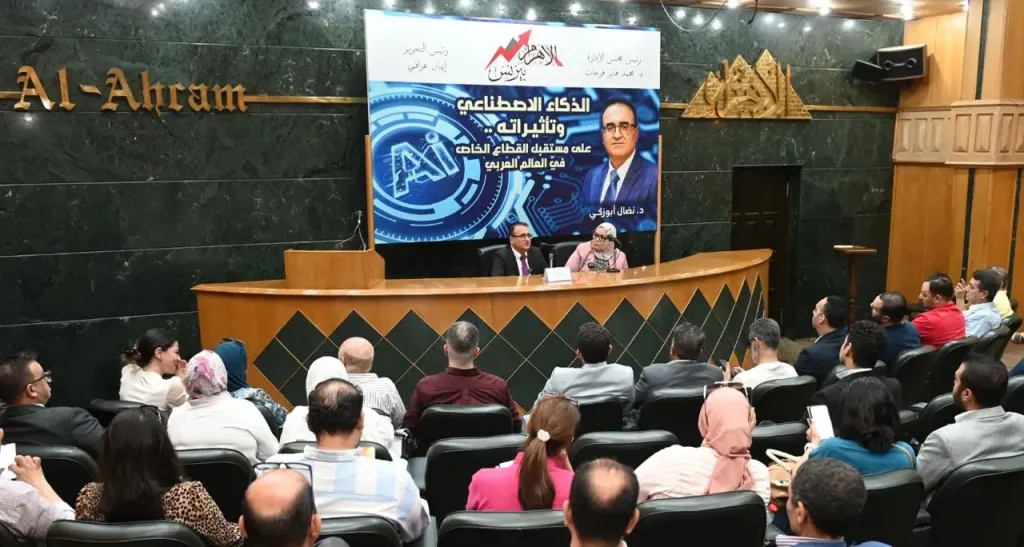
Artificial intelligence is becoming a decisive force reshaping the future of the private sector across the Arab world, fundamentally transforming business environments, economic competitiveness, institutional performance, and the future of work, according to Dr. Nidal Abou Zaki, Founder and Managing Director of Orient Planet Group (OPG), during a high-level forum hosted at Al-Ahram Establishment in Cairo.
The seminar, held at Al-Ahram’s headquarters, brought together business leaders, economists, technology experts, media professionals, and decision-makers to discuss the accelerating technological and economic transformations driven by AI and their growing influence on corporate environments across the region.
Delivering the keynote address, Dr. Abou Zaki emphasized that artificial intelligence has moved beyond being a technological innovation to become a fundamental economic enabler directly influencing productivity, investment flows, competitiveness, and growth.
“AI is no longer a technological luxury; it has become a direct driver of productivity, investment, and economic growth. Organizations and economies that strategically embrace AI today will be better positioned to compete and thrive in the future global economy,” Dr. Abou Zaki stated during the forum.
He highlighted that global forecasts project the AI market to reach nearly USD 4.8 trillion by 2033, while approximately 78% of international organizations already rely on AI technologies in at least one core business function.
Dr. Abou Zaki stressed that the transformation extends beyond technology itself, noting that data has evolved into a strategic economic asset that increasingly determines institutional competitiveness and economic influence.
“Organizations are no longer competing solely through products and services, but through their ability to own, analyze, and utilize data effectively to generate value and improve decision-making,” he said.
The discussions at the Al-Ahram forum focused on the rapid digital and economic shifts currently taking place within the Arab private sector, driven by expanding digital economies, evolving market behavior, and rising global competition.
Dr. Abou Zaki pointed out that the private sector currently employs nearly 80% of Egypt’s workforce and contributes around 75% of GDP across the Arab world. He also highlighted the increasing contribution of non-oil sectors to Gulf economies, with non-oil activities accounting for more than 55% of Saudi Arabia’s GDP and approximately 77% of the UAE’s GDP.
According to Dr. Abou Zaki, these indicators reflect the region’s growing dependence on digital industries, innovation, and technology-driven economic diversification.
The forum also explored AI’s impact on labor markets and future workforce requirements. Participants discussed estimates suggesting that nearly 40% of global jobs could be affected by digital transformation, while 44% of current workforce skills are expected to evolve over the next five years.
Addressing concerns surrounding job displacement, Dr. Abou Zaki argued that AI is more likely to reshape jobs and required skill sets rather than eliminate employment entirely. He emphasized the growing importance of skills such as data analysis, critical thinking, AI literacy, creativity, communication, and leadership.
The event additionally addressed regional digital readiness, cybersecurity risks, responsible AI governance, and the widening gap between organizations actively adopting AI technologies and those falling behind current technological trends.
Participants examined practical AI applications across customer service, operational efficiency, automation, marketing, analytics, machine learning, and generative AI technologies within modern corporate environments.
Dr. Abou Zaki also highlighted Egypt’s growing position as a regional hub for digital services, fintech innovation, and technology startups, while pointing to the advanced digital readiness demonstrated by Gulf economies including the UAE and Saudi Arabia.
He stressed that the central challenge for Arab economies is not simply adopting advanced technologies, but converting technological capabilities into sustainable economic value and long-term competitiveness.
“Future economies will increasingly be measured by their ability to produce technology rather than simply consume it. Countries capable of building their own AI ecosystems will be better positioned to attract investments and strengthen economic competitiveness,” he said.
At the same time, he warned that insufficient institutional readiness and weak strategic planning could result in nearly 70% to 80% of AI projects failing to achieve their anticipated return on investment.
The forum concluded with calls for accelerating investments in digital infrastructure, innovation ecosystems, education, and workforce development to help Arab economies capitalize on the opportunities created by AI and the broader digital transformation era.
Participants also reviewed international case studies from countries including Singapore, Malaysia, Bangladesh, and several Eastern European economies, examining how technology adoption and skills development contributed to building globally competitive economic systems.