


Egypt hosts the expert meeting and open consultations for the Arab region to formulate an Arab vision towards the global dialogue on artificial intelligence governance
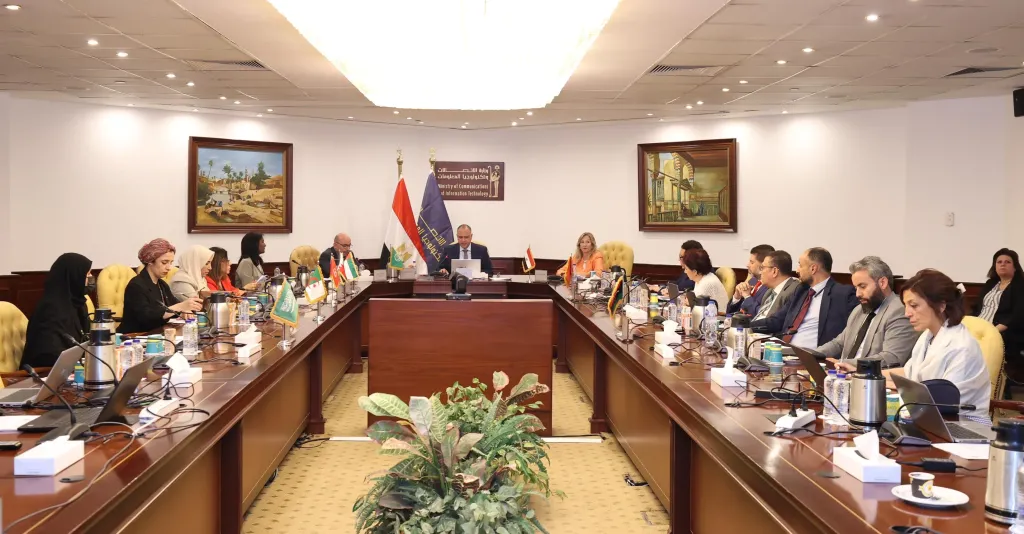
The Arab Republic of Egypt hosted the expert meeting and open consultations for the Arab region on the global dialogue on artificial intelligence governance, organized by the Economic and Social Commission for Western Asia (ESCWA) in cooperation with the League of Arab States, with the participation of experts from the United Nations Economic Commission for Africa, and a number of sister international organizations working in the Arab region, and in partnership with the Ministry of Communications and Information Technology.
The meeting comes within the framework of efforts to crystallize a unified Arab position towards the global dialogue on artificial intelligence governance, reflecting the priorities and development needs of the Arab region, and enhancing its active presence in international discussions on the future of artificial intelligence and its governance.
The Global Dialogue on Artificial Intelligence Governance is a multi-stakeholder platform of the United Nations, which aims to share best practices and lessons learned, and facilitate open, transparent and inclusive discussions on AI governance, with the participation of governments and all stakeholders. The first session of the Global Dialogue is scheduled to be held in Geneva on 6 and 7 July 2026, on the sidelines of the World Summit "Artificial Intelligence for Good" organized by the International Telecommunication Union, with the second session to be held on the sidelines of the multi-stakeholder forum on harnessing science, technology and innovation to achieve the Sustainable Development Goals, in New York in May 2027.
The meeting aimed to provide an opportunity for experts in the Arab region to contribute to shaping the features of the global dialogue on artificial intelligence governance, and to support a coordinated, comprehensive and practical Arab contribution to the preparatory process for the dialogue, to ensure the visibility of the region's priorities, development needs and practical experiences in the ongoing global debates. The participants also discussed proposals related to the content of the global dialogue, the mechanisms of its design and management and the nature of its outputs, in addition to developing realistic and measurable indicators to assess its success.
The meeting also addressed ways to strengthen multi-stakeholder cooperation at the national, regional and international levels on the priorities of artificial intelligence governance in the Arab region, and linking these priorities to the relevant global consultation process, in particular the outcomes of the Global Digital Compact and the post-review phase of the World Summit on the Information Society +20, as well as the formulation of coordinated regional messages that contribute to enriching the ongoing international debates.
During the meeting, Dr. Huda Baraka, Advisor to the Minister of Communications and Information Technology for the Development of Technological Skills, delivered a speech by the Ministry of Communications and Information Technology in the Arab Republic of Egypt. She stressed that Egypt believes in the importance of multilateral action as a key pillar in shaping the future of artificial intelligence, and pays special attention to enhancing regional and international cooperation in this field. She pointed to the importance of developing countries being an effective partner in setting the rules of global governance for artificial intelligence, not just receiving them, stressing that owning digital capabilities and infrastructure is no longer an option, but a necessity to ensure technological sovereignty.
Dr. Huda Baraka expressed her appreciation to ESCWA for its role in organizing this important regional dialogue, and for its continuous efforts in supporting joint Arab cooperation in the fields of digital transformation and artificial intelligence, also appreciating the contributions of all participants and speakers.
She added that the world is witnessing an unprecedented acceleration in the development of artificial intelligence technologies and the associated large-scale transformations in the economy, society and governance systems, which requires countries to be an active partner in formulating the rules that will govern this technology. She stressed that these consultations represent part of the global process led by the United Nations to formulate a global dialogue on the governance of artificial intelligence, and constitute a real opportunity to strengthen the Arab presence in international debates, and contribute to the formulation of solutions that respond to the priorities of the region. She pointed out that the future of artificial intelligence will not be sustainable or fair unless it is based on equal participation among all countries, taking into account the different levels of development and its needs, pointing out that the current stage requires moving from scattered national efforts to more integrated and influential regional action; She expressed her aspiration for rich and open discussions that contribute to the crystallization of a more coordinated and influential Arab vision, and support effective contributions to the global dialogue The upcoming, in a way that contributes to building a governance system for artificial intelligence that balances innovation and responsibility, between ambition and reality, and between technological progress and humanitarian considerations.
The discussions addressed a number of issues related to the relationship between technology and society, including the economic, social and cultural dimensions of artificial intelligence, the challenges of access and capacity building, the development of safe and reliable artificial intelligence systems, as well as promoting transparency, accountability and the protection of human rights. The consultations aimed to come up with practical proposals that contribute to defining the features of the global dialogue, formulating its outputs and developing measurable indicators of its success, to ensure a tangible impact in empowering countries, reducing digital gaps, and expanding the scope of equitable use of artificial intelligence applications.
This event comes on the day after the founding meeting of the Standing Committee on Artificial Artient and Emerging Technologies, which was established by the Council of Arab Ministers of Communications and the Economic and Social Council of the League of Arab States. The meeting was chaired by Mr. Ahmed Saeed, Advisor to the Minister of Communications and Information Technology for Economic and Statistical Affairs.
The Arab Republic of Egypt was tasked with coordination with the willing Arab countries, the Technical Secretariat of the Council of Arab Ministers for Communications and Information, Arab, international and regional organizations that enjoy observer status in the Council of Arab Ministers for Communications and Information, as well as qualitative Arab federations, to form technical teams, in line with the Arab Strategy for Artificial Intelligence and the Arab Digital Agenda, which were approved by the Council of Arab Ministers for Communications and Information.
The meeting resulted in the development of a preliminary conception of the teams of artificial intelligence, quantum computing and emerging technologies.