


S&P 500 Jumps 5.6% in Best Week Since April 2025 as AI and Chip Stocks Lead Wall Street Rebound
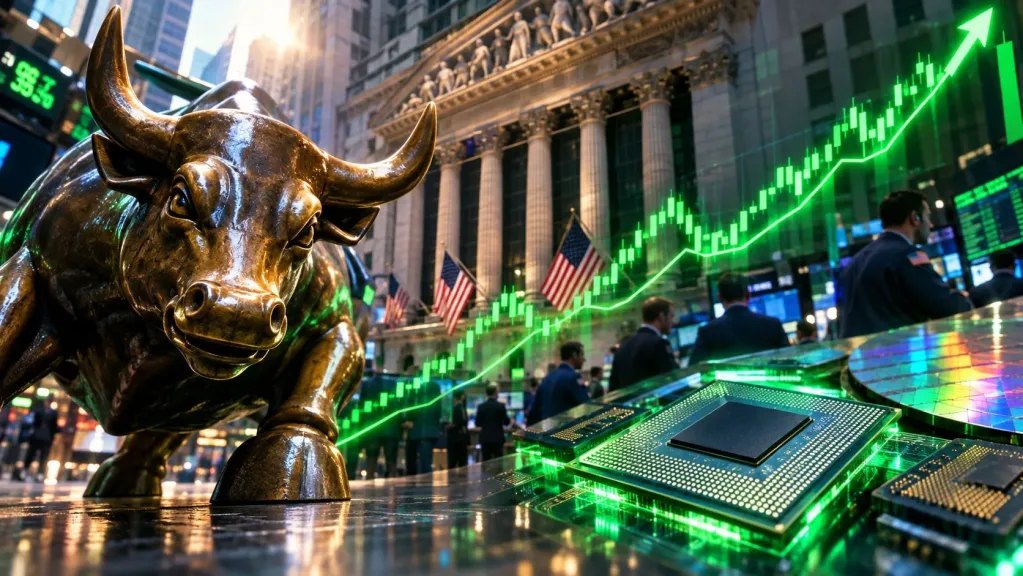
U.S. stocks staged a powerful rebound during the week ended November 27, 2026, as investors returned to technology and artificial intelligence shares following a sharp sell-off earlier in the month. The S&P 500 recorded its strongest weekly performance since April 2025, supported by renewed buying in semiconductor companies and other AI-related businesses, although concerns over inflation and Federal Reserve policy continued to weigh on the market outlook.
The S&P 500 gained 1.6% in Friday's shortened post-Thanksgiving trading session, closing at 7,297.49 points and bringing its weekly advance to 5.6%. The Nasdaq Composite rose 2.3% on Friday and 6.68% for the week, while the Dow Jones Industrial Average added 1.2% during the session and 5.46% over the five-day period. U.S. markets were closed on Thursday for Thanksgiving, with trading ending early on Friday.
Semiconductor Stocks Lead the Rally
Chipmakers were among the strongest performers during Friday's session. The Philadelphia Semiconductor Index advanced 4.7%, while SanDisk shares surged approximately 16% and Micron Technology gained 7.6%, highlighting renewed investor interest in companies supplying the memory, storage and semiconductor infrastructure required by AI systems.
Nvidia, one of the most influential companies in the artificial intelligence industry, posted a more modest gain of 0.8%. The difference in performance suggests that the rebound extended beyond the largest technology companies, benefiting a broader range of semiconductor and data-storage businesses that had experienced significant selling pressure in previous sessions.
What Brought AI Stocks Back Into Focus?
The recovery followed a severe market correction. On November 20, the S&P 500 closed more than 10% below its October 6 record, entering correction territory as investors reassessed technology valuations and questioned whether massive investments in AI infrastructure and data centers could generate sufficient returns.
Concerns surrounding the sustainability of AI-related spending had contributed to the earlier sell-off. However, renewed buying interest, alongside developments involving Nvidia's leadership and Jensen Huang's return as chief executive, helped improve sentiment during the following week.
Despite the rebound, the recovery has not fully reversed November's losses. The S&P 500 remained approximately 6.7% below its October peak, while the broader U.S. stock market was still heading toward its weakest November performance since 2008.
Federal Reserve Rate Expectations Remain a Key Risk
Monetary policy remains another major factor shaping investor sentiment. According to Reuters, traders were pricing in an almost certain Federal Reserve interest rate increase at the central bank's December 8–9 meeting.
The expectations followed stronger-than-estimated U.S. economic growth in the third quarter and accelerating inflation in October. These developments have reinforced concerns that policymakers may need to maintain a restrictive monetary stance or raise borrowing costs further.
Investors are now looking to the December meeting for guidance on the future direction of interest rates and the implications for equity valuations, corporate financing costs and global financial markets.
What the Rebound Means for Arab Investors
For investors across Arab markets, movements in U.S. technology shares can have implications beyond portfolios directly exposed to Wall Street. International investment funds and technology-focused exchange-traded funds may be affected by changes in valuations and investor sentiment toward artificial intelligence companies.
Cryptocurrencies and other high-risk assets may also experience changes in demand as global investors adjust their exposure to risk. However, their movements are not necessarily identical to those of technology stocks, as digital assets are influenced by additional factors, including liquidity, regulation and market-specific developments.
Gold is another asset worth monitoring. Changes in the U.S. dollar, Treasury yields and interest rate expectations can influence international gold prices, although supply and demand conditions and geopolitical developments also play important roles. A shift toward tighter monetary policy could increase pressure on non-yielding assets, while changing expectations about future rates may alter investor demand for gold.
Key Indicators to Watch Before the December Fed Meeting
Investors should monitor the Federal Reserve's December decision, upcoming inflation and economic growth data, U.S. Treasury yields, and financial results from major technology and semiconductor companies.
The ability of AI-related stocks to sustain their recovery will also be important in determining whether the latest gains represent a lasting improvement in market sentiment or a temporary rebound following heavy losses.
The strong weekly performance of the S&P 500 is a significant market development, but it does not, by itself, establish that the correction has ended or that a sustained upward trend has returned.
related topics
 Nvidia Pauses AI Server Shipments to Four Asian Markets: What US Chip...
 Egyptian Gold Pound Jumps EGP 640 to EGP 45,040 as Global Bullion...
 Egypt Gold Prices Stabilize After Sharp Global Sell-Off
 Nvidia’s $952 Billion Market Cap Comeback: Is the Company’s Leadership Crisis Really...
 Egypt’s 24K Gold Holds at EGP 6,400 as Global Ounce Falls to...
 Following Yesterday’s Strong Gains: Gold Prices Stabilize in Egypt Today, Tuesday, November...
 Nvidia Reinstates Jensen Huang as CEO: Why Shares Jumped 31.5% and What...
 Jensen Huang’s Return Sends Nvidia Shares Surging 31.5%, Reviving Wall Street’s AI...
 Nvidia Reinstates Jensen Huang to Executive Leadership and Establishes Independent National Security...
 Gold Prices in Egypt Remain Stable on November 23, 2026, as 21-Karat...
 Gold Price Today, Sunday, November 22, 2026, in Egypt: Local Calm Following...
 Nvidia Stock Plunges Over 40% Amid Leadership Uncertainty as Nasdaq Nears Bear...
