


Egyptian Gold Prices Drop Amid Weekend Halt; Global Ounce Registers Weekly Loss of 0.7%
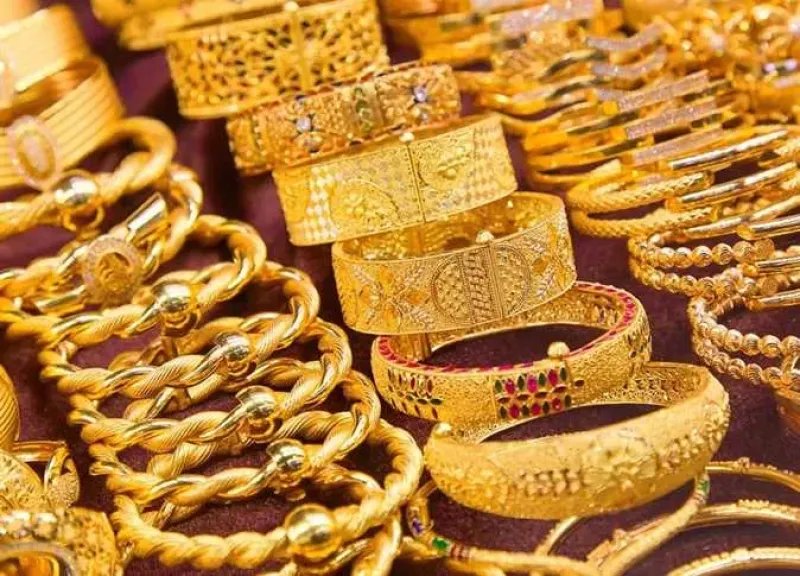
Domestic gold prices in Egypt edged lower during midday trading on Saturday, coinciding with the global weekend market closure. The decline reflects a broader international retraction, with the global spot price marking its second consecutive weekly loss, shedding 0.7% of its value due to escalating bets on US Federal Reserve interest rate hikes and ongoing geopolitical ambiguity surrounding the Middle East conflict, according to the latest brief from the "Gold Monitor" Center for Economic Studies.
Dr. Walid Farouk, Lead Bullion Analyst and Director of the Gold Monitor, stated that domestic retail prices fell by approximately 10 Egyptian Pounds (EGP) compared to Friday's close. This adjustment brought benchmark 21-karat gold down to EGP 6,800 per gram. On the global front, the spot ounce contracted by approximately $31 at the weekend close to settle at $4,510, according to World Gold Council metric feeds.
Domestic Market Rates and Multi-Karat Breakdown
Farouk added that high-purity 24-karat gold recorded EGP 7,772 per gram, while the 18-karat manufacturing tier reached EGP 5,829 per gram. Concurrently, the sovereign 8-gram Gold Coin (Ginei) was appraised at EGP 54,400. This midday movement follows a sharper EGP 20 contraction on Friday, when 21-karat gold opened at EGP 6,830 before finishing at EGP 6,810, driven by the global ounce slipping from $4,544 to $4,510.
Farouk characterized the gold ecosystem as experiencing a fragile equilibrium between two conflicting forces: near-term headwinds from a strong US Dollar coupled with restrictive interest rate projections, and core tailwinds driven by sustained sovereign central bank purchasing as an institutional safe haven against war and structural inflation.
The analytical brief detailed that non-yielding bullion faced heavy liquidation pressure this week, triggered by a rallying US Dollar Index (DXY) and expanding US Treasury yields. These factors solidified market consensus that the Federal Reserve may resort to further rate hikes to counter persistent inflationary pressures driven by high energy costs from the Middle East conflict.
Furthermore, Federal Reserve Governor Christopher Waller warned that energy shocks stemming from the conflict could accelerate headline inflation, adding that the probability of a rate hike has balanced out against a rate cut in upcoming monetary policy meetings. Consequently, interest rate futures markets began pricing in a 25-basis-point hike before the end of the current fiscal year.
US Macroeconomic Data and Sovereign Buying Surges
Compounding these pressures, US macroeconomic indicators revealed that the University of Michigan Consumer Sentiment Index for May plummeted to an all-time low of 44.8 points, down from 49.8 points in April. Concurrently, long-term inflation expectations rose to 3.9%—the highest reading in seven months—reflecting deep consumer anxiety regarding cost-of-living metrics and entrenched inflation across the US economy.
While gold has contracted roughly 14% since the escalation of hostilities in late February—dropping from historic peaks that cleared $5,200 per ounce—long-term institutional accumulation reveals a different structural trend.
A Goldman Sachs research note published on May 18 by analysts Lina Thomas and Daan Struyven revealed that their internal tracking models had consistently underreported global sovereign gold procurement for eight consecutive months due to a data-reporting gap in UK flow metrics. After correcting this discrepancy, Goldman Sachs revised its March 2026 monthly global central bank buying estimate upward from 29 tons to nearly 50 tons—a 72% surge.
The investment bank projects central banks to maintain an accumulation velocity of 60 tons monthly through the remainder of 2026. China alone logged 15 consecutive months of sovereign purchasing running up to January, prompting Goldman Sachs to defend its year-end gold price target at $5,400 per ounce.
The Gold Monitor concluded that the upcoming macro trading week will be critical for bullion's trajectory. Global financial markets are waiting for the release of US Gross Domestic Product (GDP) updates, the Personal Consumption Expenditures (PCE) price index—the Federal Reserve's preferred core inflation gauge—and subsequent public commentary from central bank governors. Higher-than-expected inflation metrics will heavily test gold's current baseline valuation support tiers.
related topics
 Gold Prices Stabilize in Egypt After Recent Decline as 21-Karat Hits EGP...
 Gold Prices in Egypt Consolidate Amid Global Headwinds and Geopolitical Tensions
 21-karat gold now sets a new record... A new surprise in the...
 Egypt’s Gold Prices Rise for Second Week as Industry Targets $9 Billion...
 Gold Prices Surge Again in Egypt as 21-Karat Hits EGP 6,750
 Gold price today, Sunday, January 25, 2026, morning, after the rise in...
 Gold Prices in Egypt Jump 8.5% in One Week as Global Rally...
 What's the price of 21-karat gold today? A new surprise in gold...
 Gold Prices in Egypt Await Saturday Trading After Week-End Gains
 Gold Prices in Egypt Remain Stable on Sunday Morning Trading
 Gold prices in Egypt today, Saturday, January 10, 2026: 21-karat gold continues...
 21-karat gold now... Gold price today, Thursday, January 1, 2026, after the...