Finance and Tech Leaders Chart Roadmap for ”Sustainable Growth” and Navigating Market Volatility at ESLSCA’s Executive Education Summit
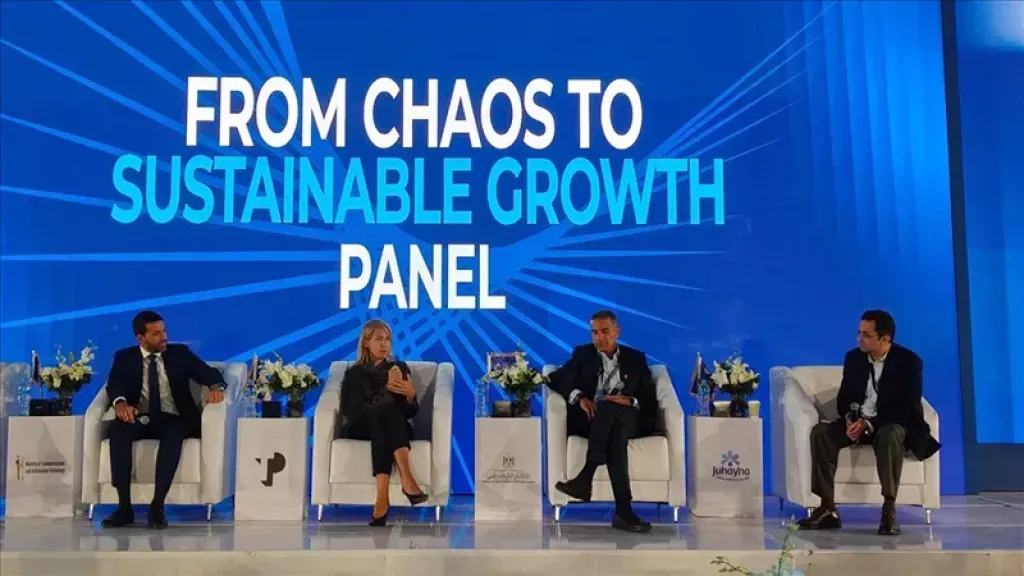
A panel discussion titled "From Chaos to Sustainable Growth," held as part of the fourth edition of the Executive Education Summit organized by ESLSCA University, explored how fintech, artificial intelligence (AI), and institutional agility can empower businesses to navigate market volatility, adapt to global economic shifts, and turn current challenges into drivers of sustainable economic growth.
Moderated by Omar El-Shenety, Founder and CEO of Qaf for Education, the session brought together prominent leaders from the finance, technology, and education sectors, including Malak El Baba, Vice President and General Manager of Visa for Egypt, Libya, and Sudan; Karim El-Hennawy, CEO and Secretary-General of ESLSCA University; Mohamed Tawfik, Managing Director of TP in Egypt and Chief Operating Officer for English-speaking African markets; and Ahmed Nader, CEO of Geidea.
Shifting from Traditional Management to Proactive Planning
While moderating the discussion, Omar El-Shenety emphasized that rapid economic and technological changes compel organizations to abandon reactive, traditional management models in favor of agile operating frameworks grounded in data analytics and proactive planning to ensure continuity and competitiveness. He also pointed to the growing specialization within professional fields, citing the evolution of medical and career tracks across generations, and stressed that the difficulty of predicting the jobs of the next 20 years requires educational institutions to equip graduates with adaptable tools to thrive in a constantly evolving workplace.
Visa Posts Record Revenues as AI Drives Shopping Trends in Egypt
For her part, Malak El Baba announced that Visa achieved record global financial results in fiscal year 2026, posting $45.9 billion in revenue and a 15% growth rate, noting that sustainable growth depends on leaders' ability to anticipate challenges through technology. She highlighted findings from Visa’s "Stay Secure" study, which revealed that 91% of Egyptian consumers rely on AI for shopping, 88% trust its role in fraud protection, and over 83% of businesses in Egypt plan to invest in "agentic commerce" over the next two years.
El Baba also pointed to the rise of social commerce and gaming-based commerce—particularly among Gen Z and Gen Alpha—calling for payment and financing solutions to be seamlessly embedded into the purchasing experience with the highest security standards. She underscored the importance of continuous dialogue with Egyptian regulators to foster an innovation-friendly environment, while praising local Egyptian talent that has increasingly exported executive leadership to Gulf markets, and urged continued investment in workforce upskilling and the digital empowerment of SMEs.
Executive Education Bridges the Gap Between Management and Technology
Karim El-Hennawy explained that the widening gap between rapid technological advancement and traditional management skills places executive education at the forefront of organizational development. He noted that universities' roles have evolved beyond knowledge transfer to building strategic thinking, crisis management, and balancing profitability with sustainability. He added that ESLSCA University has expanded its strategy to offer specialized postgraduate, master’s, and doctoral programs tailored to market demands, noting that the COVID-19 pandemic and the shift to remote work accelerated digital and institutional transformations originally projected for 2030 and 2040 into just three to four years—making practical skills, rather than rote memorization, the true benchmark of graduate readiness.
TP Expands Near Universities to Attract Talent and Export Services
Addressing regional expansion, Mohamed Tawfik affirmed that operational agility and cross-border expansion are twin pillars of growth, noting that investing in technology and human capital strengthens the ability of companies operating in Egypt to export services and compete across regional and African markets. He revealed that TP is opening branches near universities—including ESLSCA University—to facilitate the recruitment of specialized talent in computer science and healthcare sectors to serve clients in the United States and Europe. He also highlighted the company's success in mitigating regional geopolitical tensions through close coordination with the Ministry of Communications and Information Technology and ITIDA to reassure clients of business continuity, alongside securing ultra-fast fiber-optic internet infrastructure in collaboration with telecom operators.
Geidea Reaches 100,000 Merchants and Bets on Embedded Finance
In the digital payments sector, Ahmed Nader stated that accelerating financial inclusion and integrating the digital payment ecosystem among fintech companies, banks, and regulators reduce costs and fuel the growth of SMEs and e-commerce. He outlined Geidea’s growth trajectory in the Egyptian market, noting that the company launched roughly five years ago with a team of just three to four people and has since expanded to a network of 100,000 merchants and 1,200 employees.
Nader added that Geidea’s offerings have evolved from traditional point-of-sale (POS) solutions to encompass e-commerce, restaurant and retail management systems, and AI-powered embedded lending and financing. He noted that overcoming the payment sector's challenges—namely low profit margins and high infrastructure costs—relies on maximizing the value delivered to each merchant and diversifying services to keep pace with rapid market evolution.
related topics
 For the Second Year Under the Auspices of the Ministry of Communications......
 Fifth Edition of Carerha Summit 2026 Kicks Off to Discuss the Future...
 Vodafone Egypt Reports 2025/2026 Sustainability Achievements, Saving 1.5 Million Liters of Diesel...
 GAFI CEO: Linking Executive Education to the Labor Market and Leveraging AI...
 Visa Quadruples its Team in Egypt to Serve 98 Regional Markets
 Hossam Heiba: Rising Cost of Capital Imposes Stricter Investment Criteria, with AI...
 CLOUD11 Co-CEO: Digital Transformation Breaks Corporate Monopolies as ”Two-Person” Startups Now Compete...
 Arab African International Bank (AAIB) Concludes Exceptional Participation at Cairo ICT 2026...
 Egypt’s Higher Education Ministry Announces Five Winning Tech Startups in Innovation and...
 UAE Ranks Among Top 5 Globally in E-Government Development for 2026
 QNB Report: Technological Gap and AI Investments Deepen Productivity Disparity Between the...
 Vodacom and Ahmed El Beheiry Win at the 2026 Africa Tech Festival...