


Google Debuts ”Gemini Omni Flash” at I/O 2026; Monthly Active Users Cross 900 Million
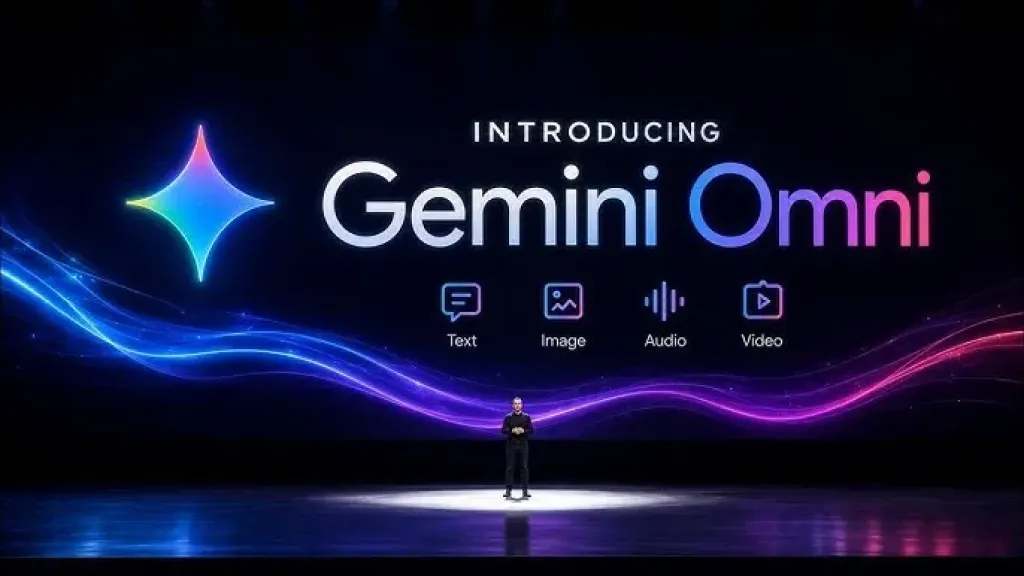
Google has officially unveiled its new artificial intelligence model, "Gemini Omni Flash," during the Google I/O 2026 developers conference. The company described the framework as a significant advancement in blending deep multi-modal reasoning with generative video and audio infrastructure, enabling users to produce complete cinematic videos from text prompts, static images, reference audio, or video clips.
According to the corporate announcement, Gemini Omni represents the next generation of Google's multimodal models, capable of processing images, videos, text, and audio concurrently. The system generates high-fidelity video outputs anchored in a realistic understanding of the physical world, allowing users to modify generated content through natural conversational interfaces rather than traditional video-editing software.
Sequential Editing and Physics Comprehension
Google clarified that the flagship release of this new family is branded as "Gemini Omni Flash." The model has been deployed immediately within the Gemini application, the Google Flow platform, and YouTube Shorts. Google notes that standalone native creation of high-res images and audio tracks will be added to the model's architecture in subsequent rollouts.
The new model permits users to execute sequential edits on video sequences using written or voice commands while maintaining absolute character and environmental consistency across scenes. This capability includes altering backdrops, adjusting kinetic motion, or re-engineering specific scene parameters without losing visual or temporal coherence.
Furthermore, Google noted that Gemini Omni Flash features an advanced understanding of physics, kinetic energy, and spatial context. This engineering milestone allows the model to simulate gravity and motion accurately, rendering highly realistic explanatory and scientific animations. The engine can also synthesize a unified video from a mixture of disparate inputs—such as combining a static portrait, a backing music track, and a descriptive script—while referencing specific source sketches to preserve strict visual identity guidelines.
Digital Avatars, SynthID Watermarking, and Scaled Metrics
Expanding its digital identity portfolio, Google introduced a new "Avatars" feature, which allows creators to construct a photorealistic digital likeness that replicates their voice and physical appearance for automated video production. The firm emphasized that it is maintaining localized testing parameters for specific voice-cloning capabilities to guarantee responsible and safe deployment.
To combat disinformation, Google confirmed that all video outputs processed via the Gemini Omni engine automatically embed "SynthID"—an imperceptible digital watermarking protocol that allows verification systems to flag AI-generated content.
Sundar Pichai, CEO of Google and Alphabet, disclosed at the summit that the Gemini application ecosystem has experienced explosive growth, surpassing 900 million monthly active users globally, compared to 400 million during the same period last year. Concurrently, daily API and user prompt volumes have scaled by more than sevenfold.
Gemini Omni Flash is immediately available to global subscribers of Google AI Plus, Google AI Pro, and Google AI Ultra tiers via the Gemini app and Google Flow. Concurrently, Google has initiated a free rollout for content creators on YouTube Shorts and the YouTube Create app, with dedicated API endpoints slated for developer and enterprise access in the coming phases.