Huawei Introduces 3 Smart Factories and a Hybrid Infrastructure to Advance AI Agents in the Financial Sector
Chinese technology and telecommunications giant Huawei is intensifying its efforts to expand the footprint of artificial intelligence (AI) in the global financial sector by launching an open, hybrid infrastructure backed by three smart factories. The initiative aims to accelerate the development of "AI agents" and effectively integrate them into the core operations of financial institutions.
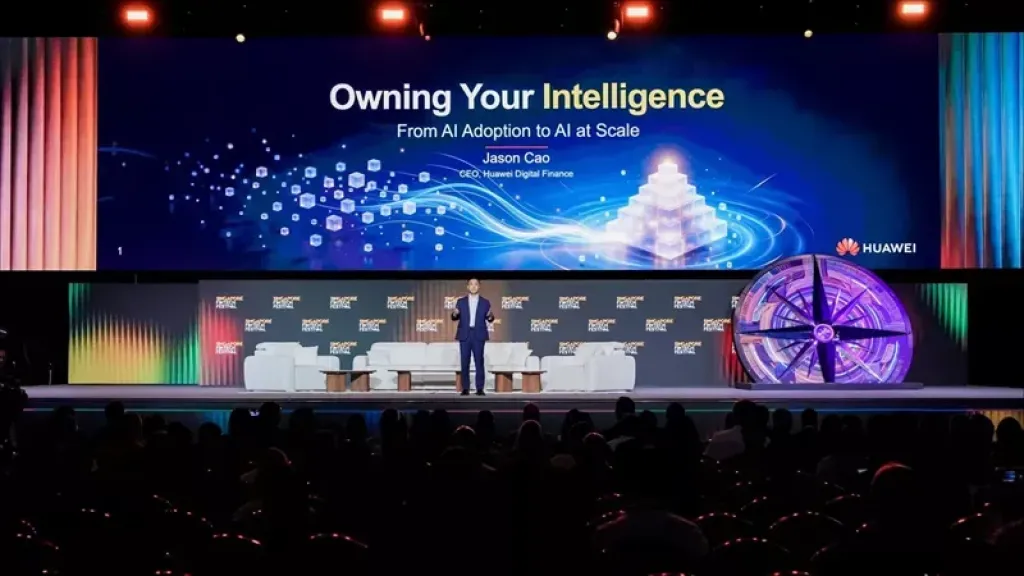
The company unveiled this vision during its participation in the Singapore FinTech Festival 2026, showcasing a suite of advanced solutions under the theme of accelerating AI adoption and developing agent-driven financial services.
Strategic Partnerships and Sector-Wide Expansion
During the festival, Jason Cao, CEO of Huawei Digital Finance, and Alvin Feng, President of Huawei International Financial Business, outlined the company’s roadmap for modernizing banking applications and scaling AI across insurance, securities, and central banks. The company also spotlighted joint solutions developed under its "RONGHAI" Financial Partner Program, highlighting the outcomes of ecosystem collaboration through its "4-Win" model.
From Limited Pilots to Enterprise-Wide Deployment
Jason Cao emphasized that competition in financial AI is shifting beyond mere model performance toward building comprehensive, enterprise-grade capabilities. This approach empowers banks to independently select, securely operate, and continuously evolve their solutions.
Drawing on China's leading experience in reducing costs through technological openness and boosting efficiency via precision engineering, Cao identified four core pillars adopted by advanced financial institutions:
Continuous Modernization (Zero Legacy): The gradual phasing out of outdated traditional systems.
Hybrid Infrastructure: Flexible integration between an enterprise's private infrastructure and the public cloud.
Administrative Centralization: Adopting a unified enterprise architecture to centrally develop and manage AI solutions.
Deep Operational Integration: Embedding smart applications into core banking services, including mobile payments, credit, and risk management.
The Dual Super-Agent Model Reshaping Banking
As AI advances in its ability to anticipate user intent and plan proactively, Huawei expects growing reliance on AI agents by both customers and employees. To meet this shift, the company is exploring an operational model centered around "two super-agents"—one for customers and one for employees—to understand needs and deliver tailored services. These are supported by a network of specialized agents covering credit, marketing, risk management, and wealth management.
This strategy aims to transform banking expertise and compliance rules into reusable, continuously evolving digital assets, while ensuring financial institutions retain full control over their data and operational logic to safeguard their competitive edge.
"Fintelligent AI" Solution and Three Smart Factories
Meanwhile, Alvin Feng unveiled the "Fintelligent AI" solution, designed to enable financial institutions to build their own proprietary AI capabilities in line with security, sustainability, and scalability standards. Built on an open, hybrid infrastructure, the solution consolidates its capabilities through three specialized smart factories:
Agent Factory: Dedicated to developing, managing, and governing AI agents.
Token Factory: Oversees token-related operations across all lifecycle stages.
Data & Knowledge Factory: Ensures a continuous flow of high-quality data and institutional knowledge.
16 Years of Expertise and 7,100 Financial Institutions
Huawei concluded its showcase at its dedicated financial sector pavilion by reaffirming its 16-year track record in the industry, having successfully delivered technological solutions to over 7,100 financial institutions worldwide, including 54 of the world's top 100 banks.