Huawei Overtakes Nvidia in China’s AI Chip Sales
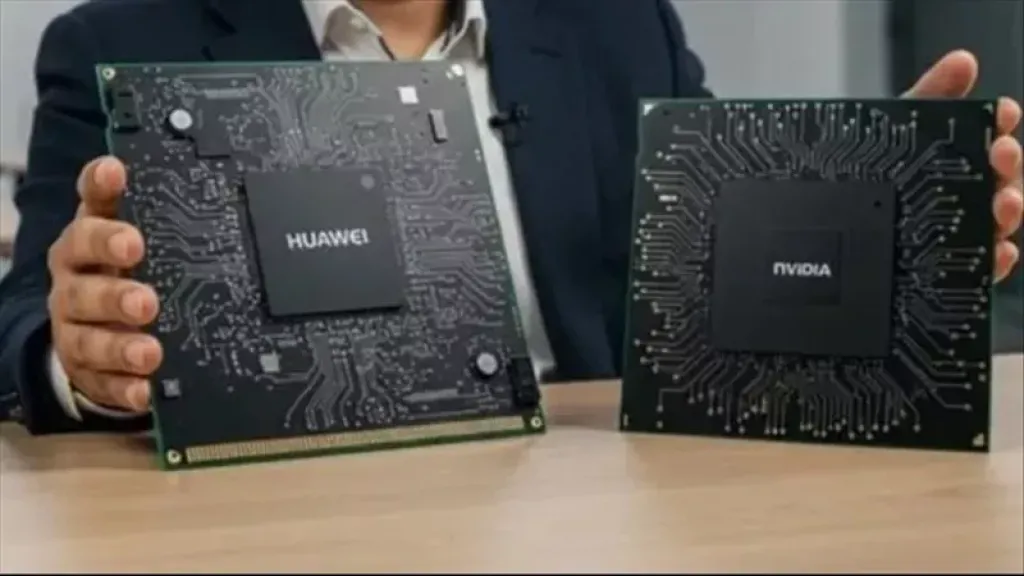
Huawei has strengthened its position in China’s semiconductor market after its Ascend artificial intelligence chips outsold Nvidia’s processors in the country, marking a notable development in Beijing’s efforts to build a domestic technology industry and reduce reliance on foreign suppliers.
Eric Xu, Huawei’s rotating chairman, confirmed that Ascend chip sales had exceeded Nvidia’s sales in China. He said the company had expanded the reach of its products and reinforced its presence in the AI computing market.
The development comes as demand continues to rise for processors used to train and operate advanced AI models, while US restrictions continue to limit Chinese companies’ access to the latest semiconductor technologies.
Sales growth amid performance and supply challenges
Despite its sales lead in China, Huawei’s processors remain behind Nvidia’s most powerful chips in individual processing capabilities. Competition between the companies therefore depends on more than chip performance, including production capacity, supply availability and the efficiency of integrated computing systems.
Huawei is seeking to expand domestic production of its processors while building a broader AI infrastructure that can connect large numbers of chips into systems capable of handling large-scale training and inference workloads.
As part of this strategy, the company unveiled the Atlas 950 SuperPoD platform, based on a new computing architecture called Peerium. The platform is designed to advance data center and high-performance computing systems by integrating central processing units (CPUs), neural processing units (NPUs), memory, storage and networking components into a unified environment.
The architecture uses UnifiedBus technology to connect system components and distribute computing resources more efficiently, moving away from traditional designs centered on a primary server connected to other servers.
However, Huawei’s expansion faces a major obstacle: limited production capacity. The company is still unable to supply enough Ascend chips to meet all domestic demand, restricting its ability to expand internationally in the near term.
Huawei is prioritizing Chinese technology companies and data center operators, while its overseas shipments remain limited and focus on markets seeking alternatives to AI processors.
US restrictions push Huawei toward alternative chip technologies
US restrictions on China’s semiconductor sector have limited access to advanced manufacturing equipment, particularly extreme ultraviolet lithography (EUV), which is used to produce the latest generations of chips.
Chinese manufacturers rely more heavily on deep ultraviolet lithography (DUV), an older technology that creates additional challenges in developing advanced processors capable of competing with global products.
Huawei is developing LogicFolding technology as part of its Tau-law approach. The aim is to increase transistor density and improve the efficiency of processors manufactured using locally available technologies, helping enhance performance despite production constraints.
The company uses this technology in its Kirin 9050 chips, which power the Mate 90 Pro Max smartphone. Huawei also aims to reach transistor densities by 2031 approaching levels associated with 1.4-nanometer manufacturing processes.
HarmonyOS supports Huawei’s broader technology ecosystem
Huawei’s strategy extends beyond processors and computing platforms to include an independent software ecosystem built around its HarmonyOS operating system.
HarmonyOS runs across a range of products, including smartphones, tablets, watches, wearable devices, computers and vehicles. Huawei says the operating system is installed on more than 90 million devices, with an ecosystem comprising around 450,000 applications and services and 11 million developers.
The company aims to gradually expand HarmonyOS beyond China and develop it into an operating system capable of competing with Android and iOS. Achieving that goal will require attracting more users and developers and offering a wider range of applications and services for international markets.
This strategy reflects Huawei’s ambition to build an integrated technology ecosystem spanning processors, computing platforms, data center equipment and operating systems, giving the company greater control over key components of digital infrastructure.
Huawei’s progress in AI chip sales comes amid intensifying technological competition between the United States and China, as advanced chip manufacturing capabilities and secure supplies have become central to the global AI race.
While Nvidia retains an advantage in the processing capabilities of its most powerful chips, Huawei’s sales lead in China signals a shift in the domestic market and highlights the growing presence of local alternatives despite continuing manufacturing and supply constraints.