AI and the Future of Arab Media: Leaders and Tech Experts Map Opportunities and Challenges at Cairo ICT 2026
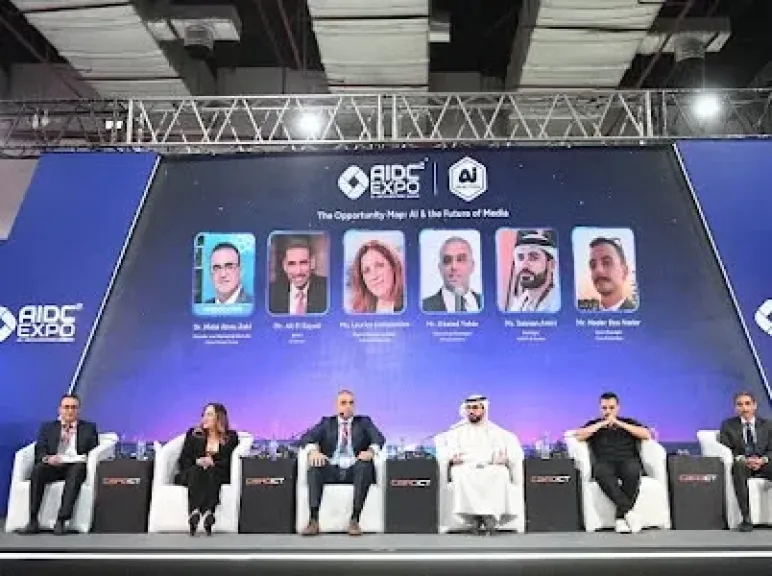
A comprehensive panel session titled "The Opportunity Map: AI and the Future of Media" took place during the "Cairo ICT 2026" exhibition and conference. Leading media figures and technology experts gathered to explore how artificial intelligence is reshaping content creation, production models, and distribution channels.
Panelists emphasized that emerging technologies present promising investment opportunities—particularly in app localization and the digitization of broadcast and print archives. However, they noted that AI also introduces serious challenges, including information credibility, intellectual property protection, and navigating the nuances of diverse Arabic dialects.
Identifying Needs First and Viewing the Arab Archive as an Investment Opportunity
Dr. Nidal Abou Zaki, Founder and Managing Director of Orient Planet Group and moderator of the session, stated that discussions surrounding AI in media should not focus solely on technology's capabilities, but rather start by identifying the unaddressed needs of Arab media and transforming them into practical opportunities.
He noted that AI is currently integrated across all stages of production—from audio-visual editing and newsroom operations to broadcast operations. Highlighting the challenge of dialectal diversity, he explained that it serves as a driver to develop models tailored to linguistic variety. He also highlighted that digitizing and archiving historical Arab content, books, and audio heritage creates a valuable resource to train AI models, unlocking new revenue streams for media organizations.
Trust Deficit, Dialectal Challenges, and Model Identity
Loris Constantin, Digital Editor-in-Chief at Forbes Middle East, highlighted the performance gap in AI applications handling colloquial Arabic dialects compared to those optimized for Modern Standard Arabic used in specialized media.
Constantin stressed that "trust" remains the primary benchmark for full AI adoption, especially for organizations managing large volumes of precise data. She explained that trust relies on two factors: the accuracy of the final output (requiring human verification) and the identity and values of the model developer (whether US- or China-based). She raised questions regarding the independent identity of Arab media in the global AI landscape and urged institutions to adapt quickly to stay competitive.
Technology Localization and Developing Local Talent
Salman Amiri, Director of the AI Center at DMCC, outlined the role of business ecosystems in bridging media institutions with tech companies, noting that DMCC houses over 250 AI firms and 900 media enterprises.
Amiri highlighted app localization as one of the most vital growth areas for technology firms, given that media needs vary significantly across regional markets. He emphasized that maximizing AI's impact depends on nurturing local talent who understand regional market specifics and can deliver tailored solutions.
A Shift Paralleling the Digital Transformation Era and New Production Frontiers
Khaled Yehia, Marketing Strategist at Microsoft MCC, compared the current AI transition to the digital transformation era experienced 10 to 15 years ago, when traditional outlets shifted from print to digital platforms.
Yehia noted that global enterprises are adopting AI to ensure business sustainability, opening avenues for tech firms to support media innovation across film, reporting, and music. He cited the production of a 34-minute documentary on the October War generated entirely by AI without direct human directorial intervention. He also mentioned Microsoft's collaboration with regional entities such as G42 to train Large Language Models capable of processing various regional dialects.
Intellectual Property in the Music Industry and Protecting Creators
Addressing the music sector, Nader Bonader, Sync Manager at Sony Publishing, emphasized that the public availability of music on the internet does not automatically grant AI developers the right to train models on copyrighted material.
Bonader called for strict adherence to IP rights, transparency, and explicit prior consent from creators and publishers. Conversely, he noted that AI tools can be leveraged positively to detect unauthorized usage and protect intellectual property rights.
Professional Journalism Addressing Misinformation and Historical Archives
Ali El-Sayed, Columnist at Al-Ahram Institution, concluded that the credibility crisis and the spread of deepfakes represent the biggest global challenges facing modern media. He noted that these risks have reaffirmed the indispensable role of traditional, professional journalism in fact-checking and debunking misinformation.
El-Sayed added that legacy news organizations with extensive historical archives possess a high-value asset that can serve as a foundation for building trustworthy AI models grounded in verified journalistic sources.