AI and the Future of Media: Cairo ICT 2026 Experts Highlight the Importance of Human Journalism, Trusted Archives and Arab Identity
Artificial intelligence is transforming the media industry, from the way content is created and distributed to how audiences access information and interact with news organizations. At the same time, its growing influence is raising concerns over misinformation, copyright, privacy and the impact of digital technologies on public awareness.
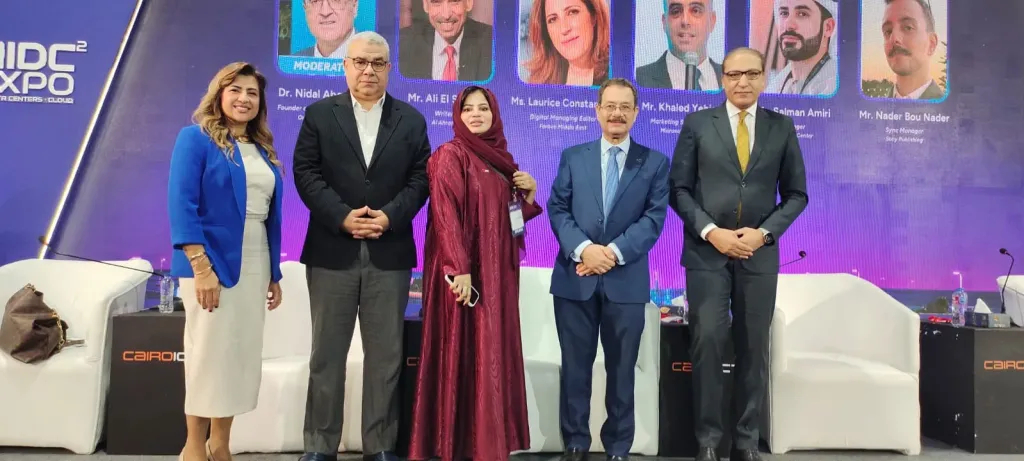
These issues were discussed by media leaders and technology experts during a session titled “The New Media Economy: How AI Is Rewriting the Rules,” held as part of Cairo ICT 2026 in Cairo on November 8.
The speakers included Dr. Ahmed Darwish, former Minister of State for Administrative Development; Mona Abu Samra, President of Dubai Media Academy; Islam Afifi, Chairman of Akhbar El Yom Organization; and Samir Omar, Head of News Channels at United Media Services.
Participants emphasized that media organizations must move beyond simply adopting new technologies. They need to invest in valuable content, build on their institutional archives and prepare journalists to work effectively with AI.
Local Media Can Compete Through Specialized AI Solutions
Dr. Ahmed Darwish said AI is changing the foundations of competition, as societies move toward greater participation and customers become increasingly involved in shaping the products and services they use.
He explained that AI systems reflect the data on which they are trained. When that data is biased or does not adequately represent different cultures and values, the resulting outputs may also be incomplete or biased.
Darwish cautioned that AI-generated misinformation could have a particularly strong effect on public awareness because it may appear more convincing than conventional online disinformation.
He argued that local companies do not need to compete directly with global technology groups by building enormous language models, which require substantial investment to develop and operate. A more practical approach, he said, is to create smaller models tailored to specific industries and business needs.
He also highlighted the potential of using institutional archives to build dedicated AI systems. Such solutions could enable media organizations to make their own newspapers, television records and other content searchable and usable through specialized models.
For local software and technology companies, this creates an opportunity to develop applications built around sector-specific requirements and locally available information.
AI Infrastructure Requires Massive Global Investment
Darwish also discussed the scale of investment being directed toward AI infrastructure.
He said the four largest companies spent $240 billion on data centers in 2025, while three other companies signed an agreement in September 2025 to build data centers valued at $500 billion.
According to the figures he presented, annual data center spending by the seven major companies stands at approximately $400 billion, an amount comparable to Egypt’s gross domestic product.
Egypt Needs Clear Rules for Data Access and Disclosure
On the regulatory front, Darwish said Egypt needs to reconsider its framework for data disclosure and circulation as digital transformation enters a decisive stage.
He pointed to the shift from relatively flexible information access in the mid-2000s toward tighter restrictions influenced by security and social considerations.
Darwish argued that a separate criminal law for AI is unnecessary because existing legal principles address criminal acts regardless of the tools used to commit them. He cited offenses such as murder and defamation as examples.
He described the Personal Data Protection Law as an important step and stressed that anonymized information should be used when feeding data into AI models.
However, he called for a dedicated legal framework defining which government data can be accessed, disclosed, shared or reused.
He said the ability of Egypt’s AI and technology industries to grow will depend in part on clear, modern rules governing data availability and use.
Darwish further noted that strict confidentiality requirements continue to limit Egyptian banks’ ability to rely on external cloud services. This makes secure domestic cloud infrastructure an important consideration for processing sensitive information.
He also called for ethical guidelines and responsible-use standards, emphasizing that the task of regulating AI cannot be left entirely to governments, particularly when the internal operations of algorithms are difficult to monitor.
Dubai Media Academy’s “Ain AI” Initiative Focuses on Arab Representation
Mona Abu Samra highlighted the risks associated with deepfake technology, warning that manipulated content can affect societies and create tensions between countries.
She also pointed to the UAE’s efforts to encourage AI adoption and develop digital capabilities across government entities and private-sector organizations, supported by initiatives and awards that promote participation and innovation.
According to Abu Samra, media is among the sectors experiencing significant changes as a result of AI.
She explained that the “Ain AI” initiative for artificial intelligence in Arab media was developed following research conducted by Dubai Media Academy, with input from experts and major regional and international media organizations.
Established on October 5, 2024, the academy serves as a research, training and thought center focused on developing young talent.
Its studies identified shortcomings in the way AI systems reflect Arabic language, visual content, Arab identity and cultural values.
The academy organized specialized discussions in the UAE to examine these issues and formulate recommendations, which helped shape the initiative.
Abu Samra acknowledged that the initiative has yet to achieve all the goals set by the academy, adding that efforts are continuing to expand its impact and deliver further results.
Afifi: Media Organizations Must Build on Their Content and Archives
Islam Afifi said the future of media organizations will not be determined simply by how many AI tools they acquire. Their ability to produce distinctive content, provide value to audiences and reach readers effectively will remain central to their competitiveness.
He noted that national media institutions have accumulated decades of experience and valuable historical material. This legacy should be used to strengthen direct relationships with audiences across digital platforms.
Afifi cited figures showing a 33% decline in visits to news websites through Google search. He also referred to estimated advertising revenues of around $44 billion for US content creators in 2026.
He said 54% of audiences obtain information through social media, while 51% use news applications and media organizations.
Highlighting the value of institutional archives, Afifi said Akhbar El Yom Organization has a history spanning 82 years, while Akher Saa magazine has been published for 92 years.
The organization holds approximately 13 million photographs, with the number falling to around 10 million after duplicate images are excluded.
He said these records represent a major competitive asset in the AI era, alongside journalists’ accumulated experience, established source networks and the ability to verify information and produce visual and video journalism.
“AI Cannot Be an Editor-in-Chief,” Says Afifi
Afifi stressed that AI cannot take over the role of an editor-in-chief or make the final decision to approve material for publication.
He said the technology can support research, collect and organize information, and assist in drafting content, but every output must be checked for accuracy before publication.
To illustrate the risks, he recalled using an AI application that gave him incorrect information about Donald Trump taking office for a second presidential term in 2025.
For Afifi, the experience demonstrated why AI-generated information must be treated as material requiring verification rather than as an automatically reliable source.
He added that Akhbar El Yom has around 700 journalists working across specialized fields. Their relationships with sources and decision-makers allow the organization to access and document information in ways that go beyond automated text generation.
Copyright and Accountability Remain Major Concerns
Afifi identified copyright protection as a major issue for media organizations as AI platforms increasingly summarize published material and provide answers without directing users to the original websites.
He called for dialogue with AI companies to establish fair arrangements that recognize media organizations’ intellectual property rights and compensate them for the content used by these systems.
He also highlighted the organization’s efforts to train journalists through its Training and Consulting Center, working with specialized experts to strengthen their ability to use new technologies.
Afifi emphasized that the journalist remains professionally and legally accountable for published material. AI tools cannot assume responsibility for inaccurate, unverified or harmful content.
Samir Omar: Human Journalists Cannot Be Replaced
Samir Omar said the digital and AI revolutions are reshaping the way people think and form perceptions, making preparation for technological change a responsibility shared by everyone.
He acknowledged the contribution of AI tools to media production and newsroom operations, but stressed that human journalists remain indispensable.
Omar said editorial independence and professional standards must continue to guide news organizations, even as social media algorithms and digital engagement indicators influence the distribution of news.
He emphasized that human judgment must remain central to editorial decisions and the way journalism serves society.
Fact-Checking Has a History Beyond AI
Omar noted that fact-checking did not emerge with artificial intelligence. Attempts to manipulate images and spread misleading information existed long before today's technologies.
He referred to an incident during Egypt’s Bread Riots on January 18 and 19, 1977, when a lawyer presented composite photographs of himself in a courtroom, appearing in different positions and roles.
The example was used to demonstrate the possibility of manipulating photographs and to challenge inconsistencies in a witness’s account.
Omar said modern AI tools have made manipulation more sophisticated and potentially more influential, but the underlying practice is not new.
Data Privacy and AI’s Influence on Public Perception
Omar warned that personal privacy is becoming increasingly difficult to protect as major data companies accumulate information about individuals’ interests, beliefs, preferences and personal decisions.
He said further advances in AI could deepen its influence on how people think, form opinions and consume information.
Young people are already using these tools for a wide range of tasks, including collecting information, writing, developing ideas and generating visual and video content.
Omar illustrated the practical reach of AI by describing how it could prepare a detailed two-day travel plan for someone visiting Cairo, covering activities and transportation between 9 a.m. and 5 p.m.
He urged media organizations to focus on the actual value AI can bring to their work rather than adopting it simply to demonstrate that they are keeping pace with technology.
He concluded that adapting to digital change requires action from media institutions, individuals and society as a whole.
Cairo ICT 2026 Showcases AI, Cloud and Digital Innovation
Cairo ICT is a major regional event for the telecommunications and information technology industries. The 2026 edition is held under the patronage of the Prime Minister and focuses on practical applications of AI to improve services, increase operational efficiency and encourage innovation across sectors.
Its accompanying events include the third edition of AIDC², dedicated to artificial intelligence, data centers and cloud computing; the 13th edition of PAFIX, covering digital payments and financial inclusion under the auspices of the Central Bank of Egypt; and the sixth edition of Connecta, which focuses on gaming, smart devices and entertainment technology.
The Innovation Arena also gives startups and entrepreneurs a platform to present their products and solutions and connect with investors, business partners and innovation-support organizations.