Human Oversight Remains Critical as AI Transforms Enterprise Operations, Experts Say at Cairo ICT 2026
Artificial intelligence is changing how organizations structure jobs, manage operations and serve customers, according to technology and telecommunications leaders speaking at Cairo ICT 2026.
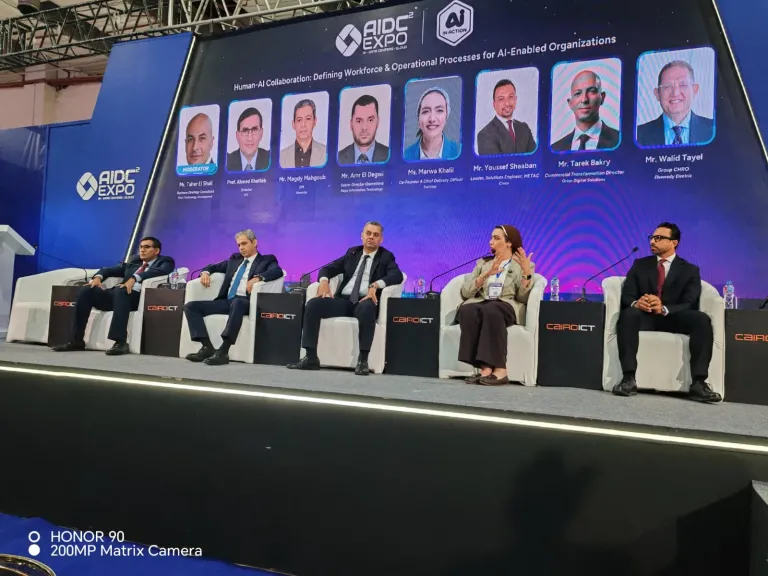
During a session on human-AI collaboration and the future of AI-powered enterprises, participants discussed the growing role of automation, the need for workforce development and the governance measures required to manage increasingly capable AI systems.
The discussion was moderated by Taher El-Shal, Business Strategy Consultant at Next Technology Development, and brought together experts from Cisco, Techline, Raya Information Technology, the National Telecom Institute, Onion Digital Solutions and Konecta.
AI Supports Employees Rather Than Replacing Them
El-Shal said AI is transforming existing jobs as well as creating new opportunities. Its role now includes collecting information, providing guidance and automating routine activities.
He cited contact centers as an example, where employees can use AI agents to retrieve relevant knowledge and receive recommendations while assisting customers.
Marwa Khalil, Co-founder and Chief Delivery Officer at Techline, added that AI agents can analyze conversations, customer journeys and sentiment to provide employees with real-time suggestions and more personalized service options.
She stressed that organizations need clear governance policies to determine which tasks AI can perform independently and which require employee review.
A Three-Tier Model for AI Governance
Khalil outlined a risk-based governance model that divides procedures into three categories:
- Low risk: AI may execute the procedure independently.
- Medium risk: AI can recommend an action, but an employee must review and implement it.
- High risk: Specialized professionals retain direct responsibility for the procedure.
She said the highest-risk category includes security incident response and investigations, where engineering expertise and human assessment are essential.
The approach is particularly relevant to banks and financial institutions, where uncontrolled automated actions could expose organizations and customers to significant risks.
Cisco Highlights Gen Z’s Growing Use of AI
Youssef Shaaban, Solutions Engineering Team Lead for METAC at Cisco, said AI is delivering value across IT service management, automated support-ticket classification and the detection of unusual system behavior.
He emphasized that AI should enhance employee productivity and support analysis, while strategic decisions remain with people.
Shaaban also pointed to changing customer expectations, shaped by digital services such as Uber, Netflix and Amazon. Organizations are responding by expanding digital communication channels, adopting chatbots and voice AI agents, and making historical customer information available to employees.
He noted that more than 70% of Gen Z employees already use consumer AI tools. With more than 60% of Egypt’s population under 30 and approximately 70% of the workforce belonging to the Millennial and Gen Z generations, organizations need to provide secure, approved AI platforms.
Without such alternatives, employees may turn to external applications that could expose corporate information to data leakage.
Agentic AI Requires Digital Identities and Access Controls
Shaaban explained that the development of Agentic AI has expanded AI’s role from generating content to executing tasks and actions.
Organizations therefore need to assign digital identities to AI agents, control their API access and define precisely what they are authorized to do.
He said these agents should be managed with controls comparable to those applied to employees, especially when they interact with financial transactions, legal requirements or sensitive customer situations.
AI may recommend corrective actions, but employees should retain responsibility for decisions and execution whenever human judgment is required.
Cybersecurity Must Keep Pace with AI
AI is also being used to identify infrastructure problems, including application failures linked to network components or cloud-hosted servers such as those on AWS, according to Shaaban.
However, he warned that AI-driven threats are developing at machine speed, creating security challenges that traditional methods alone may not address effectively.
He called for greater use of AI-powered cybersecurity solutions to identify vulnerabilities and respond to threats at the speed required.
Raya IT Uses AI to Streamline Complex Project Work
Amr El-Degwy, Senior Operations Manager at Raya Information Technology, said system integrators must both adopt AI internally and help clients integrate it into their business operations.
He explained that reviewing RFP documents for major projects could take up to two weeks, particularly when requirements need to be extracted and distributed among as many as 10 teams.
AI tools can shorten this process by analyzing documents, identifying requirements and organizing work across teams. El-Degwy cited Zoho Operations Center as an example of a tool used to support operational processes.
He added that automated analysis of system logs, events and triggers can help identify problems and recommend solutions, but organizations must establish rules governing whether AI can execute those solutions.
NTI Makes AI and Cybersecurity Core Training Components
Dr. Ahmed Khattab, Director of the National Telecom Institute, said AI and cybersecurity have become essential elements across the institute’s training programs.
Where these subjects were previously taught through separate tracks, they are now integrated into a wider range of technical disciplines. Khattab cited AI-powered mobile networks as an example of the convergence between telecommunications and intelligent technologies.
The institute is preparing engineers and graduates to use AI for automation and routine tasks, allowing them to devote more attention to system design, development and advanced technical work.
He stressed that training must preserve creativity and independent problem-solving rather than encourage complete dependence on AI.
Governance Standards and Executive Training Remain Priorities
Khattab said unified AI governance standards are still developing, with many organizations relying on their own internal initiatives. He also pointed to limited sharing of governance and security frameworks by some large language model developers.
He emphasized that organizations must identify which activities are suitable for automation and which require experienced professionals.
He also highlighted the need to train executives alongside younger employees, noting that some organizations face a gap between digitally skilled Gen Z employees and senior leaders who need a better understanding of AI’s business value.
NTI’s “Out of the Box” program seeks to address this challenge by introducing AI applications to different professional groups, including judges and medical workers. Khattab said the technology should assist judges and doctors, not replace their professional decisions.
Human Expertise Remains Central to AI Project Design
Dr. Tarek Bakry, Commercial Transformation Director at Onion Digital Solutions, said human involvement is necessary throughout the AI lifecycle.
Employees identify business needs, develop prompts, design AI agents and workflows, establish permissions and assess system outputs before critical decisions are approved.
Bakry added that security represents approximately 30% to 50% of some Agentic AI projects, demonstrating the importance of incorporating cybersecurity and governance from the design stage.
Konecta Calls for Clear Boundaries for AI Agents
Magdy Naguib, Technology Director at Konecta, said organizations should begin AI adoption by identifying business needs and defining the specific tasks that technology is expected to perform.
He stressed that every AI agent needs clearly defined access to information, systems and automated actions, with performance standards and review mechanisms in place.
Naguib added that young graduates should be trained to manage and direct AI agents. The objective is to ensure employees can control and use these systems effectively, rather than allowing AI to manage organizations without appropriate human direction.
Cairo ICT 2026 Brings Together Major Technology Platforms
Cairo ICT 2026 is being held under the patronage of the Prime Minister and focuses on practical applications of AI, digital services, operational efficiency and innovation.
Its accompanying events include AIDC², dedicated to AI, data centers and cloud computing; PAFIX, the digital payments and financial inclusion exhibition held under the auspices of the Central Bank of Egypt; and Connecta, covering gaming, smart devices and entertainment technology.
The Innovation Arena also offers startups and entrepreneurs opportunities to present their solutions and build connections with investors and business partners.