
African Finance Confidence Holds at 8/10 as Digital Fraud Hits 88% of Banks and Fintech Firms
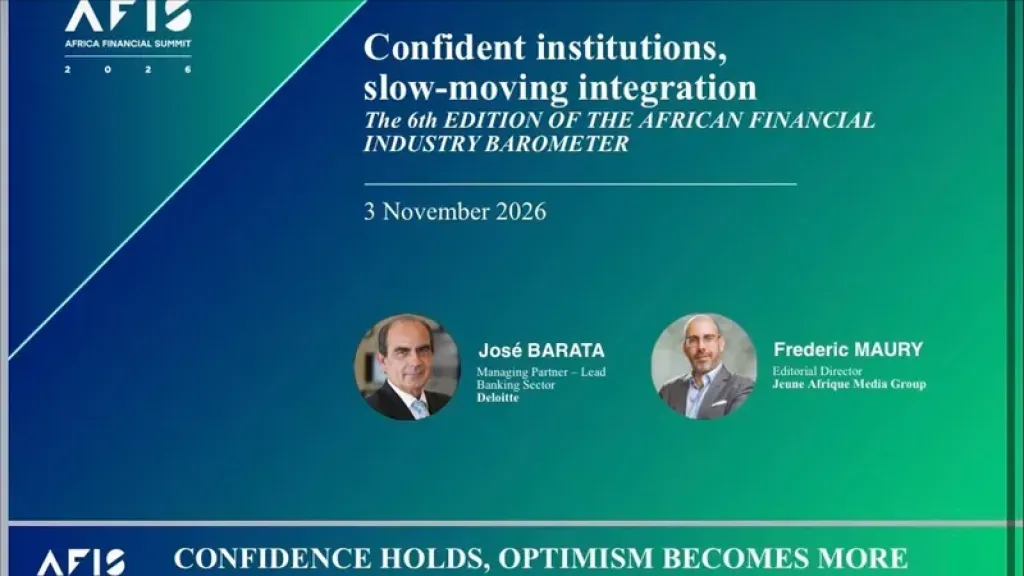
African financial institutions are maintaining confidence in the sector despite mounting cybersecurity threats and persistent barriers to regional integration, according to the 2026 African Financial Industry Barometer released by the Africa Financial Summit (AFIS) and Deloitte.
The report recorded an overall confidence score of 8 out of 10, unchanged from the previous year. However, digital fraud is becoming a more prominent concern: 66% of surveyed institutions reported an increase in incidents, with the figure rising to 88% among banks and fintech businesses.
The findings were presented at the sixth edition of AFIS, held in Luanda, Angola, on November 3 and 4, under the theme “Confident Institutions, Slow-Moving Integration.”
Confidence Varies Across Financial Institutions
Financial groups with operations in multiple markets recorded a confidence score of 8.53, the highest among the categories covered. Regional groups reached 8 points.
Capital markets led the sector rankings at 8.57, followed by fintech companies with 8.25 and banks with 8.
The outlook was more cautious among insurers and domestic institutions, whose confidence scores stood at 7.45 and 7.33, respectively.
The results suggest that institutions with broader geographical operations are generally more confident than businesses concentrated in individual domestic markets.
Cyber Threats and Geopolitical Risks Intensify
Cybersecurity was identified as the leading risk facing African financial institutions, cited by 51% of respondents.
Concern was particularly high among banks, where the figure reached 79%, up 19 percentage points. Fintech companies recorded a 63% concern rate, representing a 29-percentage-point increase.
Geopolitical risks ranked second, with 48% of institutions identifying them as a major concern, up 6 percentage points year over year.
The increase in reported digital fraud adds to these pressures, especially as financial institutions expand their reliance on online platforms and technology-enabled services.
AI Adoption Offers Benefits but Faces Practical Barriers
Artificial intelligence received positive assessments across most of the applications examined in the report. Six out of seven use cases achieved positive ratings above 60%, with fraud detection and operational efficiency among the highlighted areas.
Nevertheless, several obstacles continue to limit wider adoption.
Data quality and cybersecurity and privacy concerns each accounted for 56% of the challenges identified. Skills shortages were cited by 44%, while regulatory and legislative uncertainty represented 33%.
The results indicate that financial institutions will need to strengthen data foundations, cybersecurity safeguards and workforce capabilities while adapting to evolving regulatory requirements.
Regulatory Progress on Illicit Financial Flows
The report's indicator for combating illicit financial flows increased to 92%, marking a rise of 5 percentage points from the previous year.
This improvement comes as the sector continues to address risks linked to digital transactions, financial crime and the growing use of technology in financial services.
Regional Financial Integration Remains Slow
Progress on connecting African financial markets remains limited, according to the report.
Only 7% of participating institutions identified tangible progress in implementing the African Continental Free Trade Area (AfCFTA).
The African Exchanges Linkage Project (AELP) also faced challenges, with 43% of respondents describing the initiative as stalled.
For the Pan-African Payment and Settlement System (PAPSS), 45% of institutions said they had no plans to join. In addition, 41% reported that regional integration initiatives had not yet delivered tangible benefits.
The limited progress is encouraging institutions to focus on strengthening their positions in current markets rather than prioritizing cross-border expansion.
$775 Billion in Long-Term Assets Could Support Productive Investment
African pension funds and insurance companies collectively manage an estimated $775 billion in assets, according to the report.
AFIS and Deloitte highlighted the need to channel more of these long-term resources into productive economic activity rather than focusing solely on the size of available savings.
Financing for SMEs and housing were identified as important areas where these assets could help support investment and development across African markets.
Key Priorities for Africa's Financial Industry
The report presents a picture of a financial sector that remains confident but must address a widening range of operational and strategic challenges.
Strengthening cybersecurity, reducing digital fraud, improving data quality and building specialized AI capabilities are among the key priorities.
At the regional level, faster progress on financial integration and more effective use of long-term institutional assets could help expand financing for businesses and housing while supporting broader economic development.