
EUI Showcases Egypt’s AI Talent Through 2026 AI for Education Hackathon
EUI Showcases Egypt’s AI Talent Through 2026 AI for Education Hackathon
AI Takes Center Stage in Education Innovation
The Egypt University of Informatics (EUI) has hosted the final stage of the AI for Education Hackathon 2026, bringing together teams representing 160 universities, educational institutions and startups, alongside members of the GAINAfrica project alliance.
The event was held under the auspices of the Ministry of Communications and Information Technology (MCIT) at EUI’s campus in the New Administrative Capital.
Dr. Ahmed Hamad, Acting President of EUI, said artificial intelligence is increasingly becoming a key force behind transformation across multiple sectors, with education among the areas most affected by this shift.
He emphasized that the focus should move beyond simply introducing AI into education toward using the technology to improve learning quality, broaden access, develop students’ capabilities and prepare them for future demands.
Hackathons Connect Technology with Entrepreneurship
Hamad described hackathons as a platform that combines academic expertise, technological creativity and entrepreneurship.
Such competitions allow young innovators to tackle real challenges facing education while also highlighting Egypt’s progress in AI and promoting technology solutions developed by the local sector.
The 2026 hackathon was also linked to an international research initiative under Horizon Europe, funded by the European Union.
The project aims to test AI solutions tailored to African needs, with EUI leading its education track and working on Arabic-language AI applications designed to support teachers and learners.
1,000 Participants Compete Across 228 Teams
Dr. Amani Eissa, Director of EUI’s Entrepreneurship and Innovation Center and Chair of the hackathon’s evaluation committee, said the competition attracted approximately 1,000 participants representing 160 educational institutions and startups across 25 governorates.
The participants formed 228 teams, of which 153 passed the initial assessment stage.
The competition was subsequently narrowed to 32 teams, which presented their technology solutions before the judging panel. Six projects were ultimately selected as winners.
The evaluation covered several areas, including the viability of the proposed ideas, business models and the maturity of the AI technologies incorporated into the solutions.
Hekaya and SKAYZ Take Top Honors
In the student track, Hekaya, representing the German University, secured first place and received EGP 80,000, in addition to a special EGP 20,000 award for the best Arabic-language technology solution.
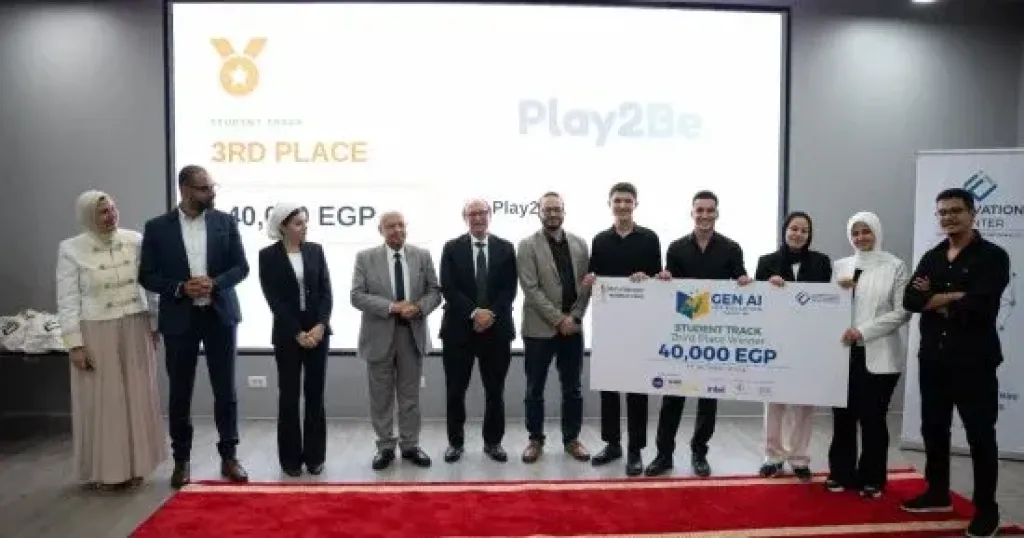
Shafahi, from the October University for Modern Sciences and Arts (MSA), ranked second with an EGP 60,000 prize, while Play2Be from EUI came third and received EGP 40,000.
In the startup track, SKAYZ won first place and EGP 120,000. NaFees AI — Anatomy Lab ranked second with EGP 80,000, while DARS took third place and received EGP 50,000.
Play2Be Develops AI-Powered Learning Experience
Among the highlighted projects was EUI’s Play2Be, which secured third place in the student category.
The team created an interactive classroom environment in which students explore a three-dimensional world while an AI-based guide asks questions instead of directly providing answers.
The concept is designed to help teachers identify students’ skills based on their responses.
Intel and Telecom Egypt Support Young Innovators
Taha Khalifa, Intel’s General Manager for the Middle East and Africa, said AI is transforming learning, creativity and approaches to complex challenges.
He noted that Intel’s sponsorship of the hackathon is part of its efforts to help develop Egypt’s next generation of AI innovators by connecting young talent with technology, mentorship and opportunities to work on real-world challenges.
Ahmed El-Fouly, Executive Vice President of Telecom Egypt for Information Technology Systems, said developing a competitive digital economy requires investment in people and the creation of an environment where young people can learn, innovate and turn ideas into technology solutions.
He highlighted WE Innovate, which supports innovation in cybersecurity and emerging technologies, develops young professionals, supports startups and provides resources for building solutions with growth potential.
El-Fouly added that Telecom Egypt has supported EUI since its establishment and has awarded 31 scholarships to outstanding students to date.
From Education Challenges to Scalable Technology
Dr. Ahmed Abdel Hamid, Chairman of Kaheelan Asset Management Group, said the group supported the hackathon through sponsorship, technical and investment mentorship, as well as participation in the judging process.
He expressed confidence in Egyptian innovators’ ability to create practical, Arabic-language solutions tailored to local education challenges, while hoping that the projects could eventually develop into technology companies capable of competing across regional markets.
Hasnaa Fathy, Head of Programs at EdVentures, said serving on the judging panel provided an opportunity to discover Egyptian talent through reviewing applications, demonstrations and the products developed by participating teams.
She highlighted the ability of several teams to combine AI with education technology to address practical challenges affecting teachers and learners.
Dr. Hoda Mokhtar, Dean of EUI’s Faculty of Computing and Information Sciences, also praised the participants’ focus on challenges facing Egyptian education and the needs of teachers and students across different stages.
She expressed hope that the participating ideas would progress into practical solutions capable of contributing to improvements in Egypt’s education system.
The startup judging panel included Dr. Hoda Mokhtar, Dr. Mohamed Hanafy from Telecom Egypt, Dr. Fady Azzouni from EdVentures and Dr. Ahmed Abdel Hamid from Kaheelan.
The student panel included Dr. Ahmed Kamal from Telecom Egypt, Wafaa El-Sawah from Intel, Bilal Yehia from EdVentures, Dr. Ahmed Essam from Kaheelan, Dr. Sherry Ezzat from EUI and Eng. Engy Abbas from Intel, who served on both judging panels.