
Open-Weight AI Models Capture 70% of Vercel Gateway Tokens as China Export Risks Grow
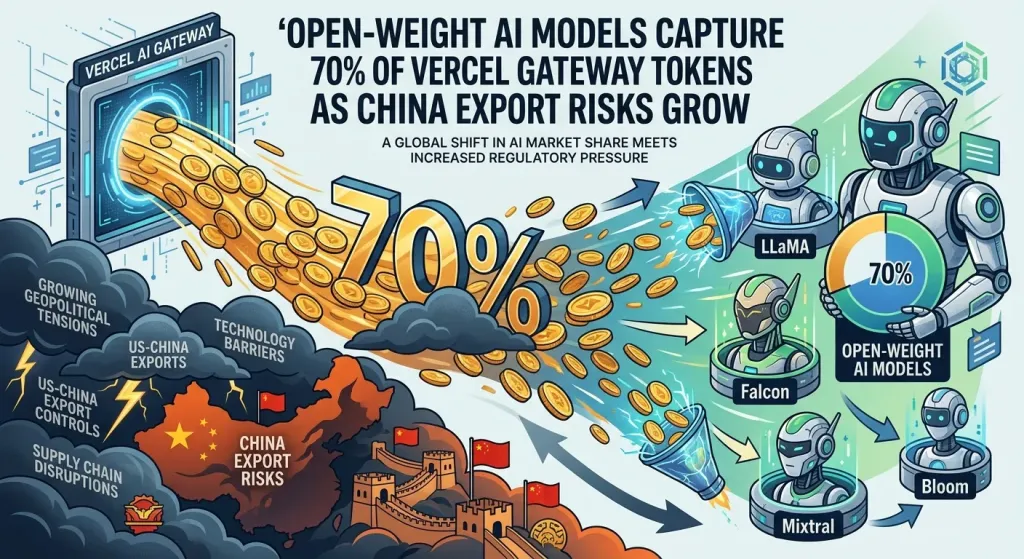
Open-weight AI models accounted for more than 70% of tokens processed through Vercel's AI Gateway in September 2026, while their share of spending climbed to nearly one-quarter, up from roughly 5% in June.
In its October 2026 AI Gateway Production Index, Vercel said open-weight models processed a majority of the platform's token volume for the first time in August. Their share of spending subsequently increased more than fourfold over three months.
AI Gateway, like OpenRouter, provides a common interface for purchasing tokens from multiple AI providers. It supports tools such as Claude Code and Codex and offers access to both proprietary and open-weight models. Its figures exclude activity through competing gateways, direct access to vendors and on-premises deployments.
Spending rises as token prices fall
Vercel reported that September spending through AI Gateway was about 13 times higher than in December 2025, even as the average price per token fell approximately 47%. Nearly one-third of teams also changed their most-used AI provider during September, suggesting competition may be limiting vendor lock-in.
TypeSafe AI's Jev was the most popular model that month, reaching 35% of paid AI Gateway teams within just 14 days. However, it accounted for only 1% of September's token volume and 0.15% of spending, reflecting its architecture.
US and Chinese models compete for spending
US models continued to attract the largest spending shares. Anthropic's Claude Opus 5.5 accounted for 11.03% of September spending, followed by OpenAI's GPT-6 Astra at 4.86%. China's DeepSeek V4.1 Flash ranked third, with 4.19%.
More than two-thirds of September spending on Chinese models went to US providers serving those models, compared with less than one-tenth in December 2025, according to Vercel.
Moonshot AI, the developer of Kimi, captured 3.6% of gateway tokens and 13.2% of spending. DeepSeek accounted for 58% of tokens but just 6.6% of spending, while Z.ai, the maker of GLM-5.3, represented 7.2% of tokens and 4.5% of spending.
China's export controls could disrupt US businesses
Potential US restrictions on open-weight models could affect American businesses hosting or relying on those systems, as well as their customers.
China proposed adding 40 technology items to its export control list on Friday, including 23 related to AI. The Associated Press reported that Moonshot's Kimi K3 and Alibaba's Qwen 3.8-Max meet the parameter threshold set by Chinese authorities, although the official announcement did not identify the models that could be affected.
Chris McGuire, a senior fellow for China and emerging technologies at the Council on Foreign Relations, said the proposal introduces significant uncertainty for US companies that host or depend on Chinese models.
He argued that Chinese AI labs are increasingly seeking revenue through licensing open-source models, while Beijing's ability to restrict those agreements at any time could make American businesses more reluctant to rely on them.
McGuire said the US should establish a comprehensive regulatory framework governing the overseas use of American AI technology and bring Chinese AI models used or hosted in the United States within its domestic AI regulations.