
Egyptian EdTech Startup STEMulator Turns Kids Into Robot Builders as Saudi Schools Drive Expansion
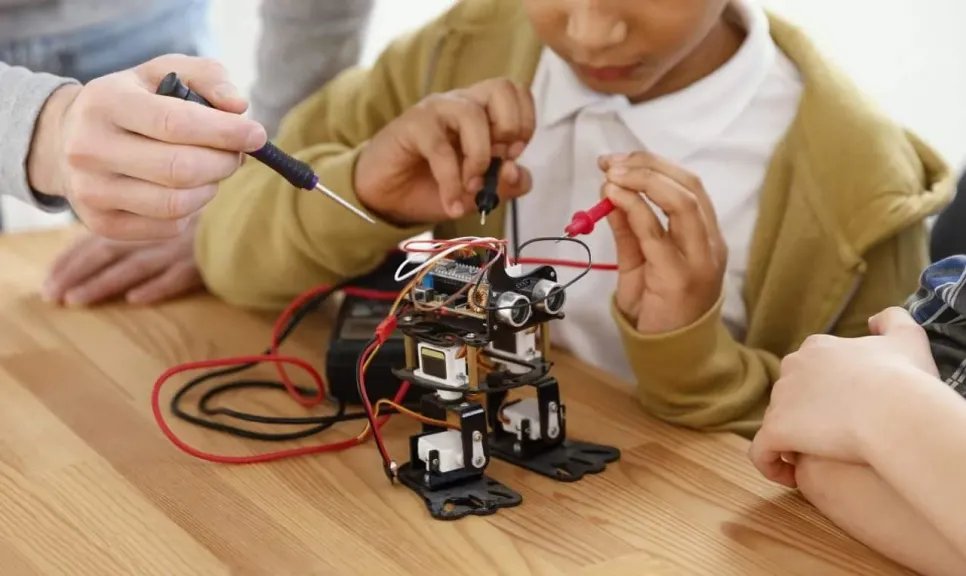
Egyptian EdTech startup STEMulator is looking to accelerate its expansion in Saudi Arabia after demand from schools in the Kingdom opened an unexpected route into the market, as the company bets that children should learn artificial intelligence by building and controlling physical systems rather than interacting with software alone.
The startup has already introduced its products into a number of Saudi schools and is now working to increase production capacity to serve growing demand, while continuing to expand across educational institutions in Egypt.
The Saudi opportunity was not initially part of STEMulator’s expansion plan. Interest from schools seeking access to the company’s educational system prompted the startup to enter the market, turning inbound demand into a potential regional growth channel.
For STEMulator, however, the larger proposition extends beyond selling robotics kits. The company has spent around four years developing an integrated hardware and software environment designed to take children from basic electronics and block-based programming to robotics, mobile applications, the Internet of Things and artificial intelligence.
Saudi Schools Open an Unexpected Growth Market
STEMulator co-founder Mohamed Hammam said demand from Saudi educational institutions emerged organically, with schools approaching the company to obtain its products.
The startup is now seeking to strengthen its presence in the Kingdom while increasing the volume of products it can manufacture and supply.
Saudi Arabia offers an increasingly relevant market for this type of educational technology as schools expand their focus on coding, robotics, AI and practical STEM education.
The Kingdom has been integrating AI more deeply into education while supporting robotics competitions and practical technology programs for school students.
For STEMulator, that creates an opportunity to move beyond its Egyptian base without having to fundamentally redesign its proposition: teaching children how software interacts with sensors, electronics and physical machines.
STEMulator Is Moving Beyond School Sales
The startup currently operates primarily through a B2B model, working with schools and other educational institutions.
That is about to change.
STEMulator is preparing to launch a B2C offering, allowing students and families to purchase and use its educational system directly rather than accessing it only through an institution.
The transition could significantly expand its addressable market.
Institutional sales give an EdTech company access to groups of students through schools, but direct-to-consumer distribution can extend usage into homes and allow children to continue experimenting outside formal classes.
It also changes STEMulator’s operational challenge.
The company says demand for its products is already exceeding the quantities it can currently provide, making manufacturing capacity increasingly important as it simultaneously expands geographically and prepares to open a consumer channel.
Designed in Egypt, Components Manufactured in China
STEMulator’s production model combines Egyptian intellectual property and assembly with international component manufacturing.
A number of components are manufactured in China according to the startup’s own designs and specifications before final assembly takes place in Egypt.
STEMulator also owns the software behind its educational platform.
That combination gives the company greater control over the interaction between hardware and software than an educational business relying entirely on third-party robotics kits.
But it also means expansion depends on physical supply chains.
Unlike a purely digital EdTech platform that can add thousands of users with relatively little additional hardware, STEMulator needs to secure components, manufacture units and increase assembly capacity as customer numbers grow.
Four Years and More Than 75 Engineers Behind the System
Building the platform took considerably longer than its founders initially expected.
Development lasted around four years, compared with an original expectation of roughly one year.
More than 75 engineers participated in developing the system over that period.
The result is a platform aimed primarily at children between six and 16 years old, combining electronic components, software and digital simulation in a single learning environment.
The central idea is to prevent AI education from becoming purely theoretical.
Instead of teaching children only how to write code or interact with AI applications, STEMulator wants them to understand how software can control real objects, receive information from sensors and produce physical responses.
More Than 24 Electronic Modules Create a Physical AI Playground
The system includes more than 24 different educational electronic modules designed to simplify concepts that can otherwise appear intimidating to younger students.
These include sensors capable of measuring variables such as heart rate and light intensity.
Children can collect data from those modules, display it on a screen or smartphone and incorporate it into technology projects.
That creates a path from a relatively simple experiment — measuring light, for example — toward understanding how connected devices collect environmental information and use software to respond to it.
The same underlying concept sits behind far more sophisticated Internet of Things, robotics and automation systems used commercially.
Ahmed Zewail and Magdi Yacoub Become Part of the Hardware
STEMulator has also incorporated an Egyptian identity into parts of its product design.
Some educational modules take inspiration from prominent Egyptian figures including Nobel Prize-winning scientist Ahmed Zewail and renowned heart surgeon Magdi Yacoub.
The approach is intended to introduce children to scientists while connecting technology education with real-world scientific achievement.
That gives the hardware another educational layer beyond its electronic function.
Instead of treating a sensor simply as a component, the company is attempting to build a wider learning experience around the device and the scientific concepts associated with it.
Children Can Build IoT Apps Without Previous Coding Experience
The software layer is designed to lower the entry barrier further.
Children can program using visual blocks rather than immediately having to master conventional programming languages.
They can also work with digital simulations before interacting with physical hardware.
Another part of the platform allows students to create mobile applications connected to Internet of Things devices without requiring previous programming experience.
A child can design an application interface, modify colors, add controls and functions, then run the resulting application on a smartphone and use it to interact with a project they have built.
This creates a complete development loop: build the electronic device, program its behavior, create the interface and then control the finished project from a phone.
The Startup Wants Children to Understand the Machine Behind AI
That hardware-software connection is particularly relevant as AI education expands.
Many introductory AI programs teach students how to use generative AI tools or develop basic software applications.
STEMulator is taking a different route.
Its founders argue that the next technology cycle will increasingly involve physical AI — intelligent software embedded in robots, machines, sensors and connected devices.
Teaching a child how to prompt an AI system is therefore only one part of digital literacy.
Understanding how a sensor generates data, how software interprets it and how an electronic system turns a decision into physical action introduces another layer of technological understanding.
That distinction could become more important as humanoid robots, autonomous machines and AI-enabled devices move beyond laboratories into factories, logistics, healthcare and homes.
Universities Are Becoming the Next Expansion Layer
Although STEMulator was initially built around younger students, the company has started expanding into Egyptian universities.
It has secured space inside a university as part of efforts to broaden the use of its platform beyond children and school students.
University expansion could also give STEMulator another environment in which to test more advanced applications of its hardware and software.
It potentially places the startup across three educational layers: schools, universities and direct-to-consumer learning at home.
ITIDA Is Backing the Startup Through TIEC
STEMulator is also receiving incubation support from the Technology Innovation and Entrepreneurship Center, part of Egypt’s Information Technology Industry Development Agency.
The startup was one of the winners of Round 51 of TIEC’s Start IT competition in June 2026.
Start IT targets entrepreneurs with ICT prototypes and proof-of-concept products that can be developed into scalable businesses.
Winning startups receive a one-year incubation package that includes financial support, workspace, consulting, technical tools, marketing assistance and access to business and technical mentors.
STEMulator is also among 10 Egyptian technology startups being showcased through ITIDA’s pavilion at Techne Summit Alexandria 2026, alongside companies operating across cybersecurity, healthtech, fintech, SaaS, deep tech, business automation and electric mobility.
Production Capacity May Be the Next Test
STEMulator’s immediate challenge is no longer simply proving that schools are interested in its product.
It is whether the company can manufacture enough units to meet that interest.
Expanding simultaneously into Saudi Arabia, Egyptian universities and the consumer market could create substantially greater demand for hardware.
That makes component sourcing, manufacturing economics, inventory and distribution increasingly important to the next phase of the business.
The company has not disclosed its current production capacity, Saudi sales figures, number of schools using the platform or the investment required to expand manufacturing.
Those numbers will become increasingly relevant if the startup moves from an incubated Egyptian EdTech company into a regional educational hardware business.
STEMulator’s Saudi expansion is therefore about more than entering another market. It is an early test of whether an Egyptian startup can turn locally developed educational hardware and software into a scalable regional product — and whether teaching children to build the machines behind AI can become a business as well as an educational proposition.