
Visa Selects 21 African Fintechs as AI and Stablecoins Reshape Financial Services
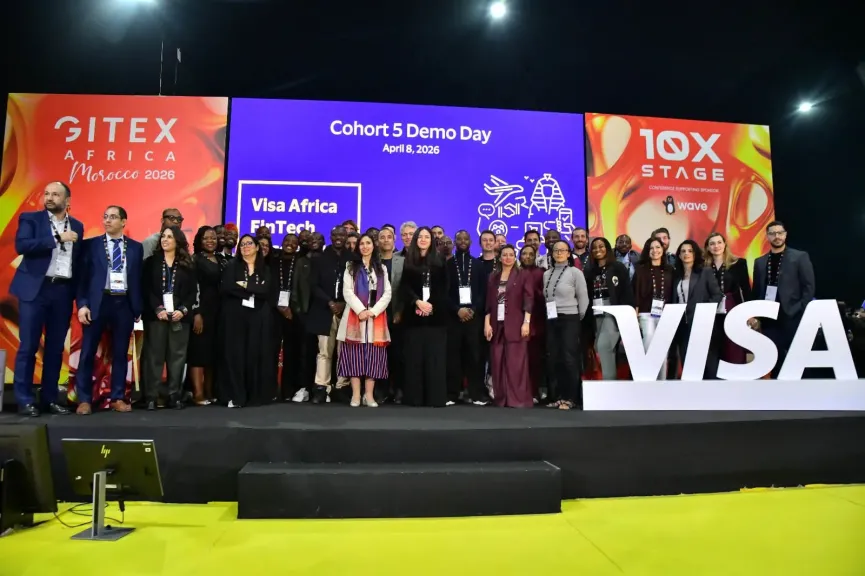
Visa Picks 21 African Fintechs as AI, Stablecoins and Agentic Commerce Reshape Finance
Visa has launched the sixth cohort of its Africa FinTech Accelerator with 21 companies from nine countries, highlighting how Africa’s fintech landscape is expanding beyond conventional digital payments into AI, stablecoins, agentic commerce and cross-border financial infrastructure.
The three-month program has kicked off in Accra, Ghana, bringing together startups operating across 24 markets, with Niger, Togo and Seychelles represented in the accelerator for the first time.
Egypt also has a visible presence in the new cohort through Fincart, ParlexAI and Remi, three companies addressing different parts of the financial technology stack — from e-commerce infrastructure and AI-powered financial interactions to cross-border money movement.
The sixth cohort arrives after Visa’s accelerator passed an important milestone earlier this year. Its first five cohorts supported 104 startups, with a combined valuation of approximately $1.4 billion.
But the composition of the latest group suggests that the program itself is changing alongside Africa’s fintech sector.
Payments remain central, but the technologies surrounding them are becoming considerably broader.
Egypt Brings E-Commerce, AI and Cross-Border Payments to the Cohort
The Egyptian participation reflects that diversification.
Fincart, founded in Cairo in 2023, is building infrastructure for e-commerce businesses, helping online sellers, SMEs and digital marketplaces manage shipping, collections, customer communication, financing and after-sales operations through one platform.
Rather than functioning simply as a payment company, Fincart is targeting the operational infrastructure behind digital commerce.
ParlexAI approaches financial services from another direction.
The company develops AI infrastructure that allows financial institutions to automate interactions across voice and digital channels, covering areas including collections, customer service, onboarding and verification.
Its participation is particularly relevant as banks and financial institutions increasingly explore how generative and agentic AI can move from internal experimentation into customer-facing financial workflows.
Remi, meanwhile, is developing infrastructure for cross-border money movement.
Its technology aims to connect different payment and settlement networks through a unified layer, making transfers faster, more transparent and programmable across emerging markets.
The company operates across Egypt, the UAE, Canada and Morocco.
Niger, Togo and Seychelles Join for the First Time
The geographic expansion of the sixth cohort is another important feature.
Companies from Niger, Togo and Seychelles are participating for the first time, widening the accelerator beyond Africa’s largest and most established fintech ecosystems.
Niger is represented by Sako, which is developing technology designed to simplify money transfers and financial transactions.
Borderless joins from Togo, while Seychelles is represented by Fusepay.
Fusepay is developing an AI-powered financial and operational system for businesses, combining ordering, inventory, invoicing, collections, payments and reconciliation within one platform.
The company is regulated by the Central Bank of Seychelles as a payment services provider.
Their inclusion demonstrates how fintech development is spreading into markets that have historically attracted considerably less venture capital than major hubs such as Egypt, Nigeria, Kenya and South Africa.
Stablecoins and Agentic Commerce Enter Visa’s Fintech Pipeline
Perhaps the most revealing element of the new cohort is the range of technologies represented.
Visa says the companies span areas including stablecoins, agentic commerce, sustainable finance, payments and financial infrastructure.
That is a considerably wider definition of fintech than the payment apps and digital wallets that dominated much of Africa’s earlier startup growth.
Stablecoins are increasingly being explored for cross-border settlement and money movement, particularly where traditional international payment rails can be expensive or slow.
Agentic commerce introduces another emerging model, in which AI agents could eventually search, compare, negotiate or complete transactions on behalf of consumers and businesses.
Visa itself has been investing in infrastructure around agentic commerce, making startups working in this area strategically relevant to the future of its global payment network.
The accelerator therefore offers Visa an early view into technologies that could eventually change not only how consumers pay, but also who — or what — initiates the transaction.
Agridex Is Building Cross-Border Infrastructure Across 35 Markets
Another participant, Agridex, illustrates the emphasis on cross-border financial infrastructure.
The company is developing trade and payment infrastructure designed to connect African producers and businesses with international markets.
It says its technology already facilitates money movement across 35 markets.
Cross-border payments remain one of the largest opportunities in African fintech because businesses often have to navigate fragmented banking systems, currencies, payment networks and regulatory regimes when moving money between markets.
Infrastructure companies attempting to connect those systems could therefore become increasingly important as intra-African digital commerce expands.
The Accelerator Is More Than a Three-Month Training Program
Visa’s Africa FinTech Accelerator operates through a three-month hybrid format.
The program begins with onboarding before moving through 10 weeks of virtual sessions, followed by an investor-focused week and an in-person Demo Day.
Startups receive support covering product development, marketing, finance and sales alongside individual mentoring from founders and industry specialists.
Participants also receive fintech training from Visa and access to the Visa Developer Portal.
The program is aimed at companies ranging from Seed to Series A, provided they have reached at least the minimum viable product stage, tested their products in the market and demonstrated potential for growth.
Participation itself is free.
Companies completing the program may subsequently be considered for investment from Visa, Plug and Play or other investors, although participation does not guarantee funding.
Visa Has Already Moved From Mentoring Startups to Investing in Them
The accelerator is increasingly functioning as more than an ecosystem-building exercise for Visa.
The payments company has already invested in African fintech companies emerging from the program.
Following the accelerator’s activities at GITEX Africa in 2025, Visa announced investments in Konnect and PayTic, demonstrating that participating companies can potentially move from mentorship into direct strategic relationships with the global payments company.
Visa has also highlighted commercial collaborations among previous accelerator participants and its wider ecosystem.
MoneyHash, for example, entered a multi-year partnership to make Visa’s Cybersource available through its platform, while other alumni have collaborated on digital credit and stablecoin-linked payment products.
That creates a strategic dimension to the accelerator.
Visa is not simply helping startups grow. It is creating a pipeline of companies whose technology could eventually connect with its own payment infrastructure.
More Than 100 Startups Have Passed Through the Program
Visa launched the Africa FinTech Accelerator in 2023.
By the completion of its fifth cohort, the program had supported 104 startups, representing more than 35 countries and a combined valuation of approximately $1.4 billion.
Cohort 5 alone brought together 18 startups from 10 African countries operating across 28 markets.
The sixth cohort adds another 21 companies and extends the program into three countries that had not previously been represented.
That expansion is important because Africa’s fintech ecosystem remains highly concentrated geographically.
Bringing founders from smaller markets into the same network as investors, banks, payment companies and technology providers could help reduce some of that concentration, particularly for startups whose domestic markets alone may not provide sufficient scale.
Visa Is Building a Window Into Africa’s Next Fintech Cycle
The biggest significance of the sixth cohort may therefore be what its composition says about where African fintech is heading.
The first major fintech wave across the continent focused heavily on digitizing payments, mobile money and access to financial services.
Those problems have not disappeared.
But the new cohort suggests the next wave is becoming more technically complex: AI systems interacting with customers, stablecoins moving money across borders, infrastructure connecting fragmented payment networks and intelligent agents potentially initiating transactions themselves.
For Visa, supporting these companies provides access to innovations that could eventually become part of the financial infrastructure through which billions of future transactions flow.
The sixth Africa FinTech Accelerator cohort is therefore not simply another group of 21 startups. It offers an early snapshot of the technologies competing to define Africa’s next financial-services cycle — one in which payments increasingly sit alongside AI, stablecoins, cross-border infrastructure and autonomous digital agents.