
Strategic Partnership Between Egypt and Estonia to Boost Digital Innovation and Growth in Tech Exports
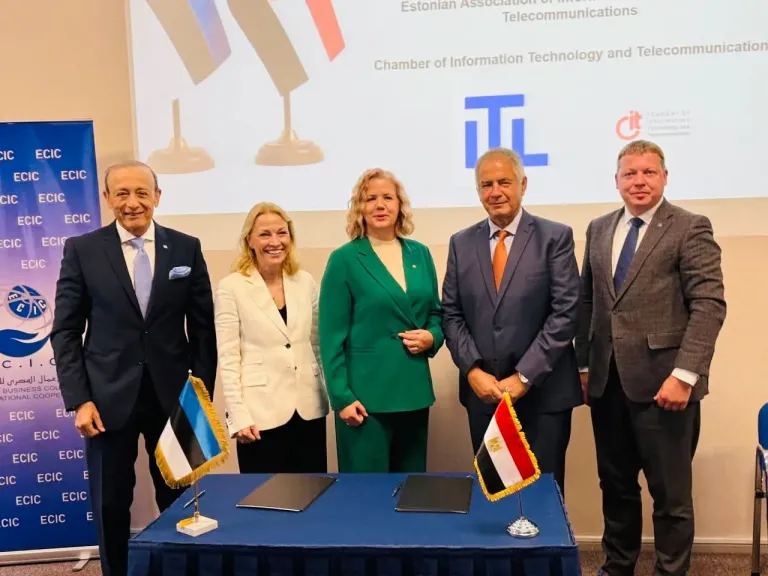
A Digital Bridge Between Cairo and Tallinn to Open Global Markets
In a strategic step to support digital transformation and expand tech investments, the Egyptian Chamber of Information Technology and Telecommunications (CIT) announced the signing of a joint Memorandum of Understanding (MoU) with the Estonian Association of Information Technology and Telecommunications (ITL) in Tallinn. The agreement aims to build a sustainable bridge of cooperation between both sectors and unlock new markets for digital companies and startups.
The MoU was signed by Eng. Khaled Ibrahim, Chairman of the "CIT" Chamber, and Ms. Doris Põld, CEO of the Estonian ITL Association. The ceremony was attended by a high-level Egyptian delegation including members of the House of Representatives, the Senate, export councils, and business leaders headed by Eng. Moataz Raslan, Chairman of the Egyptian-Canadian Business Council and Honorary Consul of Estonia in Egypt.
Empowering Local Talent and Leveraging Egyptian Market Potential
Eng. Khaled Ibrahim emphasized that this partnership with Estonia — a global role model in digital identity and cybersecurity — represents a qualitative leap towards empowering Egyptian companies and professionals to compete in international markets, while introducing Estonian businesses to promising opportunities within Egypt.
Ibrahim highlighted the solid foundation of Egypt’s tech sector, noting that the "CIT" Chamber encompasses around 15,000 specialized companies, and that Egyptian digital exports reached approximately $7.4 billion in 2025. Additionally, Egypt hosts over 270 global centers providing software and IT services.
An Economic Alliance Covering Advanced Technologies
Eng. Moataz Raslan stressed the importance of translating this agreement into tangible business partnerships. He noted that the initiative creates direct communication channels between the Egyptian business community and European markets, backed by representatives from business councils and the media.
The MoU establishes a practical framework covering vital tech domains, including Artificial Intelligence, cybersecurity, e-government, digital identity, cloud computing, smart cities, the Internet of Things (IoT), and digital payments, alongside supporting R&D and nurturing startups to build a sustainable digital future for both nations.