
Trump Replaces ”Artificial Intelligence” with ”Super Intelligence” in US Government Lexicon
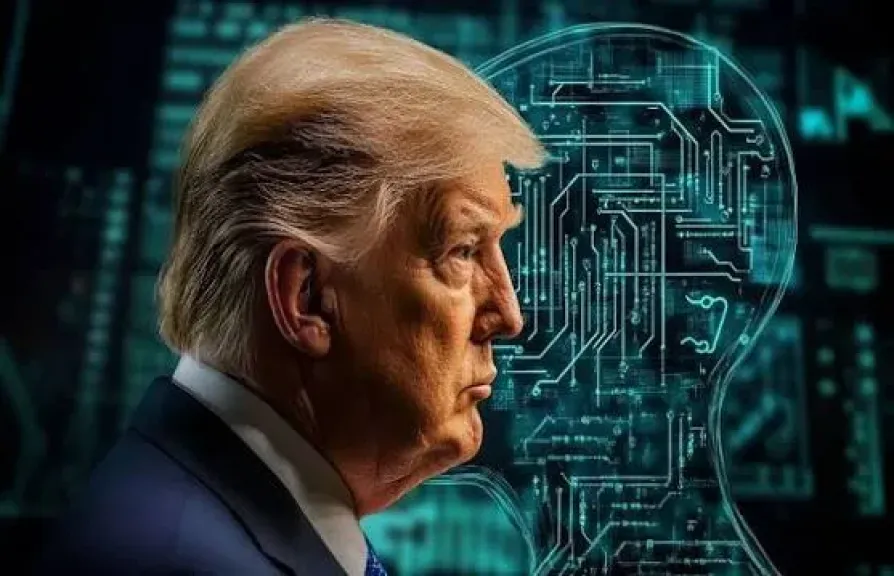
US President Donald Trump has announced his administration's decision to adopt the term 'Super Intelligence' in place of 'Artificial Intelligence' across all US government discourse and documentation.
Trump justified the shift by stating that labeling the technology as 'artificial' fails to accurately reflect the reality of the capabilities that modern intelligent systems have achieved. He argued that the technology has transcended the traditional concept of merely simulating human intelligence, evolving into a cognitive and technological force capable of outperforming humans in an increasing number of fields.
The terminology shift is deeply tied to Trump's vision of the global technological race, particularly the fierce competition between the United States and China over AI development and advanced computing capabilities.
However, the term 'Superintelligence' is not novel within scientific circles. It has been utilized for years to describe hypothetical systems that vastly exceed human cognitive abilities across virtually all domains. Scientifically, the two concepts are distinct: Artificial Intelligence serves as a broad umbrella for various current technologies, whereas Superintelligence denotes a highly advanced stage where machines broadly surpass human capabilities.
**Political and Technological Implications**
Applying 'Super Intelligence' to all current AI technologies is therefore not merely a linguistic swap, but a broadening of a term with a specific, distinct technical meaning.
While Trump can direct US federal agencies to adopt the new nomenclature in official correspondence, he lacks the authority to compel global corporations, universities, or research institutions to follow suit. The term 'Artificial Intelligence' has been entrenched in scientific research, industry, and academia for decades, forming the foundation of company names, products, research labs, and specialized conferences worldwide.
Consequently, while an administrative mandate can change the lexicon within the US government, a global paradigm shift would require massive, widespread adoption by the international tech and research communities.
The move carries significant political and technological weight. By adopting 'Super Intelligence,' Trump is framing the technology not simply as a new sector, but as a critical domain of national power and geopolitical competition. While 'AI' remains the standard scientific term, Trump's linguistic pivot projects a highly ambitious vision for the future of tech—one where smart systems transition from simulating human capabilities to decisively surpassing them.