
Egypt’s ICT Minister Opens FDC Summit 2026, Witnesses Cybersecurity MoU Signing
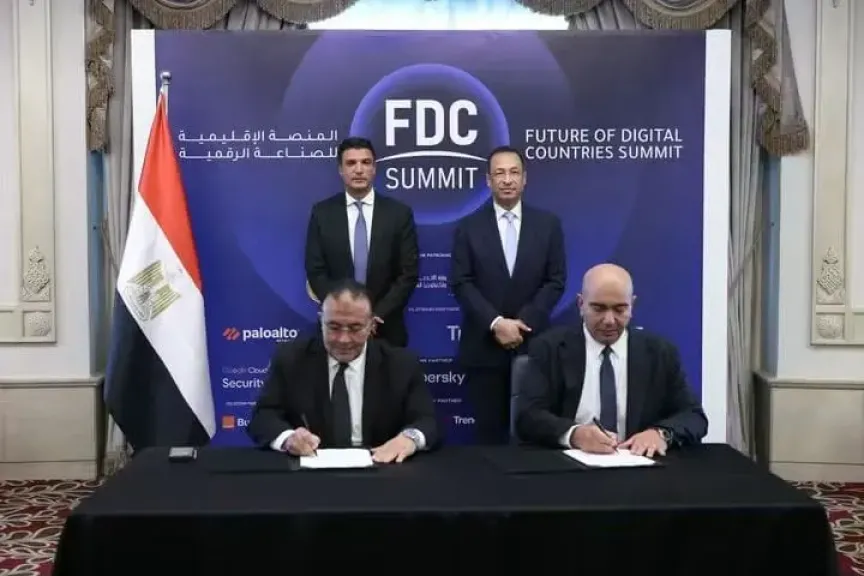
Egypt’s ICT Minister Opens FDC Summit 2026 and Witnesses Cybersecurity MoU Signing
Egyptian Minister of Communications and Information Technology Raafat Hendy inaugurated the eighth edition of the Future of Digital Countries Summit (FDC Summit 2026), held from September 22 to 24, in the presence of Minister of Trade and Industry Khaled Hashem.
Held under the auspices of MCIT, the Ministry of Trade and Industry, and the Cabinet’s Information and Decision Support Center (IDSC), the summit brings together government officials, ICT experts, and executives from leading local, regional, and international companies operating in technology, telecommunications, cybersecurity, artificial intelligence, data centers, and digital infrastructure.
During the opening session, Hendy outlined MCIT’s vision for developing Egypt’s digital economy and increasing the sector’s contribution to economic growth and job creation. He highlighted efforts to improve government services, enhance public-sector efficiency, support innovation and entrepreneurship, and strengthen digital sovereignty and data protection.
The minister said digital transformation is enabling citizens to access government services remotely through integrated digital tools, including digital identity, electronic signatures, and registered digital mail. He added that the government is targeting 400 digital government services on the Digital Egypt platform by 2030.
Hendy also highlighted the role of the 24 Creativa Innovation Hubs operating across 20 governorates in supporting startups and entrepreneurs through skills development, business incubation, investor connections, and access to new markets.
On artificial intelligence, the minister noted that Egypt began developing an integrated national AI framework in 2019. The second edition of the National AI Strategy sets targets for 2030, including supporting more than 250 AI startups, training over 30,000 specialists, and enabling 36% of citizens to use AI-powered tools.
He also highlighted locally developed AI applications, including Karnak, described as Egypt’s first national Arabic large language model, developed by Egyptian engineers at the Applied Innovation Center (AIC), as well as Loghat and Bel Masry.
Data centers were also highlighted as a key component of Egypt’s digital economy. Hendy noted their importance in hosting and processing data, supporting digital services, AI, and advanced computing, and ensuring the continuity of critical services.
According to Hendy, Egypt’s geographic position and digital infrastructure provide a strong foundation for the sector, with 20 international submarine cables crossing the country and carrying around 90% of internet traffic between Europe and Asia. Egypt aims to leverage this position by expanding data hosting and processing capabilities, attracting data center and cloud service providers, developing digital applications, and exporting technology services.
The minister added that MCIT is preparing a comprehensive national strategy for data centers, which is expected to be launched by the end of 2026.
Cybersecurity was another major focus of the minister’s remarks. Hendy described it as essential to national security and digital trust, noting that the government is implementing the second edition of the National Cybersecurity Strategy for 2023–2027 through the Egyptian Supreme Cybersecurity Council. Preparations for a third edition have also begun to address emerging technological risks and strengthen the readiness of critical sectors.
Hendy further noted that the ICT sector remains a government priority and continues to play a major role in investment, economic growth, and employment. The sector’s growth rate exceeded 19% during fiscal year 2025/2026, including a 24.3% expansion in the fourth quarter.
For his part, FDC Summit Chairman Tarek Shabaka said the 2026 edition marks a new phase for the event, shifting its focus from showcasing emerging technologies toward examining their practical use in addressing major challenges. He also noted that the summit has transitioned into an independent, non-profit organization.
AI, data centers, cloud computing, cybersecurity, data protection, and digital identity are among the key topics on this year’s agenda, bringing together policymakers, regulators, technology companies, investors, and industry experts.
On the sidelines of the summit, Hendy and Industry Minister Khaled Hashem witnessed the signing of a Memorandum of Understanding between Mideast Communication Systems (MCS) and the Industrial Modernization Centre (IMC).
The agreement focuses on raising cybersecurity awareness, developing specialized capabilities, supporting digital transformation, and enhancing cyber readiness across Egypt’s industrial sector. It also includes joint initiatives in AI, digital transformation, and cybersecurity, as well as specialized workshops, seminars, knowledge exchange, and the sharing of local and international best practices.
The two ministers also toured the FDC Summit exhibition, reviewing technology solutions and innovations presented by leading local and international companies in digital transformation, cybersecurity, and artificial intelligence.