
Headphone Security Flaw Could Enable Remote Eavesdropping From 30 Meters
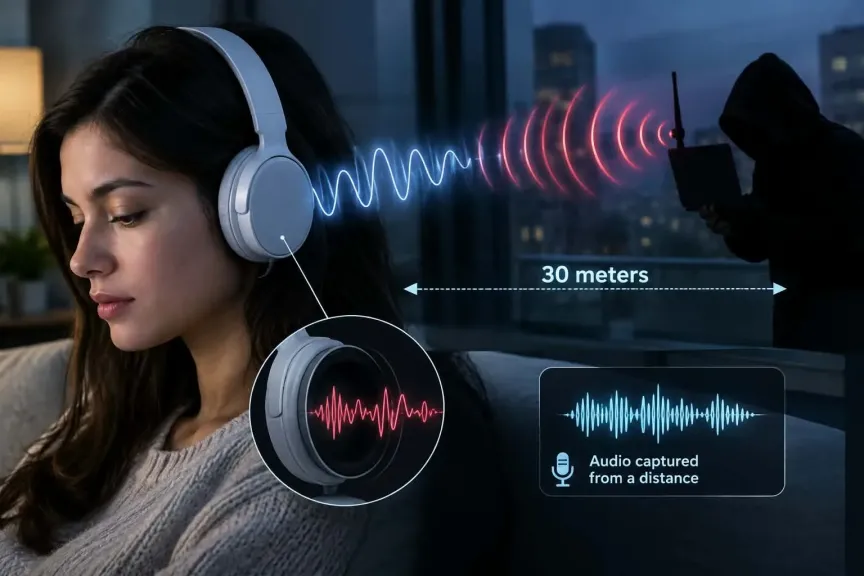
Headphone Vulnerability Could Allow Remote Eavesdropping From Up to 30 Meters
Cybersecurity researchers have uncovered a new attack technique that could allow attackers to capture audio from certain headphones from a distance, raising concerns about user privacy and device security.
The technique, known as InjectEave, exploits electromagnetic interference with electronic components inside headphones. By transmitting specially crafted radio-frequency signals, attackers may be able to induce and recover audio signals from compatible devices.
During testing, researchers were able to recover intelligible audio from some devices at distances of several meters and even through walls. With additional signal-amplification equipment, the researchers demonstrated audio recovery at a maximum distance of 30 meters.
The experiments involved several commercially available devices, including products from Sony, HP, and Philips, indicating that the issue may affect different types of headphones rather than being limited to a single manufacturer.
However, the 30-meter range does not represent the normal operating range of the attack. Under more typical conditions, the researchers recorded shorter effective distances that varied depending on the device and environment.
Unlike conventional digital attacks, the technique targets the analog pathways and electronic components within audio devices. This means that traditional security measures such as encryption may not be sufficient on their own to prevent this type of signal leakage.
Researchers suggested that manufacturers could reduce the risk through measures such as electromagnetic shielding, improved circuit design, and appropriate filtering techniques.