
Egypt’s Logistics Sector Looks Beyond More Trucks to Finance, Technology and Better Use of Assets
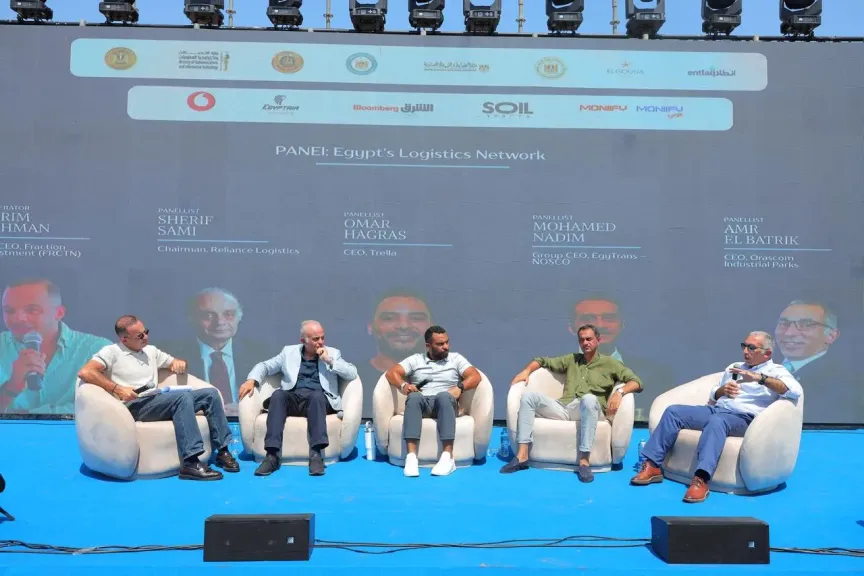
Egypt’s logistics sector may not need more physical assets as much as it needs to make better use of the ones it already has, with industry executives pointing to financing, technology and more coordinated investment processes as the next drivers of growth.
Executives from industrial development, logistics, transport and technology companies said Egypt has significant infrastructure and transport capacity, but fragmentation across financing, regulation, asset ownership and operations continues to limit efficiency.
The discussion took place during the “Egypt’s Logistics Network” panel at the fourth edition of the Egyptian Entrepreneurship Sector Annual Report Summit (SDR 2026) in El Gouna.
The executives broadly agreed on one point: building more warehouses, adding trucks or developing additional industrial land will not be enough unless investors can finance those assets, navigate regulatory processes more predictably and use technology to connect capacity with demand.
Industrial developers are becoming investment enablers
Amr El Batrik, CEO and Board Member of Orascom Industrial Parks, said the role of industrial developers has expanded beyond preparing land and infrastructure.
Developers increasingly need to support investors from the earliest stages, including helping them access financing, structuring contracts and investments in ways that lenders can finance, and delivering projects around individual operational requirements.
One of the biggest obstacles, he said, remains the number of authorities and regulatory procedures involved in moving an industrial or logistics project from investment decision to operation.
Such delays are particularly difficult because they are not always predictable enough to be incorporated into business plans or financing structures.
El Batrik called for a clearer roadmap covering the investor’s entire journey, supported by stronger coordination between government entities and other stakeholders.
Logistics assets create room for new financing models
For Sherif Samy, Chairman of National Investment & Asset Management SAE and Reliance Logistics SAE, logistics has an advantage that makes it particularly attractive for financing: much of the industry is built around identifiable assets.
Warehouses, trucks and logistics facilities can be valued and financed, but Samy argued that lenders and investors should not begin their assessment with collateral.
The first question should instead be whether a business can generate sufficient cash flow to meet its financial obligations.
Egypt’s expanding non-bank financial sector could play a bigger role here. Leasing and factoring can provide structures better suited to logistics businesses than conventional loans in some cases, while more sophisticated models could unlock another pool of capital.
Samy pointed to fractional ownership and real estate investment funds as potential mechanisms for financing logistics infrastructure.
Combining equity and debt could also help transform underused land and assets into specialized infrastructure, including container yards and cold-storage facilities, without relying entirely on conventional bank financing.
Trella sees fragmentation as an opportunity
Technology could address another structural problem: Egypt’s fragmented trucking market.
Omar Hagrass, Co-Founder and CEO of Trella, argued that fragmentation itself does not have to be a weakness if technology can connect truck owners and operators through a more visible and organized marketplace.
The bigger issue is knowing where assets are, whether they are available and where demand exists.
Real-time visibility could allow operators to match trucks with suitable loads, reduce empty journeys and improve fleet utilization, increasing logistics capacity without necessarily adding more vehicles.
Platforms aggregating truck and shipment data could eventually provide businesses with a clearer picture of available capacity across the market.
As adoption increases, such systems could also reduce waiting times around loading and unloading and improve supply-chain planning.
The underlying argument is significant: Egypt could increase effective transport capacity by making existing trucks work more efficiently rather than continuously expanding fleet size.
Egytrans-NOSCO merger puts people before scale
A different type of integration is taking place at the corporate level.
Mohamed Nadeem, Chief Commercial and Operations Officer of the merged Egytrans-NOSCO entity, said the hardest part of combining the two logistics companies was not integrating financial numbers or organizational structures.
It was bringing together people from companies that had competed with each other for more than 50 years.
Nadeem said the rationale behind the merger went beyond gaining market share or simply creating a larger company. The objective was to combine Egytrans’ diversified logistics offering with NOSCO’s execution capabilities to provide customers with more integrated services through a single provider.
Joint projects ultimately helped demonstrate the value of the combination, but he said changing behavior and integrating different corporate cultures proved to be the most difficult part of the process.
Egypt’s logistics opportunity is increasingly about efficiency
Together, the four perspectives point to a shift in how Egypt’s logistics opportunity is being defined.
Industrial developers are moving closer to financing and investor support. Non-bank financial tools could unlock capital tied to logistics assets. Technology platforms can connect fragmented transport capacity. And consolidation can create companies capable of offering more integrated services.
That means the next stage of growth may depend less on simply accumulating more land, warehouses and trucks.
The bigger opportunity is to connect capital, infrastructure, data and operators so that Egypt can extract more value from the logistics assets it already has.
The SDR 2026 Summit was held in El Gouna from September 10 to 12, bringing together government officials, investors, entrepreneurs and industry executives to discuss investment, innovation and growth opportunities across Egypt’s economy.
Sources: SDR 2026 Summit; Entlaq; statements by participating executives.