
Tencent Cloud Lands Major Saudi Logistics Workload as TruKKer Moves to Local Infrastructure
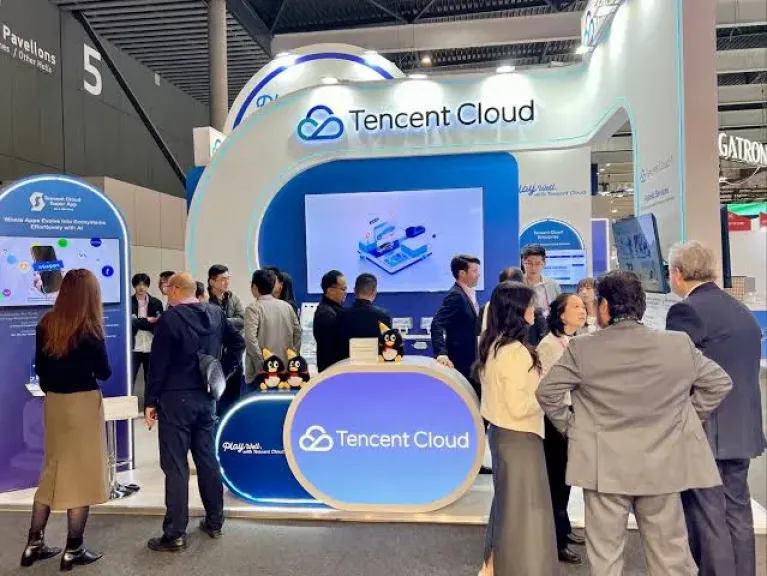
Tencent Cloud is taking another step deeper into Saudi Arabia’s enterprise technology market, signing a partnership with digital freight platform TruKKer that will move the logistics company’s platform onto Tencent’s local cloud infrastructure in the Kingdom and bring AI-powered coding tools into its technology operations.
Under the agreement, TruKKer will migrate its platform to Tencent Cloud’s Saudi Arabia region and adopt CodeBuddy, Tencent’s AI-powered coding assistant, as part of an initiative to reshape its development and operations, or DevOps, practices.
The deal gives Tencent Cloud a significant logistics workload as it builds out its Middle East presence, while giving TruKKer local cloud infrastructure for a platform that depends heavily on real-time data, truck availability and pricing across a large freight network.
Founded in 2016, TruKKer has grown into what it describes as the Middle East and North Africa’s largest digital freight network, connecting more than 75,000 verified trucks across three continents. Its platform serves industries ranging from FMCG and retail to construction, chemicals and oil and gas.
Why Saudi infrastructure matters for TruKKer
TruKKer’s technology sits at the centre of its operating model, connecting shippers and carriers while handling freight procurement, execution, tracking, documentation and payments.
Moving that infrastructure to Tencent Cloud’s Saudi region therefore goes beyond changing cloud providers.
Local infrastructure is intended to support the scale and responsiveness required by TruKKer as it manages freight operations in the Kingdom, including real-time shipment visibility and access to available trucking capacity.
Pradeep Mallavarapu, Co-Founder and Chief Technology Officer of TruKKer Middle East, said the company’s platform needs to deliver guaranteed truck availability, real-time visibility and competitive pricing at scale.
He said adopting advanced AI tools would also allow TruKKer’s teams to spend more time creating value for customers and carriers.
CodeBuddy adds another layer to the partnership.
Rather than applying AI directly to truck routing or freight pricing under the announced agreement, TruKKer will initially use Tencent’s AI coding assistant within its software development environment, targeting the processes used to build, maintain and improve its technology platform.
Tencent’s $150 million Saudi push
The agreement arrives as Tencent Cloud accelerates an infrastructure strategy in Saudi Arabia that began taking shape last year.
In 2025, the company announced its first Middle East cloud region in the Kingdom, built around two availability zones and backed by a commitment of more than $150 million covering infrastructure, resources and investment.
Tencent Cloud has since secured a Class C Cloud Service Provider licence from Saudi Arabia’s Communications, Space and Technology Commission, which the company describes as the highest certification tier granted to cloud providers in the Kingdom.
Globally, Tencent Cloud now operates 68 availability zones across 24 regions and is supported by more than 3,200 acceleration nodes, with the company identifying the Middle East as one of its fastest-growing markets.
Rachel Xie, General Manager of Tencent Cloud Middle East, said the company intends to combine its Saudi cloud region, local partnerships and AI capabilities to support the Kingdom’s digital transformation and Vision 2030 ambitions.
AI becomes the second pillar of Tencent’s regional expansion
Tencent is also using its Saudi expansion to introduce more of its AI portfolio to Middle Eastern businesses.
Earlier in August, the company opened international access to Tencent Hy3, its latest AI model, which uses a hybrid fast-and-slow reasoning approach built on a Mixture-of-Experts architecture.
The model has been made available through global developer platforms and open-source communities under the commercially permissive Apache 2.0 licence, giving companies and developers across the Middle East access to its reasoning and agent capabilities.
Tencent says API calls to Hy3 have already reached more than 68 times those recorded by its previous-generation model since the global rollout.
Businesses can access the technology through products including WorkBuddy, Tencent’s AI agent workspace, the AI-native creative platform Tencent Design Miora and TokenHub, its Model-as-a-Service platform providing access to Tencent and third-party large language models.
LEAP becomes the next stage
The TruKKer partnership comes immediately ahead of Tencent Cloud’s participation at LEAP 2026, placing Saudi Arabia at the centre of the company’s next phase of regional expansion.
For Tencent, the strategy increasingly combines two pieces that global cloud providers are competing to sell together: locally hosted computing infrastructure and the AI tools that run on top of it.
TruKKer provides an early example of how that proposition can translate into a real enterprise workload.
Instead of simply consuming cloud capacity, the freight platform is moving core technology operations onto Tencent’s Saudi infrastructure while simultaneously introducing the Chinese technology group’s generative AI tools into the way its software is developed.
That makes the partnership as much a test of Tencent Cloud’s ability to win enterprise workloads in Saudi Arabia as it is a technology upgrade for TruKKer.